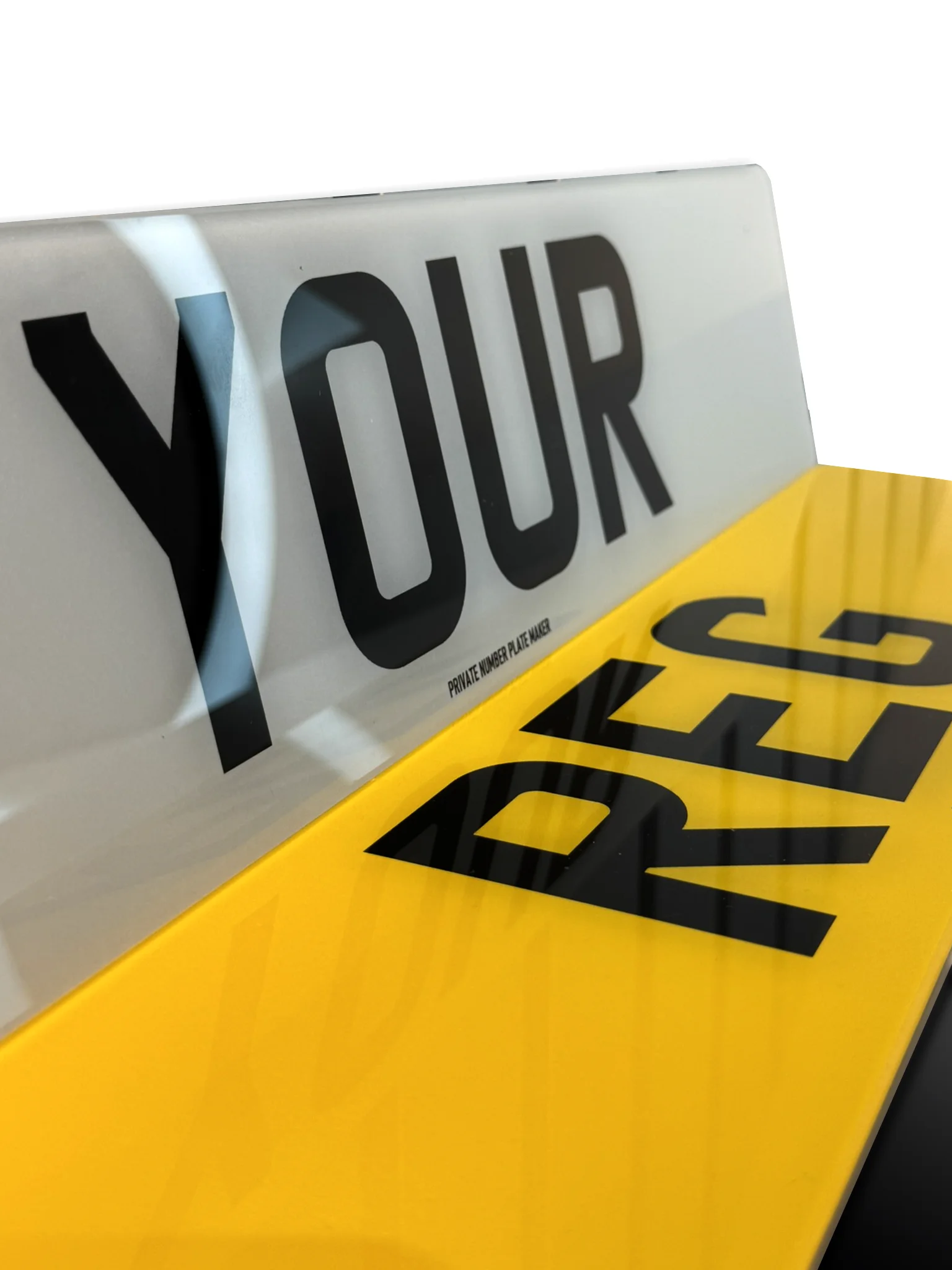
 Printed
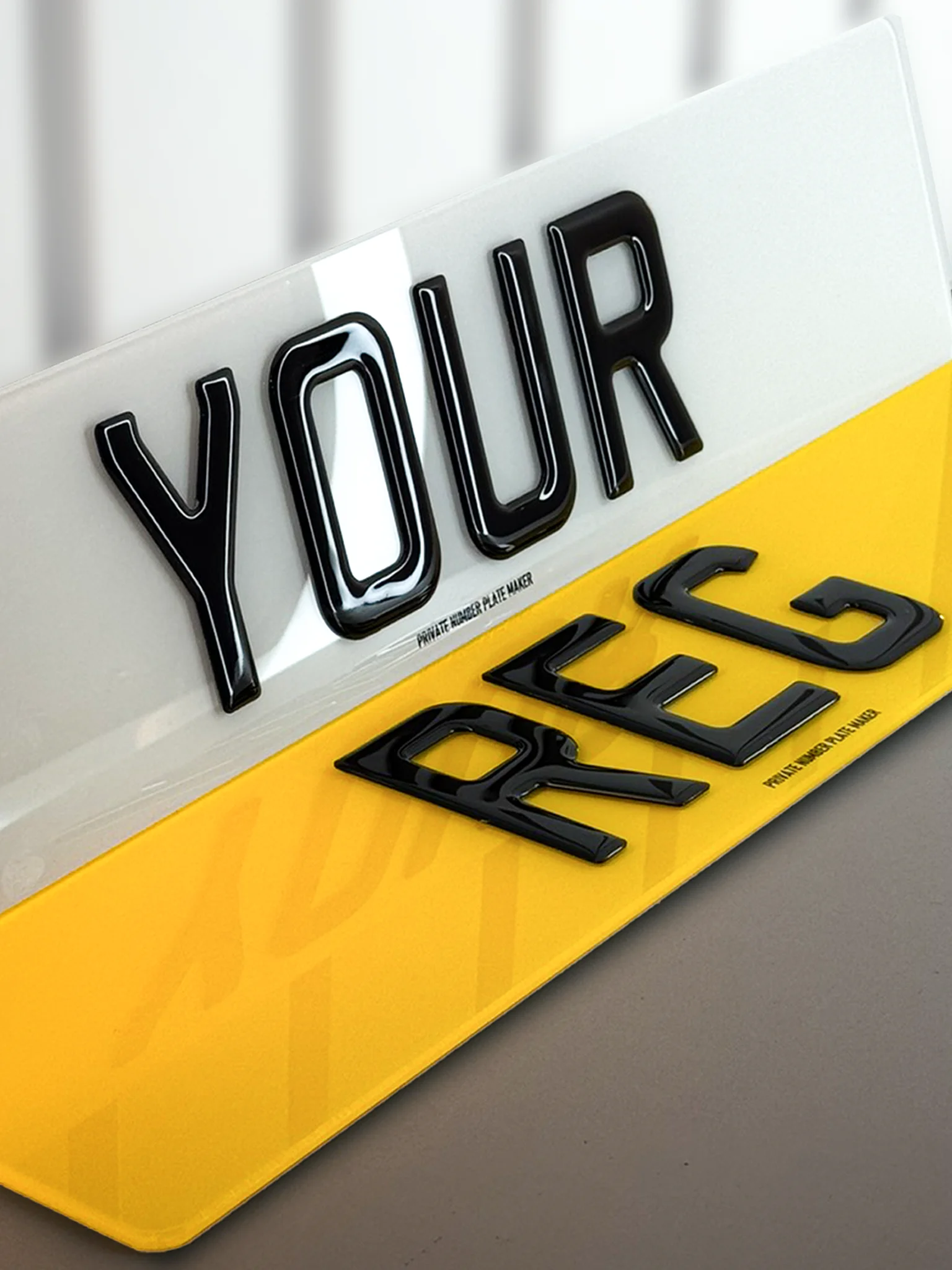 3D Plate
 4D Plate
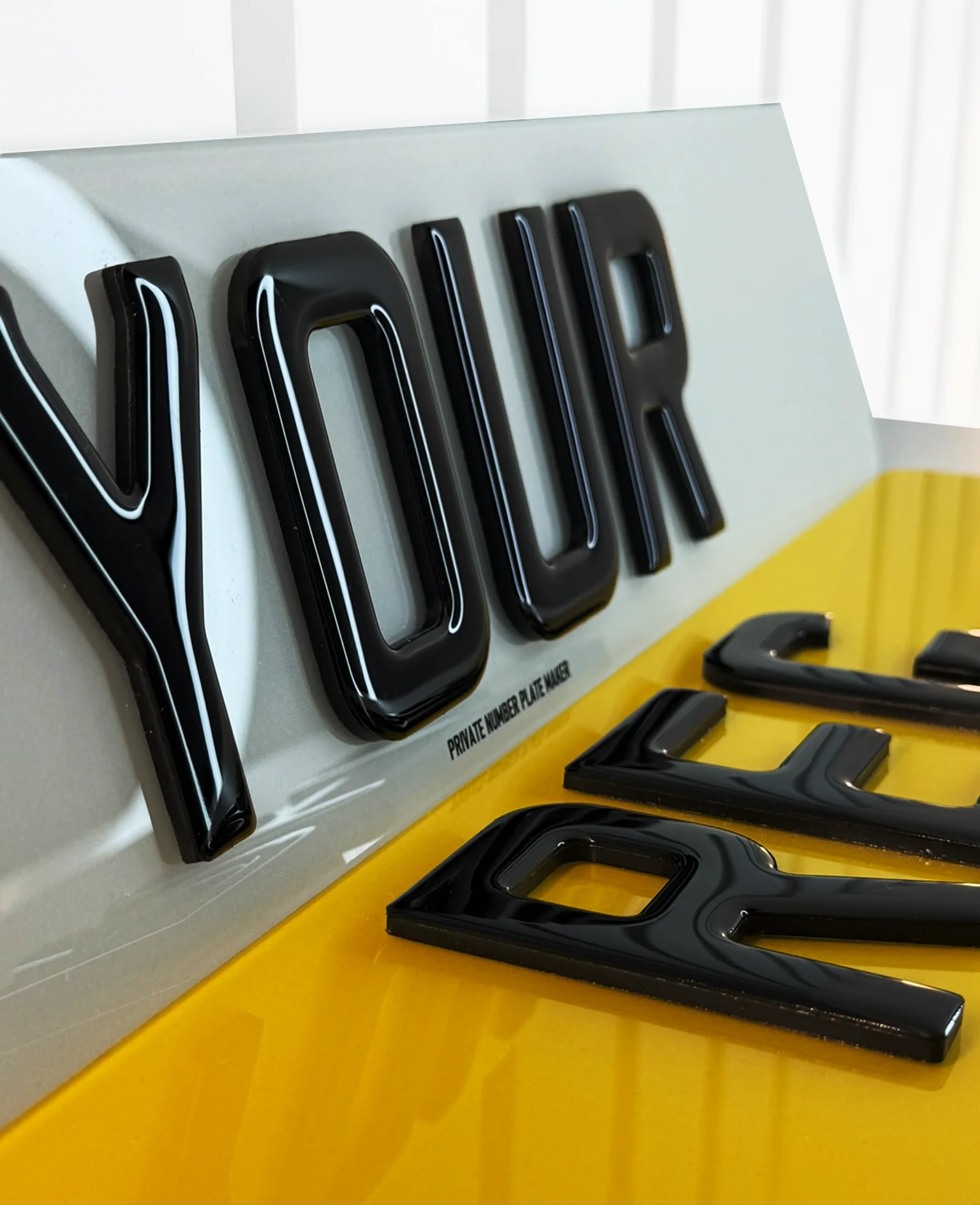 5D Plate
 Ghost
Ghost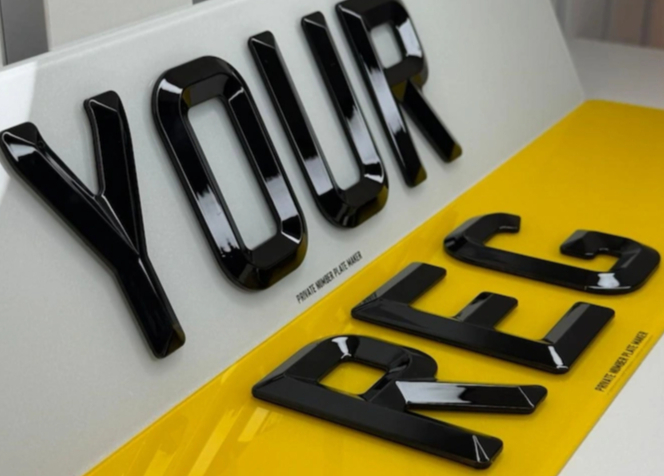 Bevel
BevelCharles Wright Font Guide: Why It's Mandatory for UK Plates

Summary
The Charles Wright font has been mandatory for all UK number plates since 1 September 2001, as specified in the Road Vehicles (Display of Registration Marks) Regulations 2001. This specific typeface was chosen for its optimal readability by both human observers and Automatic Number Plate Recognition (ANPR) cameras used by police and enforcement agencies across the United Kingdom.
The font features precise character dimensions that must be followed exactly: 79mm character height for standard vehicles, 50mm character width (excluding 'I' and '1'), 14mm stroke thickness, and 11mm spacing between characters. Any deviation from these specifications - including stylised, italicised, or two-tone characters - renders a number plate non-compliant and potentially illegal for road use.
What Is the Charles Wright Font?
The Charles Wright font is the only legally permitted typeface for vehicle registration plates in the United Kingdom. Named after its designer, this specific font was developed to meet the technical requirements of vehicle identification and enforcement systems.
Key Characteristics
Visual appearance:
- Clean, sans-serif letterforms
- Consistent stroke width throughout each character
- No decorative elements or flourishes
- Single shade of black for all characters
Technical purpose:
- Optimised for ANPR camera readability
- Designed for consistent recognition across different lighting conditions
- Maintains contrast requirements for NIR (Near Infrared) spectrum
- Prevents character confusion (e.g., 'O' vs '0', 'I' vs '1')
Why This Specific Font?
The Charles Wright font was selected following extensive testing by the DVLA and enforcement agencies. Key reasons include:
ANPR Compatibility
Modern Automatic Number Plate Recognition systems capture approximately 50 million plate reads per day across the UK. The Charles Wright font's consistent character shapes ensure reliable automated reading.
Human Readability
The font remains clearly legible to police officers, MOT testers, and other road users at various distances and angles.
Standardisation
A single mandatory font eliminates confusion and ensures all UK plates follow identical visual standards.
Security
Consistent font requirements make plate cloning and fraudulent alterations more difficult to execute convincingly.
Historical Context: When Did Charles Wright Become Mandatory?
Understanding the history of UK number plate font requirements helps explain why the Charles Wright font remains essential today.
Timeline of UK Number Plate Font Regulations
| Year | Change |
|---|---|
| Pre-1967 | Various fonts permitted, limited standardisation |
| 1967 | First mandatory font specifications introduced |
| 1989 | Updated font requirements with improved reflectivity standards |
| 2001 | Charles Wright font made mandatory (1 September) |
| 2021 | BS AU 145e becomes mandatory (font requirements unchanged) |
The 2001 Regulation Change
On 1 September 2001, the Road Vehicles (Display of Registration Marks) Regulations 2001 came into force. This statutory instrument (SI 2001/561) established the Charles Wright font as the exclusive permitted typeface for all UK number plates.
Why 2001?
The timing coincided with several developments:
- Widespread deployment of ANPR technology by police forces
- Increased need for standardised vehicle identification
- European harmonisation of vehicle registration standards
- Growing concerns about plate cloning and fraud
Plates Fitted Before 2001
Vehicles registered before 1 September 2001 may display plates with older font styles under certain conditions. Vehicles constructed before 1 January 1973 can display traditional black and silver plates. These plates are exempt from reflectivity requirements but must still meet character dimension standards. Any replacement plates for pre-2001 vehicles must use Charles Wright font unless qualifying for historic vehicle exemption.
Legal Framework and Regulations
The Charles Wright font requirement is embedded in UK legislation and enforced through multiple regulatory mechanisms.
Primary Legislation
Road Vehicles (Display of Registration Marks) Regulations 2001
Regulation 14 of this statutory instrument specifies the exact requirements for character display on number plates. Key provisions include:
- Characters must be in the prescribed font (Charles Wright)
- Characters must be solid black (single shade)
- No background patterns permitted
- Specific dimensional requirements must be met
Vehicle Excise and Registration Act 1994
Section 42 provides enforcement powers and penalty provisions for number plate offences. This includes fines for displaying registration marks in an unauthorised manner.
DVLA Requirements
The DVLA specifies that number plates must:
- Use the mandatory Charles Wright font
- Display solid black characters (no two-tone or gradient effects)
- Meet all dimensional specifications
- Be manufactured by DVLA-registered suppliers (RNPS)
British Standard BS AU 145e
While BS AU 145e:2018 governs plate material specifications (reflectivity, impact resistance, weathering, NIR compatibility), it works alongside the font requirements set out in the 2001 Regulations. Both standards must be satisfied for full compliance.
Technical Specifications and Dimensions
The Charles Wright font operates within precise dimensional requirements. Both the font style and character measurements must be correct for compliance.
Character Dimensions (Standard Vehicles)
| Specification | Measurement |
|---|---|
| Character height | 79mm |
| Character width | 50mm (excluding 'I' and '1') |
| Stroke thickness | 14mm |
| Character spacing | 11mm |
| Age identifier gap | 33mm |
| Minimum margins | 11mm |
Motorcycle Plates
Motorcycles have different dimensional requirements:
- Character height: 64mm
- Character width: 44mm
- Stroke thickness: 10mm
- Character spacing: 10mm
Motorcycle Number Plates Guide | 3D Gel Plates Motorcycles Complete Guide
Font Variations That Are NOT Permitted
The following modifications to the Charles Wright font render plates non-compliant:
Prohibited:
- Italicised or slanted characters
- Two-tone or gradient characters
- Decorative flourishes or extensions
- Modified character spacing
- Non-standard stroke thickness
- Reflective or coloured characters
- Shadow effects or 3D illusions that alter character shape
Permitted (when manufactured correctly):
- 3D gel overlay (if character shape remains Charles Wright compliant)
- 4D laser-cut acrylic (if dimensions meet specifications)
- 5D dual-layer construction (if all requirements satisfied)
Why Font Compliance Matters for ANPR
Automatic Number Plate Recognition technology is the primary reason the Charles Wright font remains mandatory. Understanding this connection explains why enforcement is strict.
How ANPR Cameras Read Plates
ANPR systems use the following process:
- Camera captures image in visible and Near Infrared spectrum
- Software identifies plate location and character boundaries
- Optical Character Recognition (OCR) converts image to text
- Database cross-reference for enforcement actions
Charles Wright Font and ANPR Accuracy
The Charles Wright font optimises each stage of this process:
- Character Recognition: Consistent character shapes reduce OCR errors. The font minimises confusion between similar characters (e.g., '8' vs 'B', '0' vs 'O')
- NIR Contrast: Solid black Charles Wright characters maintain required contrast levels in the Near Infrared spectrum, which ANPR cameras use for capture
- Lighting Conditions: The font performs reliably across different lighting scenarios - daylight, darkness, rain, and varying angles
- Speed Tolerance: ANPR systems can accurately read Charles Wright font plates on vehicles travelling at motorway speeds
Non-Compliant Fonts and ANPR Failure
Plates with non-standard fonts cause problems: increased OCR error rates, failed enforcement captures, potential misidentification of vehicles, and wasted police and enforcement resources. This is why police and Trading Standards actively target non-compliant plates.
Do 3D Plates Work with ANPR Cameras Guide | 4D Plates ANPR Definitive Guide
Compliance and Enforcement
Understanding how Charles Wright font compliance is enforced helps vehicle owners make informed decisions.
Who Enforces Font Requirements?
- Police Forces: Use ANPR cameras and visual inspections during traffic stops
- DVLA: Conducts compliance checks and can issue fines for non-compliant plates
- Trading Standards: Investigates suppliers selling non-compliant plates and can prosecute businesses
- MOT Testers: Must check number plate condition and legibility during annual tests
Penalties for Non-Compliant Fonts
For Vehicle Owners:
- Fine up to £1,000 per offence (Section 42, Vehicle Excise and Registration Act 1994)
- MOT failure if plates are illegible or non-compliant
- Potential vehicle seizure in serious cases
For Suppliers:
- Unlimited fines for businesses selling non-compliant plates
- Removal from the DVLA Registered Number Plate Supplier (RNPS) register
- Criminal prosecution for repeated offences
Recent Enforcement Activity
In 2026, enforcement focus has increased on plates with stylised or modified fonts, suppliers operating without RNPS registration, online sellers providing non-compliant plates, and ghost plates with font alterations.
Number Plate Fines UK Guide | Government Crackdown Ghost Plates 2026 Guide
How to Check If Your Plate Uses Charles Wright Font
Vehicle owners can perform several checks to verify their number plates use the correct font.
Visual Inspection Checklist
Check character appearance:
Characters should match standard Charles Wright proportions. No italic slant or decorative elements. Single shade of black throughout. Consistent stroke thickness.
Check character dimensions:
Use a ruler to verify 79mm character height (standard vehicles). Verify 11mm spacing between characters. Check 14mm stroke thickness.
Compare with reference:
DVLA provides font reference images on gov.uk. Compare your plate characters with official examples. Look for any deviations in character shape.
Check plate markings:
BS AU 145e marking should be present (for plates after 1 September 2021). Supplier details should appear at centre-bottom.
Common Font Violations to Watch For
Frequently seen non-compliant features:
- "Carbon fibre" pattern within characters
- Gradient or fade effects on characters
- Extended or stretched characters
- Custom "racing" or "sport" fonts
- Characters with outlines or shadows
Charles Wright Font and Different Plate Types
The Charles Wright font requirement applies to all plate types, but certain styles require additional consideration.
3D Gel Plates
3D gel plates can comply with Charles Wright requirements if the gel overlay does not alter the underlying character shape, characters remain solid black (no two-tone gel effects), and all dimensional specifications are met.
3D Gel Number Plates Explained Guide | 3D Gel Plates FAQ Guide | Are 3D Gel Plates Legal Guide | UV Curing Process 3D Gel Plates Guide
4D Laser-Cut Plates
4D plates use laser-cut acrylic characters and must comply when acrylic characters follow Charles Wright proportions, no gradient or coloured acrylic that alters character appearance, and supplier maintains proper documentation.
4D Number Plates Explained Guide | 4D Number Plate FAQ Guide | Are 4D Plates Legal 2026 Guide | 4D Plate Thickness Guide
5D Plates
5D plates combine 3D gel and 4D acrylic characteristics. Compliance requires both layers maintain Charles Wright character shape, all dimensional specifications are satisfied, and NIR contrast is maintained through both materials.
5D Number Plates Explained Guide | Are 5D Number Plates Legal Guide | 5D vs 4D vs 3D Number Plates Comparison Guide | Premium Number Plates 5D Worth Investment Guide
Ghost Plates
Ghost plates present particular compliance challenges. Legal ghost plates must maintain Charles Wright font underneath any gradient effect, have no reflective coating that interferes with ANPR, and be manufactured by RNPS-registered suppliers. Illegal ghost plates often modify fonts to reduce ANPR readability - these carry significant penalties.
Legal Ghost Plates UK Guide | Are Ghost Plates Legal 2026 Guide | How to Identify Legal Ghost Plates Guide | Illegal Ghost Plates Penalties Guide | Tinted Number Plates vs Ghost Plates Legal Guide
Green Flash Plates (EV)
Electric vehicle plates with the green flash must still use Charles Wright font for all registration characters. The green flash is an additional element that does not affect font requirements.
Green Number Plates UK Guide | Are Green Number Plates Legal Guide | Who Can Get Green Number Plates Guide | Green Number Plates Benefits Guide | 5D Plates Electric Vehicles Guide
Our Manufacturing Process at Private Number Plate Maker Ltd
As a DVLA-registered number plate manufacturer (RNPS ID: 75449), we manufacture every plate on-site at our Ilford workshop in Ilford, East London. Unlike resellers or drop-shippers, we maintain full control over our manufacturing process to ensure Charles Wright font compliance.
Document Verification
Before manufacturing any plate, we verify customer documentation according to Schedule 2 of the Road Vehicles Regulations 2001 and current DVLA guidance. Accepted documents include:
- Driving licence
- Passport
- V5C registration certificate
- V750 certificate of entitlement
- V778 retention document
- V948 authorisation letter
Bank statements and screenshots are not accepted as proof of identity or entitlement.
V5C vs V750 vs V778 Guide | How to Photograph Documents for Verification Guide
Font Compliance Assurance
We use certified manufacturing equipment that produces Charles Wright font characters to exact specifications:
- Digital templates match DVLA requirements precisely
- Quality control checks verify character dimensions
- Each plate undergoes visual inspection before dispatch
Material Sourcing
We source all reflective materials, acrylic, and gel components from certified manufacturers who provide BS AU 145e compliance documentation for each batch. This ensures every plate we produce meets both font and material standards.
Collection and Delivery
We offer same-day collection from our Ilford workshop and next-day UK delivery for all compliant plates. Our local service covers East London including Barking, Romford, and Dagenham.
Same Day Number Plates Ilford Guide | Number Plate Delivery Times Guide
Common Misconceptions About Charles Wright Font
Several myths circulate about font requirements. Here are the facts:
Myth: "Any Readable Font Is Acceptable"
Fact: Only the Charles Wright font is legally permitted for UK number plates. Other fonts, even if readable, render plates non-compliant.
Myth: "3D and 4D Plates Don't Need Charles Wright Font"
Fact: 3D and 4D plates must still use Charles Wright font as the base character shape. The 3D or 4D effect is an overlay, not a font replacement.
Myth: "Old Vehicles Can Use Any Font"
Fact: Only vehicles registered before 1 January 1973 displaying black and silver plates have font exemptions. All other vehicles must use Charles Wright font regardless of age.
Myth: "Online Sellers Can Provide Custom Fonts"
Fact: No supplier, online or physical, can legally provide plates with non-Charles Wright fonts. RNPS-registered suppliers must follow the same regulations.
Myth: "Font Violations Won't Be Enforced"
Fact: Police ANPR systems and MOT testers actively check font compliance. Non-compliant plates can result in fines and MOT failure.
3D vs 4D vs Standard Number Plates Comparison Guide | 4D vs 3D Plates Guide
Future Changes and Regulatory Updates
Number plate regulations continue to evolve. Here's what vehicle owners should monitor:
2026 Enforcement Focus
The DVLA and police forces have announced increased enforcement of number plate regulations in 2026, particularly targeting plates with modified or stylised fonts, unregistered suppliers selling non-compliant plates, and online marketplaces offering illegal plates.
Potential Standard Updates
While no font changes have been announced, vehicle owners should monitor DVLA announcements for regulatory changes, government consultations on number plate legislation, and BSI publications for standard revisions.
Technology Developments
ANPR technology continues advancing, which may influence future plate requirements. Potential areas include enhanced character recognition systems, additional security features to prevent cloning, and digital verification systems.
Are Bevel Plates Legal 2026 UK Regulations Guide | ANPR Proof Plates Illegal Guide
Frequently Asked Questions
The Charles Wright font is the only legally permitted typeface for UK number plates, mandatory since 1 September 2001 under the Road Vehicles (Display of Registration Marks) Regulations 2001. It was selected for its optimal readability by both humans and ANPR cameras, with consistent character shapes that minimise recognition errors.
For standard vehicles: 79mm height, 50mm width (excluding 'I' and '1'), 14mm stroke thickness, and 11mm spacing between characters. Motorcycles: 64mm height, 44mm width, 10mm stroke. These dimensions are fixed under Regulation 14 of the 2001 Regulations.
Yes, provided the underlying character shape remains true to Charles Wright specifications. The gel or acrylic overlay must not alter character proportions, spacing, or stroke thickness, and characters must stay solid black with no gradient effects.
Perform a visual inspection: check for clean sans-serif letterforms with consistent 14mm stroke thickness, verify 79mm character height and 11mm spacing using a ruler, ensure single-shade black characters with no italics or decorative elements, and compare against DVLA reference images on gov.uk.
Vehicle owners face fines up to £1,000 per offence, MOT failure if plates are illegible, and potential vehicle seizure. Suppliers risk unlimited fines, removal from the DVLA RNPS register, and criminal prosecution.
This guide references the following official and verified sources:
Road Vehicles (Display of Registration Marks) Regulations 2001 (SI 2001/561)
www.legislation.gov.ukVehicle Excise and Registration Act 1994 - Section 42
Enforcement powers and penalty provisions
British Standards Institution - BS AU 145e:2018 Specification
Specification for Retroreflecting Number Plates
knowledge.bsigroup.comBritish Number Plate Manufacturers Association (BNMA) - Font Guidance
Industry guidance and best practices
www.bnma.orgGovernment announcements via gov.uk news section
www.gov.ukTrading Standards and police enforcement reports
www.bnma.orgRelated Number Plate Guides
Explore our comprehensive guides on UK number plate regulations, styles, and compliance:
Bevel Number Plates Explained Guide | Bevel Plates Vehicle Type Style Guide
Bevel vs 4D vs 5D vs 3D Comparison Guide | Layered Number Plates Dual Layer Construction Guide
Number Plate Fitting Guide | Number Plate Maintenance Guide
Number Plates for Fleets Guide | Emergency Replacement Plates Guide
Cheap Number Plates Online Guide | Real 4D Number Plate Reviews UK Drivers Say Guide
3D Gel Plate Reviews Guide | 3D Plates Popular UK Cars Gallery Guide
5D Gel vs Standard 4D Number Plates Guide | 5mm 4D vs 5D Plates Guide