
 Printed
 3D Plate
 4D Plate
 5D Plate
 Ghost
Ghost Bevel
BevelNumber Plate Fines UK: What You Need to Know
Summary
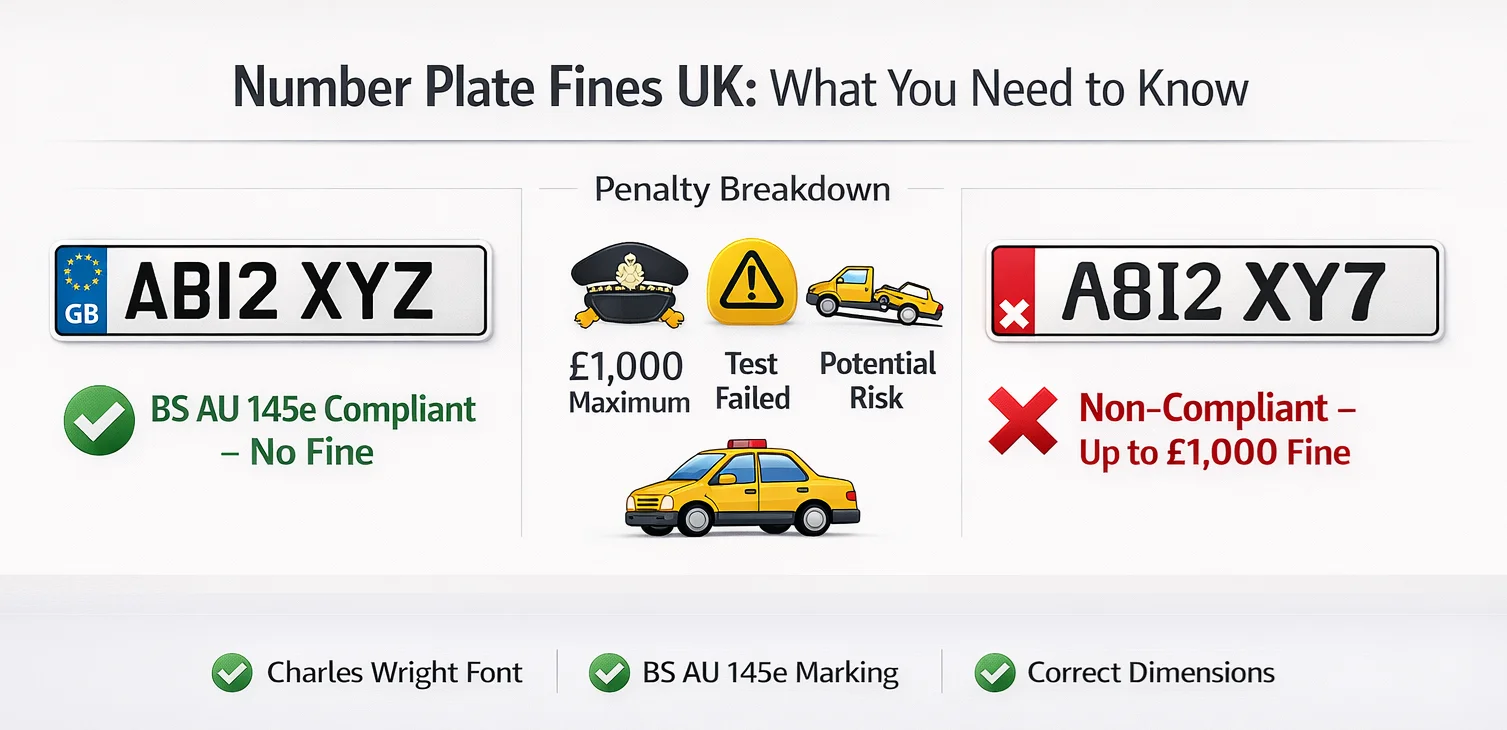
Number plate fines in the UK can reach up to £1,000 per offence under Section 42 of the Vehicle Excise and Registration Act 1994, with non-compliant plates also resulting in automatic MOT failure. The most common violations include incorrect font usage, missing BS AU 145e marking, improper character spacing, and plates that interfere with ANPR camera readability.
Since 1 September 2021, all replacement number plates Guide must meet BS AU 145e:2018 standards, and enforcement has increased significantly in 2026 with police and DVLA targeting illegal plate suppliers and vehicle owners. Non-compliant plates can also lead to vehicle seizure in serious cases, particularly when plates are deliberately modified to evade ANPR systems.
Related guide: DVLA document requirements Guide | BS AU 145e explained Guide
Legal Framework: Why Number Plate Fines Exist
Number plate regulations are not arbitrary rules - they serve critical public safety and enforcement purposes backed by UK legislation.
Primary Legislation
Vehicle Excise and Registration Act 1994
Section 42 of this Act provides the enforcement basis for number plate offences. The legislation specifies:
- Maximum fines up to level 3 on the standard scale (currently £1,000)
- Powers for vehicle seizure in serious cases
- Criminal liability for both suppliers and vehicle owners
Road Vehicles (Display of Registration Marks) Regulations 2001
This statutory instrument (SI 2001/561) sets out detailed requirements for number plate display. Regulation 14 covers character dimensions, while Regulation 16 addresses construction and marking requirements.
Road Traffic Act 1988
Section 47 makes it an offence to use a vehicle with registration marks that do not comply with regulations. This applies to every journey on public roads.
Why These Laws Exist
The legislation serves several public interest purposes:
ANPR System Reliability
Police and enforcement agencies rely on Automatic Number Plate Recognition cameras for vehicle tracking. Non-compliant plates compromise this system.
Vehicle Crime Prevention
Proper plate requirements make vehicle cloning and theft more difficult.
Road Safety
Legible plates help identify vehicles involved in accidents, hit-and-runs, and traffic violations.
Revenue Protection
Correct plates ensure proper vehicle tax and insurance enforcement.
Related guide: How ANPR cameras work Guide | Illegal ghost plates penalties Guide
Maximum Number Plate Fines and Penalties
Understanding the potential financial consequences helps vehicle owners make informed decisions about plate compliance.
Fine Structure
| Offence Type | Maximum Fine | Notes |
|---|---|---|
| Non-compliant number plates | £1,000 | Per offence under Vehicle Excise and Registration Act 1994 |
| MOT failure (plate related) | N/A | Test failed until plates corrected |
| ANPR interference (deliberate) | £1,000+ | May face additional charges |
| Supplier violations | Unlimited | Businesses face higher penalties |
How Fines Are Applied
Per Offence Basis
Each non-compliant plate can be treated as a separate offence. This means:
- Front plate violation = one offence
- Rear plate violation = separate offence
- Potential £2,000 total for both plates
Fixed Penalty Notices
Police may issue fixed penalty notices for minor violations:
- Typically £50-£100 for straightforward cases
- Can be contested in court
- Still requires plate correction
Court Prosecution
Serious or repeated offences may face court prosecution:
- Higher fines possible
- Legal costs added
- Criminal record in some cases
Additional Consequences Beyond Fines
MOT Failure
Non-compliant plates result in automatic MOT failure. Vehicle cannot be taxed without valid MOT. Re-test fees apply. Driving without MOT carries separate penalties.
Vehicle Seizure
In serious cases, police can seize vehicles for deliberate ANPR interference, multiple violations, or suspected criminal activity.
Insurance Complications
Non-compliant plates may affect insurance claims. Insurers may question vehicle legality and claims could be disputed.
Common Number Plate Violations That Trigger Fines
Most number plate fines result from specific, identifiable violations. Understanding these helps you check your own plates.
Font Violations
Charles Wright Font Requirement
The Charles Wright font has been mandatory since 1 September 2001.
Common violations:
- Stylised or custom fonts
- Italicised characters
- Two-tone or gradient characters
- Decorative flourishes
BS AU 145e Marking Violations
Mandatory Since 1 September 2021
All replacement plates must display BS AU 145e marking.
Common violations:
- Missing BS AU 145e marking entirely
- Old BS AU 145d marking on new plates
- Illegible or obscured marking
Exception: Plates fitted before 1 September 2021 with BS AU 145d remain legal.
Character Dimension Violations
| Specification | Required | Common Violation |
|---|---|---|
| Character height | 79mm | Smaller characters |
| Character width | 50mm | Narrow or wide characters |
| Stroke thickness | 14mm | Thin or thick strokes |
| Character spacing | 11mm | Incorrect gaps |
| Age identifier gap | 33mm | Missing or wrong gap |
| Margins | 11mm minimum | Insufficient margins |
Supplier Detail Violations
Required Markings
Every plate must display supplier business name and supplier postcode at centre-bottom location.
Common violations:
- Missing supplier details entirely
- Illegible supplier information
- Incorrect or fake supplier details
ANPR Interference Violations
Most Serious Category
Deliberate ANPR interference carries highest penalties.
Common violations:
- Reflective sprays or coatings
- Tinted covers or frames
- Ghost plates with reflective elements
- Deliberately obscured characters
Related guide: Charles Wright font Guide | BS AU 145e explained Guide | Ghost plates penalties Guide
MOT Failure: Number Plate Compliance Requirements
MOT testers must check number plates as part of every vehicle test. Failure results in test failure until corrected.
MOT Inspection Criteria
Visible from Driver's Seat
Plates must be clearly visible without the driver leaving the vehicle.
Legibility Requirements
- Characters must be clear and readable
- No significant fading or damage
- No obstructions (frames, covers, dirt)
Condition Check
- No cracks affecting readability
- No delamination of characters
- Secure attachment to vehicle
Common MOT Number Plate Failures
| Issue | Result | Fix Required |
|---|---|---|
| Cracked plate | FAIL | Replace plate |
| Faded characters | FAIL | Replace plate |
| Missing BS AU 145e (post-2021) | FAIL | Replace plate |
| Incorrect font | FAIL | Replace plate |
| Obscured characters | FAIL | Remove obstruction |
| Loose attachment | FAIL | Re-secure or replace |
How to Check If Your Number Plates Are Compliant
Vehicle owners can perform several checks to verify their plates meet legal requirements before enforcement action occurs.
Visual Inspection Checklist
Font Check
Characters match Charles Wright font style. No stylised or decorative elements. Single shade of black throughout.
Marking Check
BS AU 145e visible (for plates after 1 September 2021). Supplier name and postcode present. Markings legible and not obscured.
Condition Check
No cracks or damage. Characters securely attached. No significant fading.
Dimension Check
Use ruler to verify character height (79mm). Check character spacing appears consistent. Verify margins are adequate.
Common Misconceptions About Number Plate Fines
Several myths circulate about number plate enforcement. Here are the facts:
Myth: "Fines Are Rarely Enforced"
Fact: Enforcement has increased significantly in 2026. ANPR cameras automatically flag violations, police conduct targeted operations, and fines are regularly issued and collected.
Myth: "Only Suppliers Get Fined"
Fact: Vehicle owners face equal liability. Section 42 applies to vehicle users. Owners are responsible for plate compliance. Supplier fines do not exempt owners.
Myth: "Old Plates Are Grandfathered"
Fact: Only pre-September 2021 BS AU 145d plates remain legal. All other requirements still apply. Font requirements unchanged since 2001. Damage or fading requires replacement.
Myth: "Custom Plates Have Different Rules"
Fact: All plates must meet same requirements. Private registrations follow same rules. No exemptions for custom styles. RNPS verification still required.
Myth: "Online Sellers Can Provide Legal Custom Fonts"
Fact: No legal custom fonts exist for UK plates. Charles Wright font mandatory for all. Online sellers cannot override legislation. RNPS suppliers must follow same rules.
Frequently Asked Questions
Under Section 42 of the Vehicle Excise and Registration Act 1994, the maximum fine for non-compliant number plates is £1,000 per offence. Since front and rear plates can be treated as separate offences, potential fines could reach £2,000. Police may issue fixed penalty notices (£50-£100) for minor violations, while serious cases involving deliberate ANPR interference may face court prosecution with higher penalties.
Yes, non-compliant number plates result in automatic MOT failure under DVSA inspection criteria. Testers check for legibility, correct Charles Wright font, BS AU 145e marking (for plates supplied after 1 September 2021), and absence of damage or obstructions. Common failures include cracked plates, faded characters, incorrect fonts, or missing supplier details.
The most frequent violations include: incorrect font (non-Charles Wright), missing BS AU 145e marking on post-2021 plates, improper character dimensions (79mm height, 14mm stroke), missing supplier details, and ANPR-interfering modifications like reflective coatings or ghost plates. Deliberate ANPR interference carries the highest penalties.
Perform a visual inspection: 1) Verify Charles Wright font with no stylised elements; 2) Check for BS AU 145e marking (post-Sept 2021 plates) and supplier name/postcode at centre-bottom; 3) Use a ruler to confirm 79mm character height and 11mm spacing; 4) Ensure no cracks, fading, or obstructions.
Ghost plates that use reflective coatings, sprays, or gradient effects to interfere with ANPR camera readability are illegal. Penalties include fines up to £1,000, MOT failure, and potential vehicle seizure. In 2026, enforcement has intensified against ghost plates with ANPR-interfering elements.
This guide references the following official and verified sources:
Vehicle Excise and Registration Act 1994 - Section 42
www.legislation.gov.ukRoad Vehicles (Display of Registration Marks) Regulations 2001 (SI 2001/561)
www.legislation.gov.ukBritish Standards Institution - BS AU 145e:2018 Specification
knowledge.bsigroup.comMOT Inspection Manual - DVSA
www.gov.uk