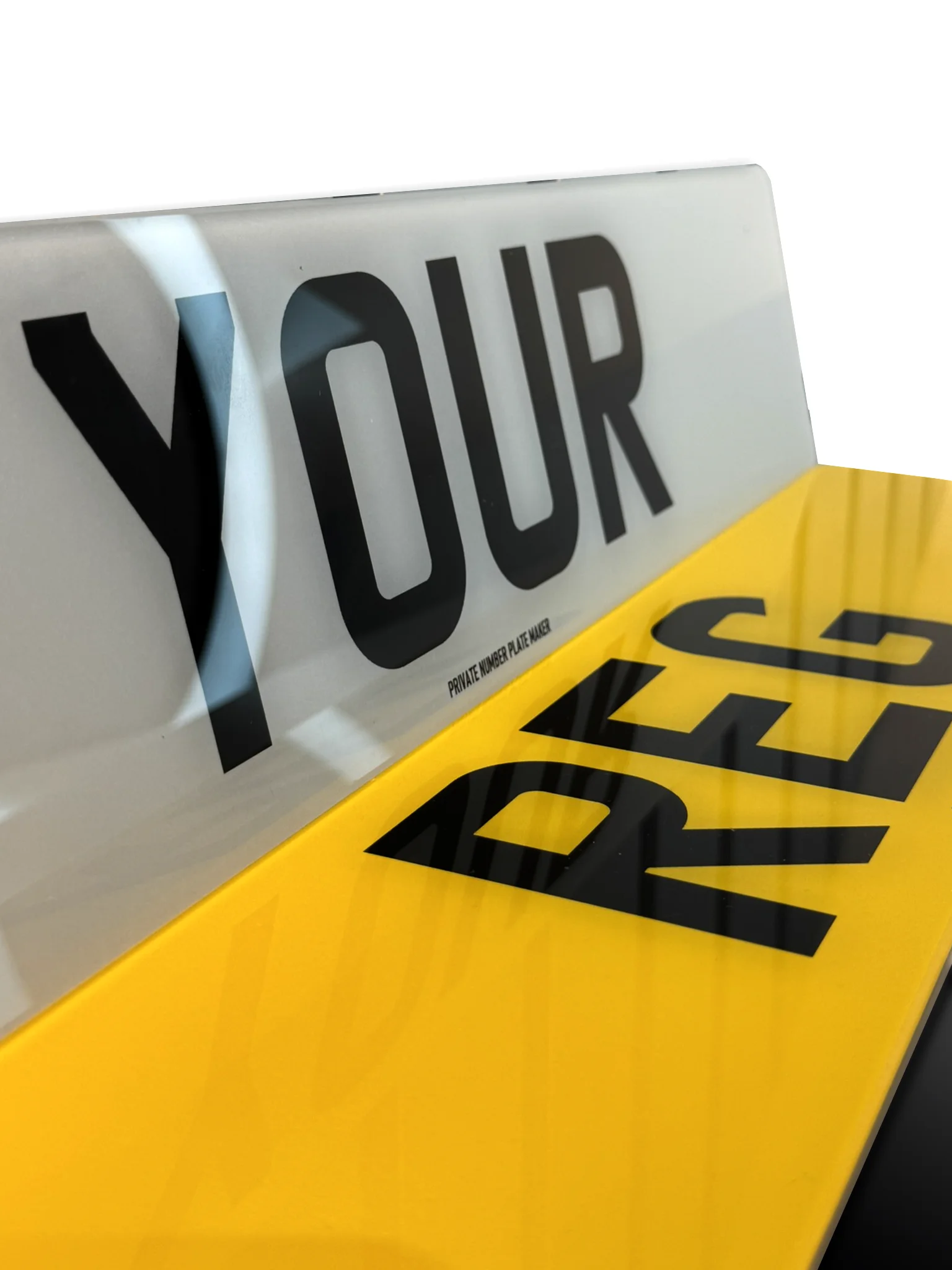
 Printed
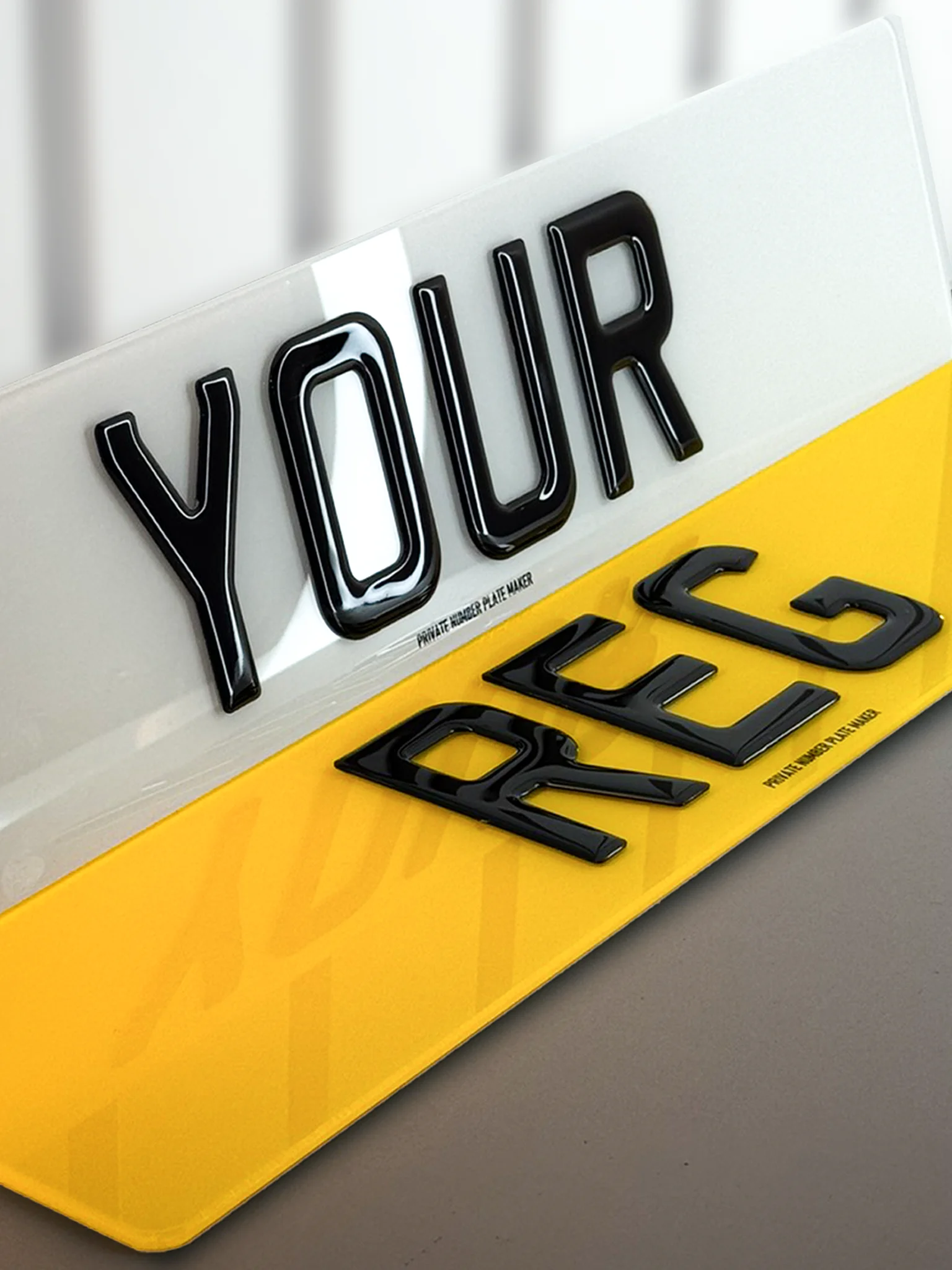 3D Plate
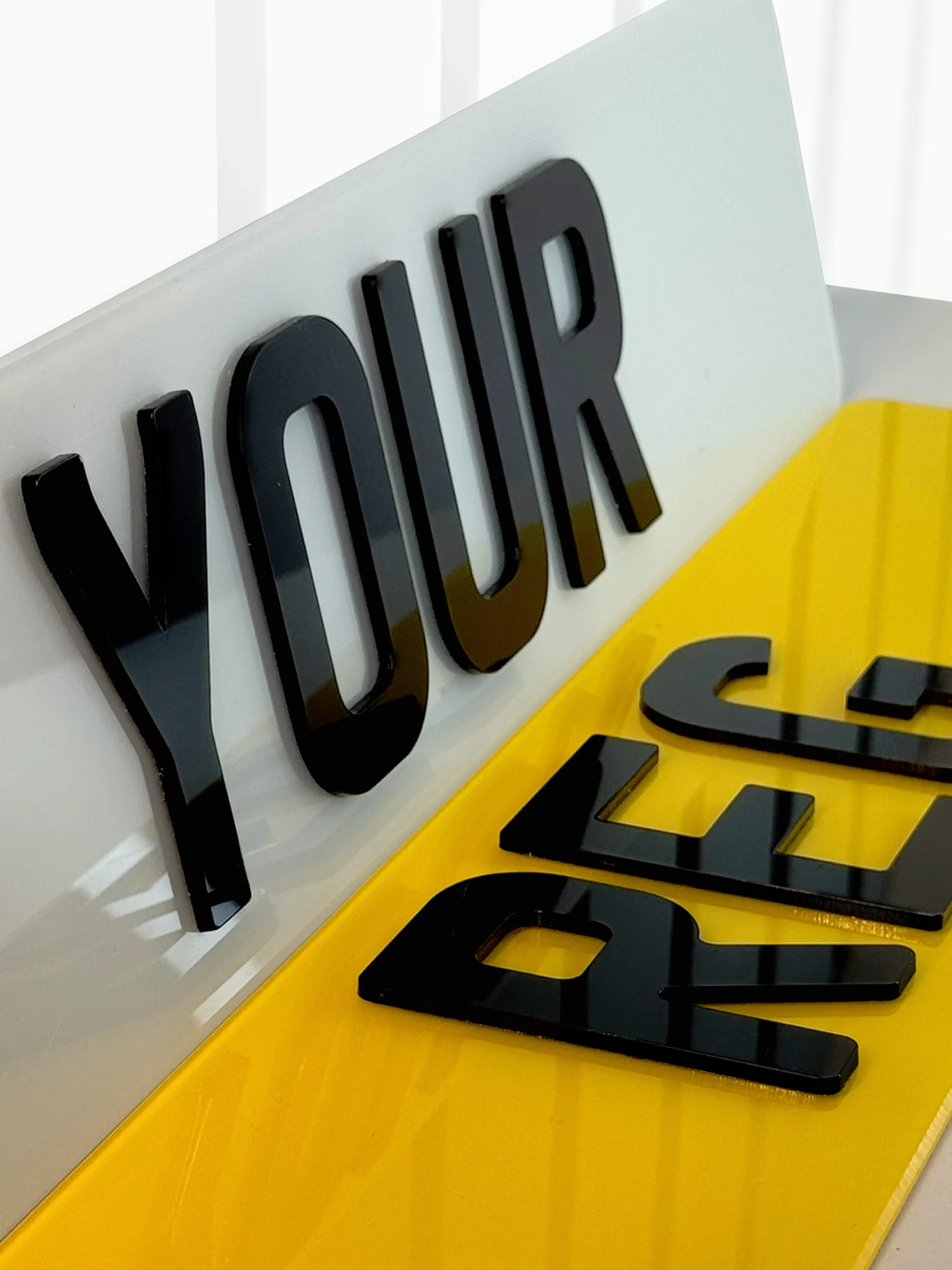 4D Plate
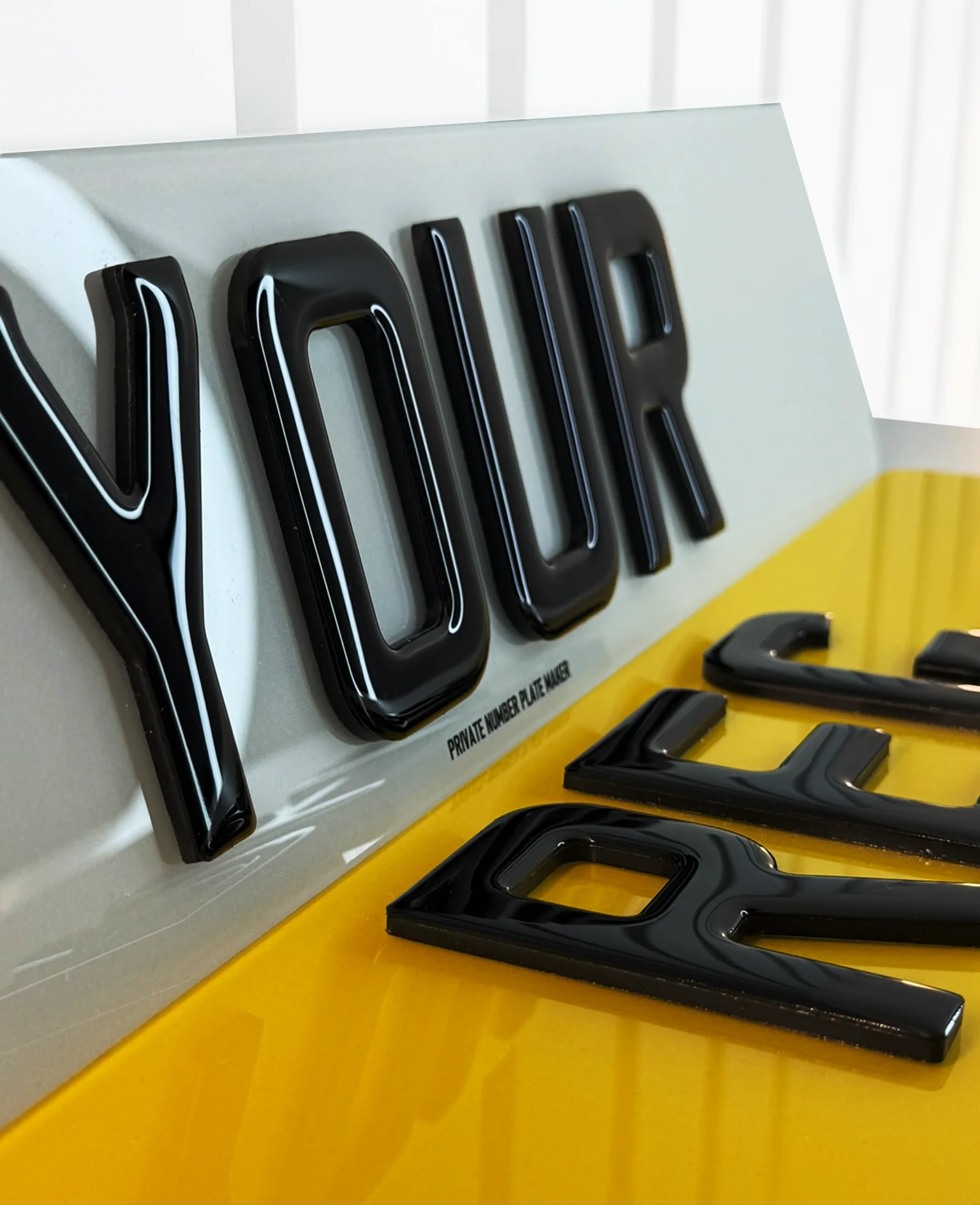 5D Plate
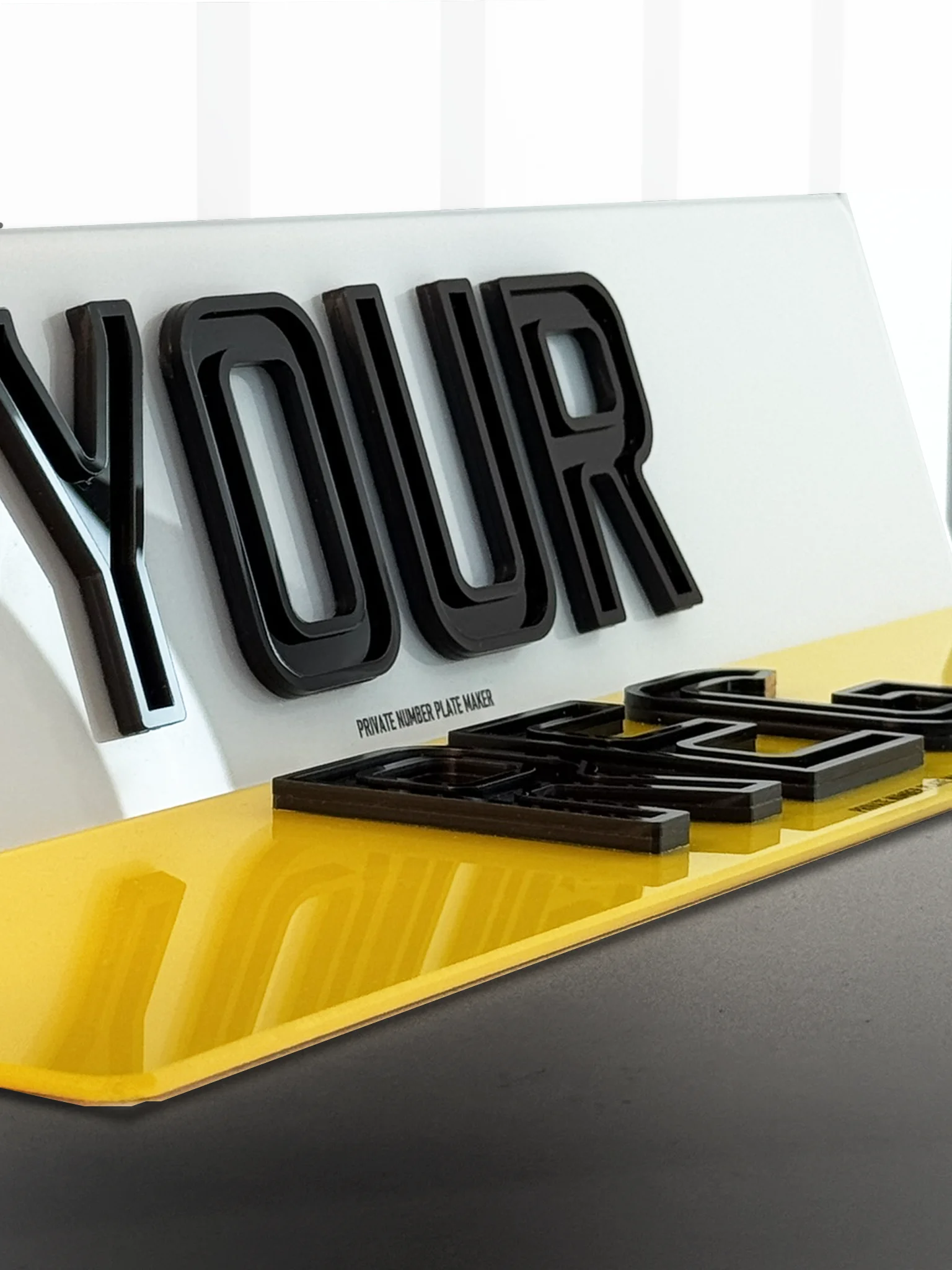 Ghost
Ghost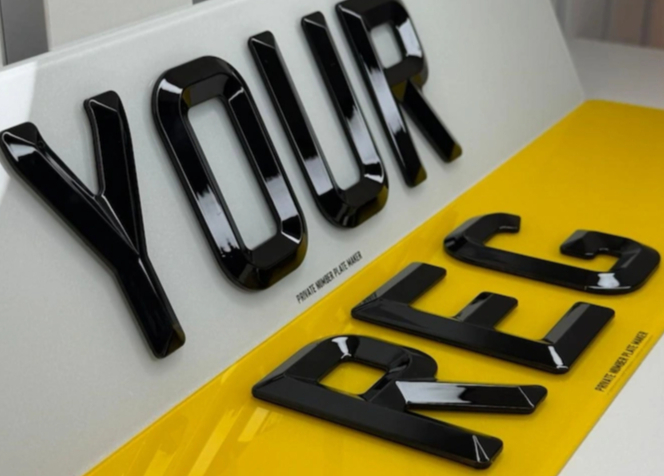 Bevel
Bevel3D Gel Number Plates Explained: The Complete Guide

Summary
3D gel number plates feature raised characters created by applying UV-cured polyurethane resin over printed characters on a reflective substrate, producing a domed glossy finish approximately 2mm in height. The manufacturing process involves precision template creation, resin application through casting or screen printing, and 8-minute UV curing cycles that harden the gel while maintaining optical clarity and durability.
All 3D gel plates must meet BS AU 145e:2018 standards including Charles Wright font, correct character dimensions (79mm height, 50mm width, 14mm stroke), visible supplier details, and BS AU 145e marking for plates supplied after 1 September 2021. When manufactured correctly, 3D gel plates are fully legal for UK road use and provide enhanced aesthetic appeal over standard 2D plates while maintaining full compliance. At Private Number Plate Maker Ltd (RNPS ID: 75449), we manufacture 3D gel plates on-site at our Ilford workshop using BS AU 145e-certified materials with full document verification and same-day collection available.
What Are 3D Gel Number Plates?
3D gel number plates represent a premium plate style that uses raised gel resin characters to create visual depth and enhanced appearance compared to standard flat plates.
Core Technology Explained
Construction Layers:
| Layer | Material | Purpose |
|---|---|---|
| Base Substrate | BS AU 145e reflective material | Legal compliance, retroreflection |
| Printed Characters | Black ink on substrate | Character definition |
| Gel Resin | UV-cured polyurethane | Raised 3D effect, glossy finish |
| Protective Coating | UV-resistant top layer | Durability, fade resistance |
Key Characteristics:
- Raised characters approximately 2mm in height
- Domed/glossy gel finish
- UV-cured for durability
- Available in black (standard) and coloured variants
How 3D Gel Differs from Other Plate Types
| Plate Type | Character Construction | Edge Profile | Height |
|---|---|---|---|
| Standard 2D | Printed flat on substrate | Flat (no depth) | 0mm (flush) |
| 3D Gel | UV-cured resin over print | Domed/rounded | 2mm raised |
| 4D Acrylic | Laser-cut acrylic bonded | Flat 90-degree edge | 3-5mm |
| 5D | Acrylic base + gel overlay | Flat + domed combination | 5mm total |
Related guide: Compare all plate types side-by-side in our full comparison guide
Why Choose 3D Gel Plates
Advantages:
- Enhanced visual appearance over standard plates
- Durable gel coating resists fading
- Smooth domed surface easy to clean
- Cost-effective premium option
- Fully compliant when manufactured correctly
Considerations:
- Gel can yellow over extended UV exposure
- Less depth than 4D acrylic options
- Gel may chip on impact
- Premium cost over standard 2D
The 3D Gel Manufacturing Process: Step by Step
Understanding how 3D gel plates are manufactured helps you identify quality versus inferior products.
Step 1: Template Creation and Substrate Preparation
Process Details:
Digital Template Setup
- Charles Wright font loaded to specification
- Character dimensions verified (79mm height, 50mm width, 14mm stroke)
- Spacing confirmed (11mm between characters, 33mm age identifier gap)
- Registration number input and verified
Substrate Selection
- BS AU 145e:2018 certified reflective material
- White substrate for front plates
- Yellow substrate for rear plates
- Batch documentation verified
Character Printing
- Black characters printed onto substrate
- High-resolution printing for sharp edges
- Ink must be UV-resistant
- Quality check before gel application
Quality Checkpoints:
- Font accuracy verified
- Dimensions measured
- Print quality inspected
- Substrate certification confirmed
Step 2: Gel Resin Application
Application Methods:
| Method | Description | Advantages |
|---|---|---|
| Screen Printing | Resin pushed through mesh template | Consistent thickness |
| Resin Casting | Liquid resin poured into character moulds | Precise character definition |
| Automated Dispensing | CNC-controlled resin application | High precision, repeatable |
Resin Specifications:
- Polyurethane-based gel resin
- Optical clarity for character visibility
- UV-resistant formulation
- Viscosity controlled for consistent application
Application Process:
- Template aligned over printed characters
- Resin applied to character areas only
- Surface tension creates natural dome effect
- Excess resin removed
- Air bubbles eliminated before curing
Step 3: UV Curing Process
Curing Specifications:
| Parameter | Specification | Purpose |
|---|---|---|
| UV Wavelength | 365-405nm | Optimal resin polymerisation |
| Curing Time | 8 minutes typical | Complete hardening |
| UV Intensity | Controlled mW/cm2 | Consistent cure depth |
| Temperature | Ambient to 40?C | Prevents substrate damage |
Curing Process:
- Plates loaded into UV curing chamber
- UV lamps activated at specified intensity
- 8-minute curing cycle completes polymerisation
- Gel hardens from liquid to solid state
- Plates cooled before handling
Quality Indicators:
- Gel fully hardened (no tackiness)
- Optical clarity maintained
- No yellowing from over-curing
- Adhesion to substrate confirmed
Related guide: Learn more about our UV curing process for 3D gel plates
Step 4: Quality Control and Compliance Verification
Final Inspection Checklist:
| Check | Requirement | Standard |
|---|---|---|
| Character Height | 79mm (cars) | Regulation 14 |
| Character Width | 50mm (excluding 'I' and '1') | Regulation 14 |
| Stroke Thickness | 14mm | Regulation 14 |
| Character Spacing | 11mm between characters | Regulation 14 |
| Gel Height | Approximately 2mm | Industry standard |
| BS AU 145e Marking | Visible on plate | BS AU 145e:2018 |
| Supplier Details | Name and postcode | Regulation 16 |
Compliance Verification:
- Charles Wright font confirmed
- All dimensions measured
- BS AU 145e marking applied
- Supplier details added
- Final visual inspection completed
Documentation:
- Batch records created
- Compliance certificate available
- RNPS registration number recorded
- Quality control sign-off
Materials and Components Used in 3D Gel Plates
Quality 3D gel plates depend on certified materials that meet legal and durability standards.
Reflective Substrate Requirements
BS AU 145e:2018 Standards:
| Requirement | Specification | Testing |
|---|---|---|
| Reflectivity | Retroreflective performance | Retroreflection measurement |
| Impact Resistance | Withstands road debris | Impact testing |
| Weathering | 2,275 hours UV exposure | Weathering test |
| NIR Compatibility | Infrared spectrum performance | NIR contrast testing |
Related guide: What is BS AU 145e:2018? Full explanation | Charles Wright font requirements
Substrate Layers:
- Reflective film layer
- Rigid backing (aluminium or plastic)
- Adhesive layer for gel bonding
- Protective top coating
Certification Requirements:
- BS AU 145e:2018 certified
- Batch documentation from manufacturer
- Supplier verification
- Traceability maintained
Gel Resin Specifications
Polyurethane Gel Properties:
| Property | Specification | Purpose |
|---|---|---|
| Composition | UV-cured polyurethane | Durability, clarity |
| Viscosity | Controlled for application | Consistent gel height |
| Optical Clarity | High transparency | Character visibility |
| UV Resistance | UV-stabilised formulation | Prevents yellowing |
| Adhesion | Bonds to printed substrate | Prevents peeling |
| Hardness | Shore D 60-80 | Impact resistance |
Gel Application Quality:
- Consistent 2mm height across all characters
- No air bubbles trapped in gel
- Smooth domed surface finish
- Complete character coverage
- No gel bleed beyond character edges
Ink and Printing Requirements
Character Printing Standards:
| Requirement | Specification | Why It Matters |
|---|---|---|
| Ink Type | UV-resistant black ink | Prevents fading |
| Print Resolution | High resolution (600+ DPI) | Sharp character edges |
| Colour | Solid black (no two-tone) | Legal requirement |
| Opacity | Complete coverage | Character definition |
Print Quality Checks:
- No ink smudging or bleeding
- Complete character coverage
- Sharp edge definition
- Consistent ink density
Legal Compliance: Are 3D Gel Plates Legal in the UK?
3D gel plates are legal in the UK when manufactured to comply with all regulatory requirements under the Road Vehicles (Display of Registration Marks) Regulations 2001.
Related guide: Are 3D gel plates legal? Complete UK legality guide
Mandatory Compliance Requirements
All 3D Gel Plates Must Have:
| Requirement | Specification | Legal Basis |
|---|---|---|
| Charles Wright Font | Mandatory font since 2001 | Regulation 14 |
| Character Height | 79mm (cars), 64mm (motorcycles) | Regulation 14 |
| Character Width | 50mm (excluding 'I' and '1') | Regulation 14 |
| Stroke Thickness | 14mm | Regulation 14 |
| Character Spacing | 11mm between characters | Regulation 14 |
| Age Identifier Gap | 33mm | Regulation 14 |
| Margins | 11mm minimum | Regulation 14 |
| BS AU 145e Marking | Required (post-Sept 2021) | BS AU 145e:2018 |
| Supplier Details | Name and postcode on plate | Regulation 16 |
| Solid Black Characters | No two-tone effects | Regulation 16 |
What Makes 3D Gel Plates Non-Compliant
| Non-Compliant Feature | Why It's Illegal | Consequence |
|---|---|---|
| Gel obscures character shape | Charles Wright must be maintained | MOT failure |
| Incorrect character dimensions | Regulations specify exact measurements | Fine up to £1,000 |
| Missing BS AU 145e marking | Standard compliance not verifiable | Enforcement action |
| Missing supplier details | RNPS requirements not met | Questioned by police |
| Coloured gel on characters | Must be solid black | MOT failure |
| Gel extends beyond characters | Alters character boundaries | MOT failure |
ANPR Compatibility Requirements
Why 3D Gel Must Work with ANPR:
- Police use ANPR for enforcement
- Cameras read in Near Infrared spectrum
- Character contrast must be maintained
- Gel must not interfere with reads
Related guide: Do 3D plates work with ANPR cameras? Technical breakdown | How ANPR cameras work
Compliance Testing:
- NIR contrast verified during manufacturing
- Character recognition tested
- Gel transparency confirmed
- Multiple angle reads confirmed
MOT Inspection for 3D Gel Plates
MOT Testers Check:
- Character legibility from reasonable distance
- Gel not obscuring character shape
- No damage affecting readability
- BS AU 145e marking visible (post-2021 plates)
Common MOT Failures:
- Gel peeling or detaching
- Characters obscured by damaged gel
- Missing compliance markings
- Gel discolouration affecting readability
Durability and Longevity of 3D Gel Plates
Understanding 3D gel plate durability helps you make informed decisions about maintenance and replacement.
Expected Lifespan
Typical Durability:
| Condition | Expected Lifespan | Factors |
|---|---|---|
| Normal Use | 3-5 years | Standard UK conditions |
| Harsh Conditions | 2-3 years | Coastal, industrial areas |
| Excellent Care | 5-7 years | Regular cleaning, garage kept |
| Poor Maintenance | 1-2 years | No cleaning, harsh chemicals |
Comparison to Other Plate Types:
| Plate Type | Typical Lifespan | Durability Rating |
|---|---|---|
| Standard 2D | 5-7 years | Very Good |
| 3D Gel | 3-5 years | Good |
| 4D Acrylic | 5-7 years | Very Good |
| 5D | 6-8 years | Excellent |
Related guide: Maintenance tips to extend your plate's life
Factors Affecting 3D Gel Durability
Environmental Factors:
| Factor | Impact on Gel | Mitigation |
|---|---|---|
| UV Exposure | Can cause yellowing over time | UV-resistant resin, parking in shade |
| Temperature Extremes | Repeated expansion/contraction | Quality resin handles extremes |
| Road Salt | Can degrade gel surface | Regular winter cleaning |
| Car Wash Chemicals | Harsh chemicals damage gel | Use mild car shampoo |
| Impact Damage | Gel can chip on stone chips | Careful driving, avoid debris |
Quality Factors:
- Resin quality affects longevity
- UV stabilisation prevents yellowing
- Adhesion quality prevents peeling
- Manufacturing precision affects durability
Signs Your 3D Gel Plates Need Replacement
Replace When:
| Sign | Severity | Action |
|---|---|---|
| Gel yellowing | Moderate | Plan replacement |
| Gel peeling | High | Replace immediately |
| Characters obscured | High | Replace immediately |
| Cracks in gel | Moderate-High | Replace soon |
| BS AU 145e marking faded | Moderate | Monitor, replace if MOT |
| Before MOT | Preventive | Replace if borderline |
Related guide: Complete UK buying guide for replacement number plates
3D Gel vs Alternative Plate Types
Understanding how 3D gel compares to other options helps you choose the right plate for your needs.
3D Gel vs Standard 2D Plates
| Feature | 3D Gel | Standard 2D | Winner |
|---|---|---|---|
| Appearance | Raised domed characters | Flat printed characters | 3D Gel |
| Cost | £25-35 per plate | £12-20 per plate | Standard 2D |
| Durability | 3-5 years | 5-7 years | Standard 2D |
| Compliance | Fully compliant | Fully compliant | Equal |
| Maintenance | Easy to clean | Easy to clean | Equal |
| Best For | Premium appearance on budget | Cost-effective compliance | Depends on priority |
3D Gel vs 4D Acrylic Plates
| Feature | 3D Gel | 4D Acrylic | Winner |
|---|---|---|---|
| Appearance | Domed glossy finish | Sharp flat edges | Personal preference |
| Depth | 2mm raised | 3-5mm acrylic | 4D Acrylic |
| Cost | £25-35 per plate | £35-50 per plate | 3D Gel |
| Durability | 3-5 years | 5-7 years | 4D Acrylic |
| UV Resistance | Good (may yellow) | Excellent | 4D Acrylic |
| Best For | Entry-level premium | Enhanced premium | Depends on budget |
Related guide: Detailed 4D vs 3D breakdown | 4D plates explained
3D Gel vs 5D Plates
| Feature | 3D Gel | 5D | Winner |
|---|---|---|---|
| Construction | Gel over print | Acrylic + gel dual-layer | 5D |
| Depth | 2mm | 5mm total | 5D |
| Appearance | Single gel layer | Combined acrylic + gel | 5D |
| Cost | £25-35 per plate | £55-75 per plate | 3D Gel |
| Durability | 3-5 years | 6-8 years | 5D |
| Best For | Budget premium | Maximum impact | Depends on budget |
Related guide: Full comparison: 3D vs 4D vs 5D number plates | 5D plates explained
Plate Type Selection Guide
Choose 3D Gel If:
- Want premium appearance on moderate budget
- Prefer domed glossy finish
- Daily driver vehicle
- Plan to replace in 3-5 years
Choose Standard 2D If:
- Budget is primary concern
- Maximum durability needed
- Fleet vehicles
- Compliance only (no style priority)
Choose 4D If:
- Want more depth than 3D
- Prefer sharp acrylic edges
- Better UV resistance needed
- Mid-range premium budget
Choose 5D If:
- Want maximum visual impact
- Budget allows premium option
- Show or enthusiast vehicle
- Want best of both technologies
Related guide: Are premium 5D number plates worth the investment?
Common Misconceptions About 3D Gel Plates
Several myths circulate about 3D gel plates. Here are the facts.
Myth: "3D Gel Plates Are Automatically Illegal"
Fact: 3D gel plates are legal when manufactured to compliance standards:
- Charles Wright font must be maintained
- All dimension requirements apply
- BS AU 145e marking required
- Gel must not obscure character shape
Why This Myth Exists:
- Some suppliers sell non-compliant 3D
- Gel can be applied incorrectly
- Confusion with illegal modified plates
- Lack of clear public information
Related guide: Are 4D plates legal in 2026? | Are 5D number plates legal?
Myth: "3D Gel Always Yellows Quickly"
Fact: Quality 3D gel resists yellowing with proper materials:
- UV-stabilised resin prevents yellowing
- 3-5 year typical lifespan
- Proper care extends life
- Cheap gel yellows faster
Prevention:
- Choose quality manufacturer
- Park in shade when possible
- Regular gentle cleaning
- Avoid harsh chemicals
Myth: "3D Gel Interferes with ANPR Cameras"
Fact: Properly manufactured 3D gel works with ANPR:
- Gel is transparent over characters
- NIR contrast maintained
- Character shape not altered
- Testing confirms compatibility
When ANPR Issues Occur:
- Gel obscures character boundaries
- Gel discoloured/damaged
- Non-compliant font used
- Plate dirty or obscured
Related guide: 4D plates ANPR definitive guide
Myth: "All 3D Gel Plates Are the Same Quality"
Fact: Significant quality variations exist between manufacturers:
- Resin quality varies
- UV stabilisation differs
- Manufacturing precision varies
- Compliance not guaranteed across all suppliers
How to Verify Quality:
- Check supplier RNPS registration
- Verify BS AU 145e compliance
- Ask about resin specifications
- Check reviews and reputation
Myth: "3D Gel Is the Most Durable Premium Option"
Fact: 4D acrylic and 5D offer better longevity:
- 3D gel: 3-5 years typical
- 4D acrylic: 5-7 years typical
- 5D: 6-8 years typical
- Acrylic more UV stable than gel
Best Durability: Standard 2D: 5-7 years | 4D Acrylic: 5-7 years | 5D: 6-8 years | 3D Gel: 3-5 years
Our 3D Gel Plate Manufacturing at Private Number Plate Maker Ltd
As a DVLA-registered manufacturer (RNPS ID: 75449), we produce 3D gel plates on-site at our Ilford workshop in Ilford.
Our Manufacturing Standards
Quality Control Process:
- BS AU 145e:2018 materials verified
- Charles Wright font templates confirmed
- Character dimensions measured
- Gel height consistency checked (2mm)
- UV curing cycle monitored (8 minutes)
- ANPR readability tested
- Final inspection before dispatch
Material Sourcing:
- Certified reflective substrates
- UV-stabilised gel resin
- UV-resistant ink
- Batch documentation maintained
Compliance Assurance:
- RNPS registration maintained
- DVLA requirements followed
- Document verification completed
- Records kept for audit
3D Gel Plate Specifications We Offer
| Specification | Our Standard |
|---|---|
| Gel Height | 2mm raised |
| Resin Type | UV-cured polyurethane |
| UV Curing | 8-minute cycle |
| Font | Charles Wright (mandatory) |
| Character Height | 79mm (cars) |
| BS AU 145e | Certified materials |
| Lead Time | Same-day collection available |
Related guide: Same-day number plates in Ilford: what you need to know
Our Ilford Workshop Services
Same-Day Collection:
- Castleview Gardens, Ilford, East London
- Documents verified on arrival
- Plates manufactured while you wait
- Quality check before collection
UK Delivery:
- Next-day delivery available
- Secure packaging for gel plates
- Tracking provided
- Signature required
Local Coverage:
- Barking, Romford, Dagenham areas
- Greater London accessible
- UK-wide delivery service
Why Choose Our 3D Gel Plates
On-Site Manufacturing:
- Unlike resellers, we manufacture on-site
- Full quality control over every plate
- Immediate correction of any issues
- No drop-shipping delays
Quality Materials:
- BS AU 145e certified substrates
- UV-stabilised gel resin
- Premium ink for fade resistance
- All materials batch-traced
Compliance Guarantee:
- RNPS registration (ID: 75449)
- All legal requirements met
- MOT pass guarantee
- Replacement if manufacturing defect
Maintenance and Care for 3D Gel Plates
Proper maintenance extends the life and appearance of 3D gel plates.
Cleaning Guidelines
Safe Cleaning Methods:
- Mild car shampoo and water
- Soft microfiber cloth
- Gentle wiping motion
- Rinse thoroughly
What to Avoid:
- Abrasive cleaners (scratch gel surface)
- Stiff brushes (damage gel)
- Solvent-based products (may cloud gel)
- High-pressure washers at close range
- Ice scrapers on plate surface
Regular Inspection Schedule
Monthly Checks:
- Gel surface clear and undamaged
- Characters securely bonded
- No yellowing or discolouration
- BS AU 145e marking visible
Seasonal Checks:
- After winter (salt damage check)
- Before MOT test
- After long journeys
- Following any impact
When to Replace 3D Gel Plates
Replace when: gel yellowing affects appearance, gel peeling or cracking, characters becoming obscured, BS AU 145e marking no longer visible, or before MOT if condition borderline.
Related guide: UK number plate fines: what you need to know | Fitting guide
3D Gel Plates for Motorcycles
Motorcycle number plates have different dimension requirements but can also feature 3D gel characters when manufactured to compliance standards.
Motorcycle-Specific Requirements:
- Character height: 64mm (vs 79mm for cars)
- Character width: 44mm (excluding 'I' and '1')
- Stroke thickness: 10mm
- Same Charles Wright font mandatory
- BS AU 145e marking still required
Related guide: 3D gel plates for motorcycles: complete guide | Motorcycle number plates overview
3D Plates on Popular UK Cars
See how 3D gel plates look on some of the UK's most popular vehicles.
Related guide: View our gallery: 3D plates on popular UK cars
Frequently Asked Questions
Yes, 3D gel number plates are fully legal in the UK when manufactured to comply with the Road Vehicles (Display of Registration Marks) Regulations 2001 and BS AU 145e:2018 standards. This means using the mandatory Charles Wright font, correct character dimensions (79mm height, 50mm width, 14mm stroke), solid black characters, visible BS AU 145e marking, and supplier details including RNPS registration. At Private Number Plate Maker Ltd (RNPS ID: 75449), all 3D gel plates are manufactured on-site in Ilford with full document verification to ensure MOT compliance.
Quality 3D gel number plates typically last 3-5 years under normal UK driving conditions when manufactured with UV-stabilised polyurethane resin and BS AU 145e:2018 certified substrates. Lifespan can be extended with proper care: regular gentle cleaning with mild car shampoo, avoiding harsh chemicals, and parking in shade where possible to minimise UV exposure. Signs it's time to replace include gel yellowing, peeling, or characters becoming obscured. For maximum longevity, consider our 4D acrylic or 5D options.
3D gel plates are made through a precise four-stage process at our Ilford workshop: 1) Digital template creation using Charles Wright font with verified character dimensions on BS AU 145e-certified reflective substrate; 2) UV-cured polyurethane resin applied via screen printing or casting to create the domed effect; 3) 8-minute UV curing cycle at 365-405nm wavelength to harden the gel while maintaining optical clarity; 4) Final quality control checking dimensions, BS AU 145e marking, and ANPR readability. All plates are manufactured under RNPS ID: 75449 with full batch documentation.
The key difference is character construction: 3D gel plates use UV-cured resin applied over printed characters to create a smooth, domed finish approximately 2mm high, while 4D acrylic plates feature laser-cut acrylic letters bonded to the substrate with sharp 90-degree edges at 3-5mm depth. 3D gel offers a cost-effective premium look (£25-35 per plate) with good durability, whereas 4D acrylic provides enhanced depth and superior UV resistance (£35-50) with a typical 5-7 year lifespan. Both are fully legal when compliant.
Lower-quality 3D gel plates can yellow with extended UV exposure, but plates manufactured with UV-stabilised polyurethane resin - like those we produce at our Ilford workshop - significantly resist discolouration throughout their 3-5 year typical lifespan. To minimise yellowing: park in shade when possible, clean gently with mild car shampoo, and avoid solvent-based products. If yellowing affects character legibility or appearance, replacement is recommended before your MOT. All our materials are batch-traced and BS AU 145e:2018 certified for consistent quality.
Related guide: Read real 3D gel plate reviews from UK customers
This guide references the following official and verified sources:
Road Vehicles (Display of Registration Marks) Regulations 2001 (SI 2001/561)
legislation.gov.ukBritish Standards Institution - BS AU 145e:2018 Specification
knowledge.bsigroup.comVehicle Excise and Registration Act 1994 - Section 42
legislation.gov.ukMOT Inspection Manual - DVSA
gov.ukBritish Number Plate Manufacturers Association (BNMA) - Premium Plate Guidelines
www.bnma.org