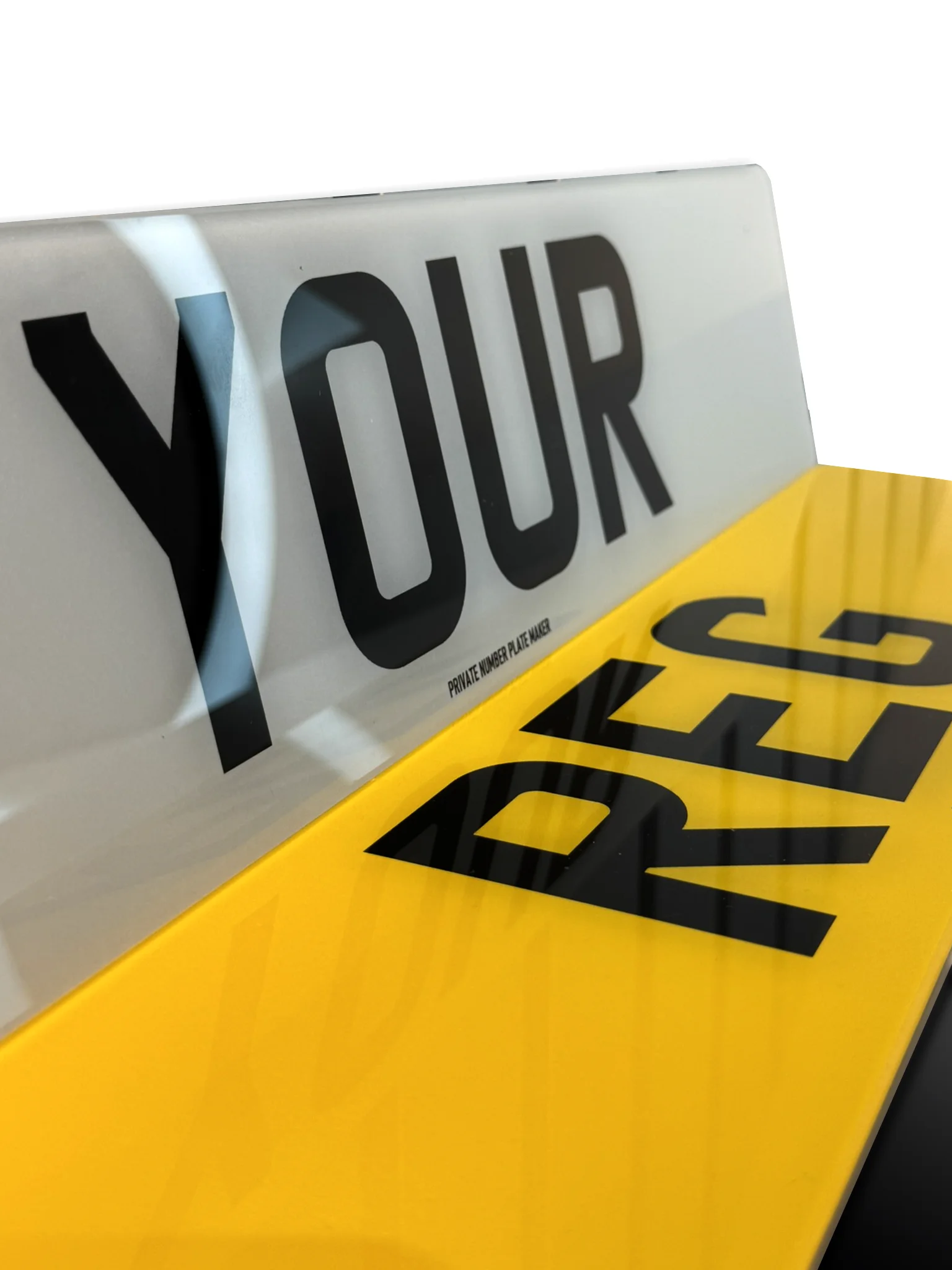
 Printed
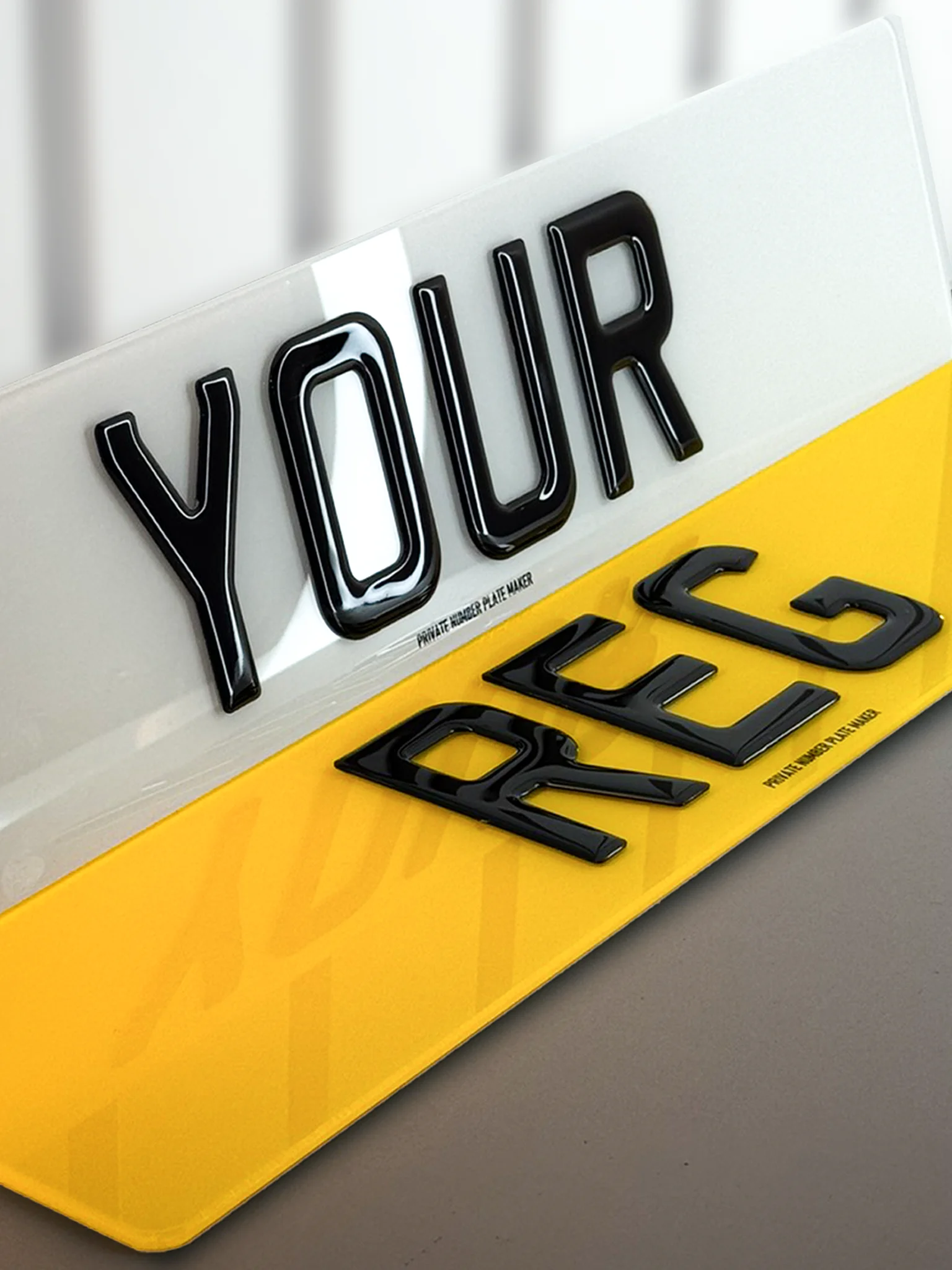 3D Plate
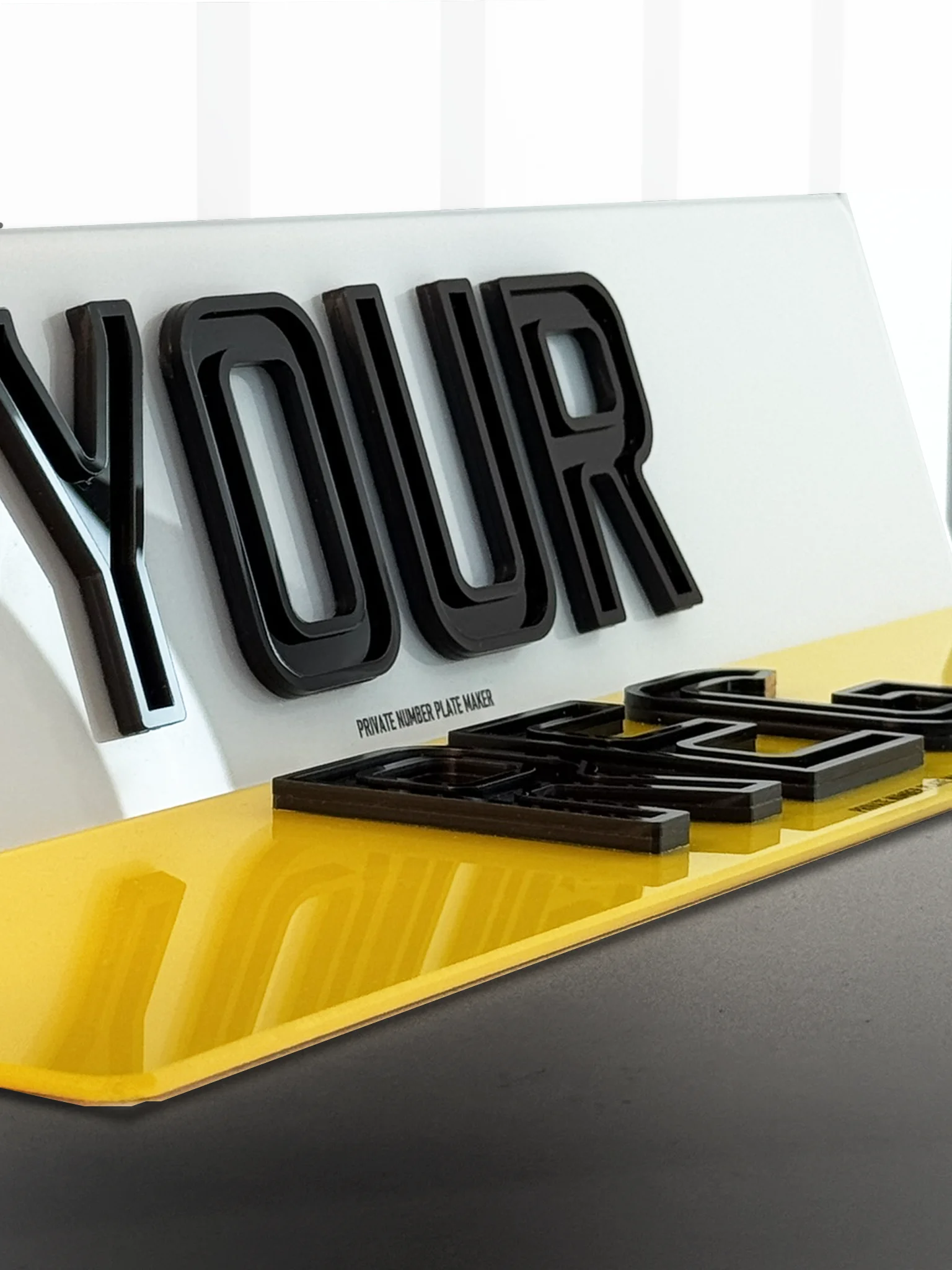
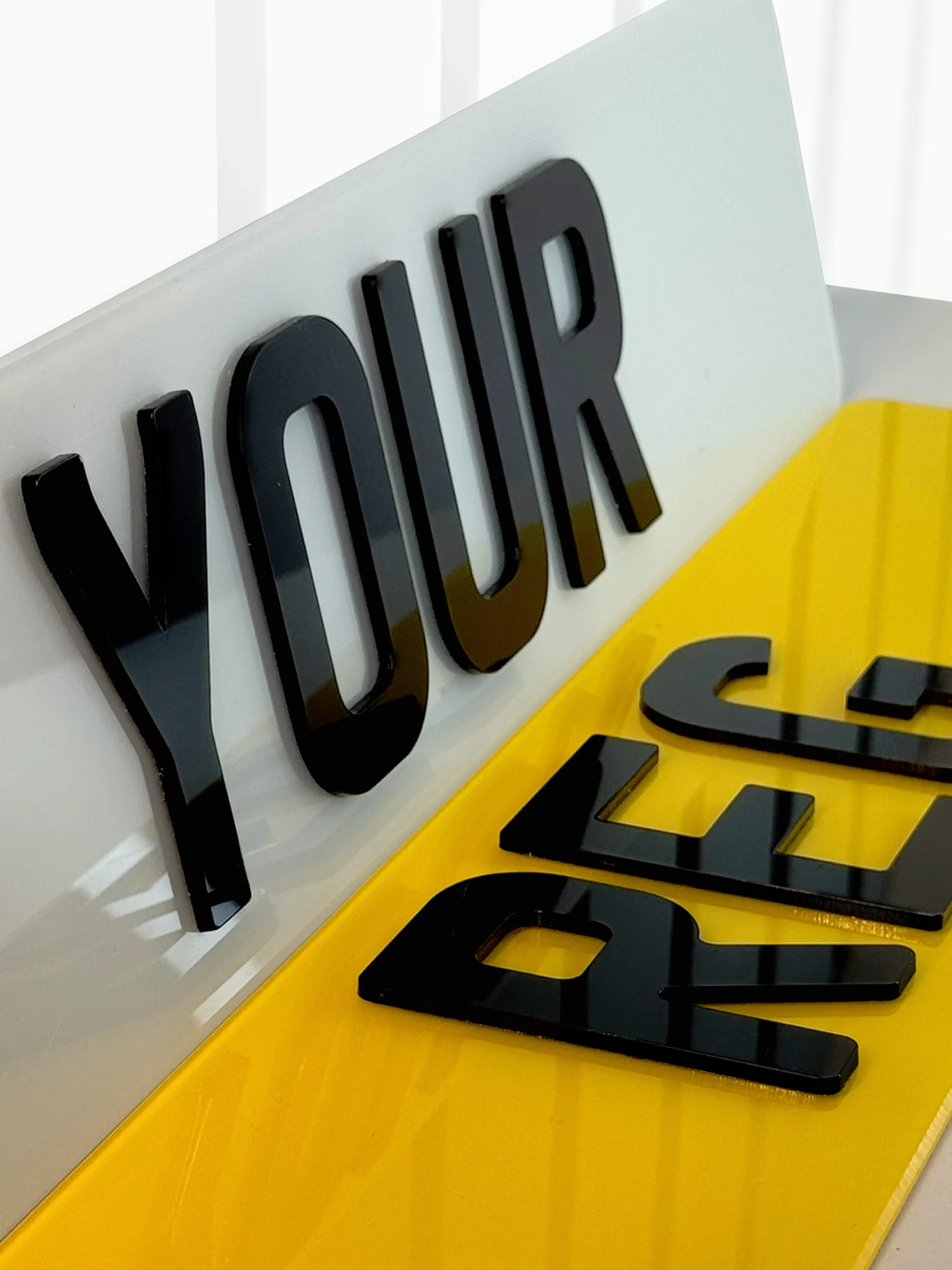 4D Plate
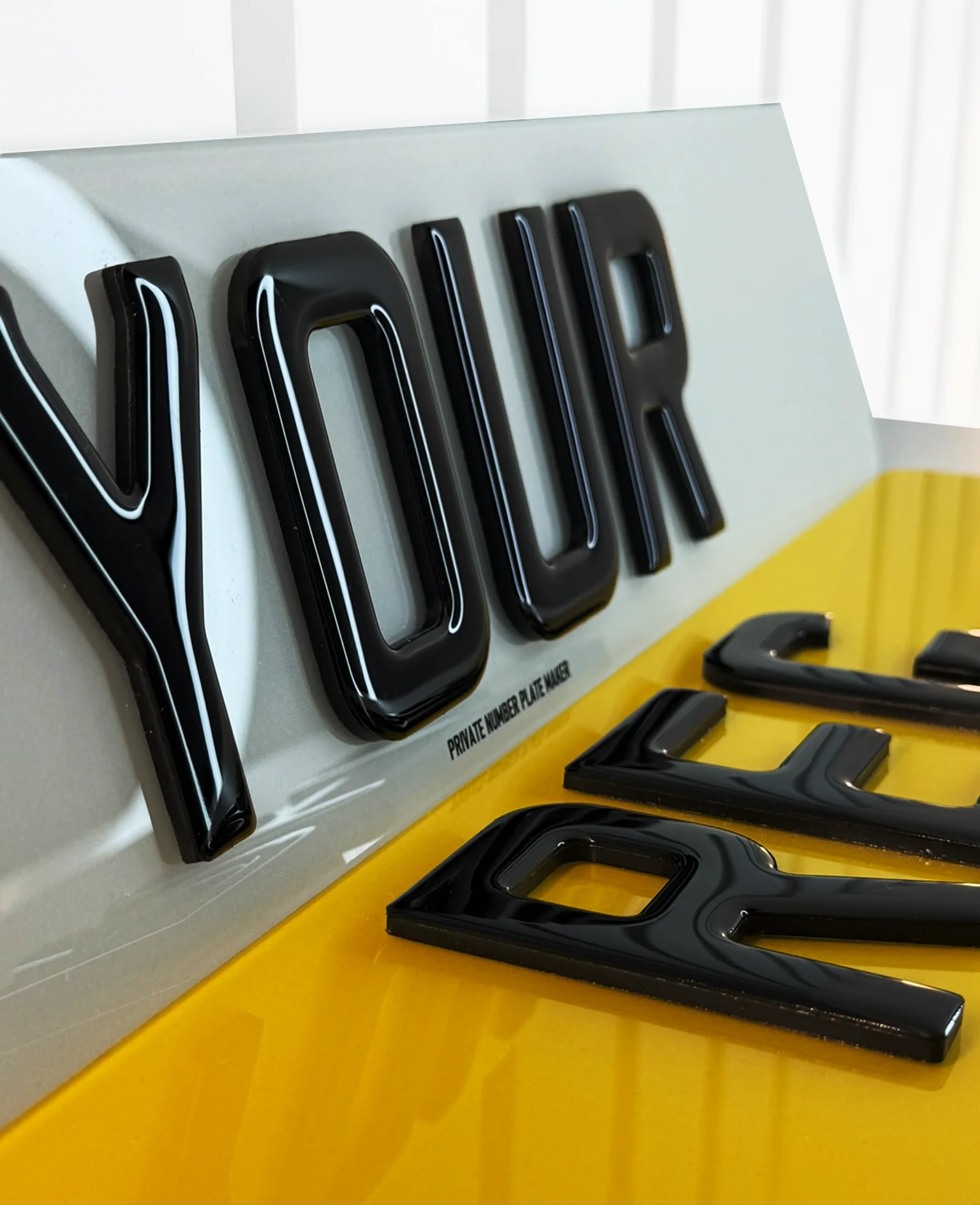 5D Plate
 Ghost
Ghost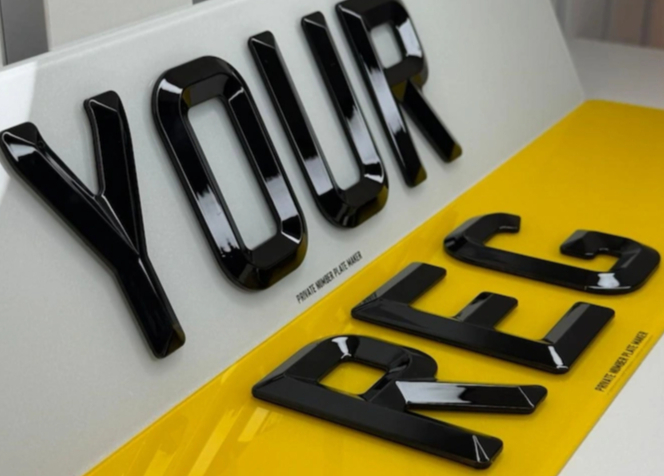 Bevel
Bevel4D Number Plates Explained: Complete Guide to Laser-Cut Plates
Summary
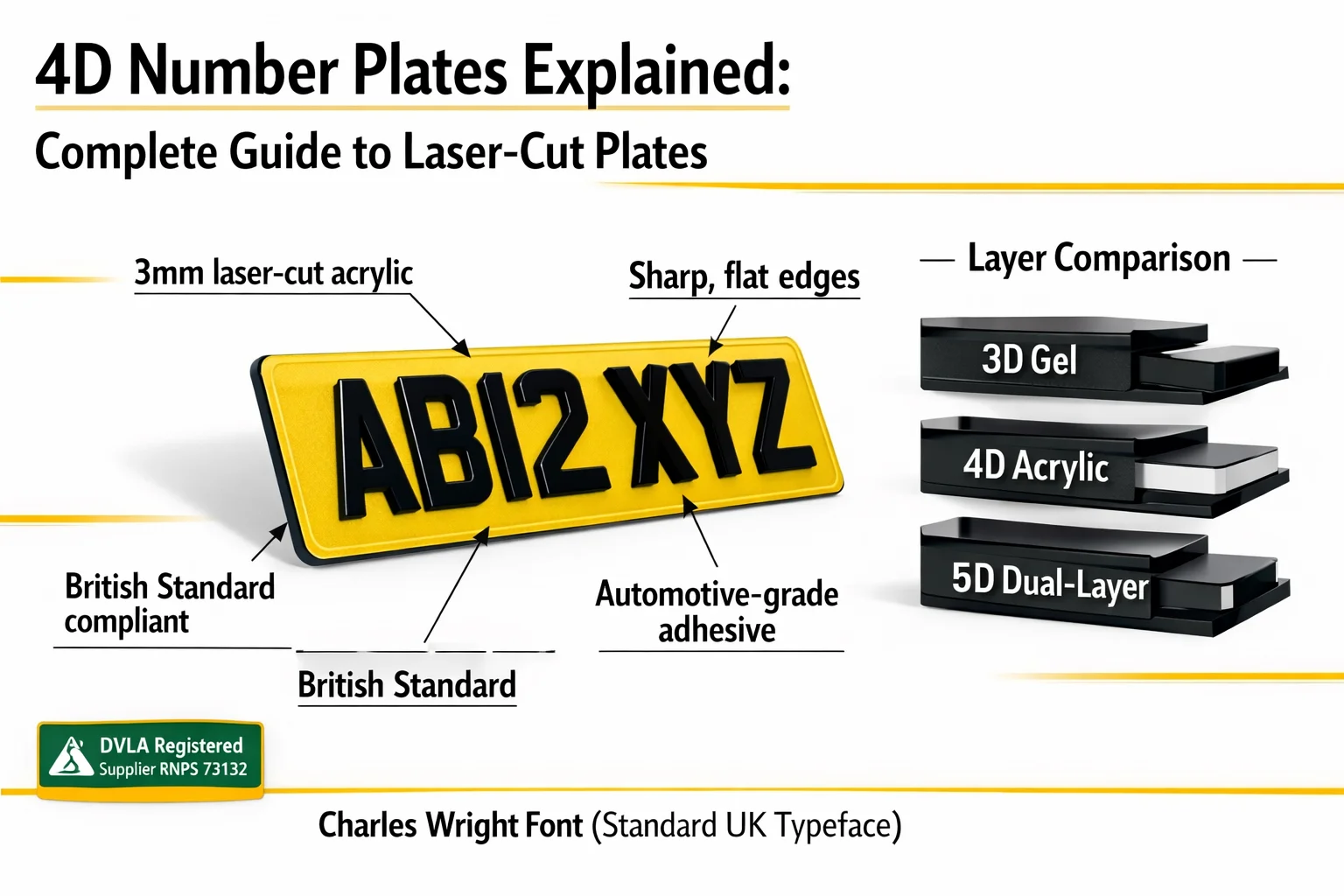
4D number plates feature laser-cut acrylic characters (typically 3mm or 5mm thick) bonded to a reflective plate base using automotive-grade adhesive, creating the deepest and most pronounced character depth available while remaining fully DVLA legal when manufactured to BS AU 145e:2018 standards. The "4D" name refers to the three-dimensional acrylic characters plus the shadow effect they create in sunlight, distinguishing them from 3D gel plates which use UV-cured resin gel over printed characters.
At Private Number Plate Maker Ltd, we manufacture every 4D plate on-site at our Ilford workshop using BS AU 145e-certified materials and verify all required documents before production as a DVLA-registered supplier (RNPS ID: 75449). Our 4D plates use precision laser-cutting equipment to achieve exact Charles Wright 2001 font specifications with sharp, flat edges that provide superior durability and the most premium appearance available for UK number plates.
This guide explains 4D plate construction, manufacturing processes, legal compliance requirements, durability comparisons with other plate types, and fitting considerations. We reference official sources including the Road Vehicles (Display of Registration Marks) Regulations 2001 and BS AU 145e:2018 to ensure all information is accurate and verifiable.
Related guide: Quick 4D plates FAQ: everything UK drivers need to know | 4D plates legality 2026
What Are 4D Number Plates?
Understanding 4D plate construction helps you make an informed choice about premium plate options.
Understanding 4D Plate Construction
4D number plates represent the premium end of legal number plate options in the UK. The construction differs significantly from both standard 2D and 3D gel plates:
| Component | 4D Plate Specification | Purpose |
|---|---|---|
| Character material | 3mm black acrylic sheet | Creates depth and durability |
| Cutting method | Precision laser-cutting | Ensures accurate character shapes |
| Font | Charles Wright 2001 | DVLA mandatory requirement |
| Adhesive | Automotive-grade bonding | Secures characters to substrate |
| Base substrate | BS AU 145e reflective | Provides legal compliance |
| Character depth | 3mm raised (typical) | Maximum legal depth effect |
Why "4D" Rather Than 3D?
The naming convention reflects the visual effect rather than a technical fourth dimension:
- 3D = Raised gel characters (three-dimensional depth)
- 4D = Laser-cut acrylic + shadow effect (depth plus visual dimension from shadows)
- 5D = 3mm acrylic + 2mm gel overlay (combined technologies)
The "fourth dimension" refers to the shadow cast by the raised acrylic characters in sunlight, creating additional visual depth beyond the physical 3mm thickness.
Related guide: Learn more about 3D gel plate technology | 5D plates explained
How Are 4D Plates Manufactured?
Professional 4D plate manufacturing requires precision equipment and careful quality control.
Step-by-Step Manufacturing Process
Step 1: Design and Layout
- Registration number laid out in Charles Wright 2001 font
- Character dimensions verified (79mm height for cars)
- Spacing checked against regulations (11mm between characters)
- Plate dimensions confirmed for vehicle type
Step 2: Acrylic Sheet Preparation
- 3mm black acrylic sheet selected
- UV-stabilised grade for outdoor durability
- Quality inspection for imperfections
- Cut to manageable working size
Step 3: Laser Cutting Characters
- CO2 laser cutter programmed with character shapes
- Laser power calibrated for clean cuts through 3mm acrylic
- Cutting speed optimised to prevent edge melting
- Each character cut individually with precision
Step 4: Edge Finishing
- Laser-cut edges inspected for smoothness
- Any rough edges lightly polished
- Characters cleaned to remove cutting residue
- Quality check on character shape accuracy
Step 5: Substrate Preparation
- BS AU 145e:2018 reflective substrate cut to size
- Surface cleaned for optimal adhesion
- Character positions marked on substrate
- BS AU 145e mark positioned correctly
Step 6: Adhesive Application and Bonding
- Automotive-grade adhesive applied to character backs
- Characters positioned precisely on substrate
- Pressure applied to ensure full contact
- Curing time allowed for full bond strength
Step 7: Final Quality Inspection
- All characters checked for secure bonding
- BS AU 145e mark verified visible
- Supplier RNPS ID confirmed present
- Overall plate appearance inspected
Related guide: Charles Wright font requirements: complete guide | BS AU 145e explained
Laser Cutting Technology
Professional 4D plate manufacturing uses specialised laser equipment:
| Laser Type | Typical Use | Advantages |
|---|---|---|
| CO2 Laser | Acrylic cutting | Clean edges, precise cuts |
| Fibre Laser | Metal marking | Not used for 4D characters |
| Diode Laser | Engraving | Not suitable for cutting |
CO2 Laser Specifications for 4D Plates:
- Power: 60-100 watts typical
- Wavelength: 10.6 micrometres
- Cutting speed: Calibrated for 3mm acrylic
- Accuracy: +/- 0.1mm tolerance
Why Laser Cutting Matters:
- Consistent character shapes across all plates
- Sharp, clean edges without burrs
- No mechanical stress on acrylic material
- Repeatable precision for every character
4D vs 3D vs 5D: Understanding the Differences
Understanding construction differences helps you choose the right premium plate for your needs.
Construction Comparison
| Feature | 3D Gel | 4D Laser-Cut | 5D Dual-Layer |
|---|---|---|---|
| Character Construction | UV-cured resin gel | 3mm laser-cut acrylic | 3mm acrylic + 2mm gel |
| Character Thickness | 2mm raised | 3mm raised | 5mm total depth |
| Edge Profile | Rounded gel edges | Sharp, flat acrylic edges | Sharp edges with gel top |
| Visual Effect | Subtle raised appearance | Bold depth with shadow | Maximum depth and definition |
| Durability | High | Very High | Highest |
| Price Range | Mid-range | Premium | Highest |
| Legal Status | Fully legal | Fully legal | Fully legal |
Related guide: Full comparison: 3D vs 4D vs 5D number plates
When to Choose 4D Over 3D
Consider 4D laser-cut plates if you:
4D Advantages:
- Maximum character depth (3mm vs 2mm gel)
- Sharper, more defined character edges
- Superior durability for high-mileage vehicles
- Better resistance to stone chips and impacts
- More pronounced premium appearance
- Longer lifespan (7-10+ years typical)
3D May Be Better If:
- Budget is primary concern (3D typically £20-£30 less per pair)
- You prefer subtler raised effect
- Vehicle will be sold within 2-3 years
- You want good upgrade from standard without maximum cost
Related guide: Detailed 4D vs 3D breakdown | All plate types comparison
5D: The Next Evolution
5D plates combine 4D and 3D technologies:
- 3mm laser-cut acrylic base (4D characteristic)
- 2mm UV-cured gel overlay (3D characteristic)
- 5mm total character depth
- Combines durability of 4D with gel finish of 3D
- Maximum premium appearance available
Related guide: Are premium 5D number plates worth the investment?
Legal Compliance for 4D Plates
4D plates must meet the same legal requirements as all other number plate types.
DVLA Requirements for 4D Number Plates
Road Vehicles (Display of Registration Marks) Regulations 2001:
- Regulation 16: Characters must be easily distinguishable
- Charles Wright 2001 font mandatory
- Correct character dimensions and spacing
- Reflective substrate required
- Supplier identification visible
Key Compliance Points for 4D:
- 3mm acrylic depth is legal (no maximum depth specified)
- Characters must remain readable to eye and cameras
- No highlighting effects on characters
- Solid black acrylic only (no colours or tints)
- BS AU 145e:2018 certification required
Related guide: Are 4D plates legal in 2026? Complete UK guide
BS AU 145e:2018 Requirements
All new number plates from 1 September 2021 must comply with BS AU 145e:2018:
Four Mandatory Requirements:
| Requirement | Purpose | Testing |
|---|---|---|
| Reflectivity | ANPR camera visibility | Retroreflection measurement |
| Impact Resistance | Withstands road debris | Impact testing |
| Weathering | UV and environmental resistance | 2,275 hours UV exposure |
| NIR Compatibility | Infrared spectrum performance | NIR contrast testing |
Related guide: What is BS AU 145e:2018? Full explanation | How ANPR cameras work
What Makes 4D Plates Illegal
4D plates become illegal when they have:
- Acrylic thickness exceeding practical limits (affecting readability)
- Highlighting or gradient effects on characters
- Non-Charles Wright fonts
- Incorrect character spacing or dimensions
- Missing BS AU 145e certification mark
- Missing supplier RNPS identification
- Coloured or tinted acrylic (must be solid black)
- Reflective coatings on characters
Penalties: Under Section 42 of the Vehicle Excise and Registration Act 1994, fines up to £1,000 (Level 3 standard scale) can apply for non-compliant plates.
Technical Specifications for 4D Plates
All 4D number plates must meet these specifications to remain legal.
Character Dimensions (Car Standard)
| Specification | Measurement | Tolerance |
|---|---|---|
| Character height | 79mm | +/- 1mm |
| Character width | 50mm (excluding I and 1) | +/- 1mm |
| Stroke thickness | 14mm | +/- 0.5mm |
| Character spacing | 11mm between characters | +/- 0.5mm |
| Age identifier gap | 33mm | +/- 1mm |
| Minimum margins | 11mm around edges | Minimum |
| Acrylic thickness | 3mm (typical 4D) | +/- 0.2mm |
Note: The character 'I' and numeral '1' may be narrower than other characters.
Related guide: Charles Wright font requirements: complete guide
Acrylic Material Specifications
Quality 4D plates use specific acrylic grades:
| Property | Specification | Purpose |
|---|---|---|
| Material type | Cast acrylic sheet | Superior to extruded for durability |
| Thickness | 3mm nominal | Standard 4D depth |
| Colour | Solid black | DVLA requirement |
| UV stabilisation | UV-resistant grade | Prevents fading and yellowing |
| Impact rating | High impact resistance | Withstands road debris |
| Temperature range | -40?C to +80?C | UK climate suitable |
Adhesive Bonding Specifications
Automotive-grade adhesive ensures long-term durability:
| Property | Requirement | Why It Matters |
|---|---|---|
| Adhesive type | Automotive-grade acrylic adhesive | Weather and UV resistant |
| Bond strength | High shear strength | Prevents character loss |
| Temperature tolerance | -40?C to +80?C | UK climate range |
| UV resistance | UV-stable formulation | Prevents adhesive degradation |
| Curing time | 24-48 hours for full strength | Plates should not be fitted immediately |
| Water resistance | Waterproof when cured | Withstands washing and weather |
Durability and Lifespan
Understanding 4D plate longevity helps you plan for maintenance and replacement.
Expected 4D Plate Lifespan
Properly manufactured 4D plates typically last 7-10+ years under normal UK driving conditions:
| Ownership Period | Expected Condition | Notes |
|---|---|---|
| 0-2 years | Excellent, like new | No visible wear |
| 2-5 years | Very good | Minor surface marks possible |
| 5-7 years | Good | Some fading may begin |
| 7-10+ years | Acceptable | Consider replacement if fading significant |
Factors Affecting Lifespan:
- Parking conditions (garage vs outdoor)
- Mileage and road types
- Climate and weather exposure
- Cleaning frequency and methods
- Quality of initial manufacturing
Related guide: Number plate maintenance tips to extend lifespan
4D Durability Advantages
4D laser-cut plates offer superior durability compared to other types:
| Durability Factor | 3D Gel | 4D Acrylic | Advantage |
|---|---|---|---|
| UV Resistance | High | Very High | 4D acrylic more UV-stable |
| Impact Resistance | High | Very High | Solid acrylic resists chips better |
| Chemical Resistance | Good | Excellent | Acrylic more resistant to cleaners |
| Temperature Stability | Good | Excellent | Acrylic handles extremes better |
| Edge Durability | Good | Excellent | Laser-cut edges don't peel |
Common Durability Concerns Addressed
Question: Do 4D Characters Fall Off?
Properly bonded 4D characters should not detach under normal conditions:
- Automotive-grade adhesive creates permanent bond
- Full curing takes 24-48 hours after manufacture
- Temperature cycling tested during manufacturing
- Failure usually indicates manufacturing defect or impact damage
Question: Does Acrylic Crack or Chip?
Quality 4D acrylic is highly impact-resistant:
- Cast acrylic more resistant than extruded grades
- 3mm thickness provides good strength
- Stone chips may mark surface but rarely crack through
- Direct impact damage possible but uncommon
Question: Will 4D Plates Fade Over Time?
UV-stabilised acrylic resists fading effectively:
- Quality acrylic contains UV inhibitors
- 7-10 year lifespan before noticeable fading
- Garage parking extends lifespan significantly
- Replace if fading affects readability
Related guide: Complete UK buying guide for replacement number plates
MOT Compliance for 4D Plates
4D plates pass MOT when manufactured correctly and maintained properly.
MOT Inspection Requirements
4D plates pass MOT when manufactured correctly:
MOT Plate Checks:
- Characters easily readable from reasonable distance
- Font matches Charles Wright 2001 specification
- No cracks, discolouration, or damage
- BS AU 145e mark present and visible
- Supplier identification visible
- Plate securely attached to vehicle
- 3mm acrylic depth does not cause failure
Common 4D Plate MOT Failures:
- Characters detached or loose
- Significant fading affecting readability
- Cracked acrylic characters
- Missing or illegible BS AU 145e mark
- Plate not securely fixed
Maintaining MOT Compliance
Keep your 4D plates MOT-compliant with these practices:
Regular Maintenance:
- Clean plates monthly (more in winter)
- Check character bonding regularly
- Verify all characters remain legible
- Ensure fixings are secure
- Replace plates showing significant wear
When to Replace:
- Characters becoming loose or detached
- Significant fading affecting readability
- Cracks through acrylic characters
- Missing or illegible BS AU 145e mark
- MOT failure due to plate condition
Fitting 4D Plates to Vehicles
4D plates use standard UK number plate fixing positions with some considerations for acrylic thickness.
Standard Fitting Process
4D plates use standard UK number plate fixing positions:
Fitting Steps:
- Remove old plates carefully
- Clean mounting surface thoroughly
- Position new 4D plate correctly (front/rear)
- Insert screws through fixing holes
- Tighten securely (do not over-tighten)
- Check plate is secure and straight
Important Fitting Considerations for 4D:
- 3mm acrylic is heavier than standard plates
- Use appropriate length screws for thicker plates
- Do not over-tighten (can crack acrylic)
- Use rubber washers to protect acrylic surface
- Check plate sits flush without warping
Related guide: Complete number plate fitting guide with photos
Fixing Options for 4D Plates
| Fixing Type | Best For | Considerations |
|---|---|---|
| Standard screws with washers | Most vehicles | Use rubber washers |
| Security fixings | High-theft areas | Prevents plate removal |
| Adhesive pads | Some applications | Check adhesion regularly |
| Quick-release brackets | Security-conscious owners | Easy plate removal |
| Manufacturer brackets | Specific models | OEM fitment |
Security Tip: 4D plates are more valuable than standard plates; consider security fixings to deter theft.
Vehicle Compatibility
4D plates fit all standard UK vehicle mounting points:
| Vehicle Type | Compatibility | Notes |
|---|---|---|
| Cars (all types) | Fully compatible | Standard 520mm x 111mm |
| Motorcycles | Compatible (different size) | 64mm characters, rear only |
| Vans/LCVs | Fully compatible | Same as car plates |
| Import vehicles | Compatible | May need custom sizing |
| Classic vehicles | Fully compatible | Period-correct formats available |
Note: Motorcycle 4D plates use 64mm characters and different dimensions.
4D Plate Maintenance and Care
Proper cleaning and care extends the lifespan and appearance of your 4D acrylic plates.
Cleaning 4D Acrylic Plates
4D plates require regular cleaning to maintain appearance:
Cleaning Process:
- Rinse with water to remove loose dirt
- Apply mild car shampoo with soft cloth
- Gently wipe acrylic characters (do not scrub hard)
- Rinse thoroughly with clean water
- Dry with soft microfiber cloth
Cleaning Frequency:
- Monthly under normal conditions
- Every 2 weeks in winter (road salt)
- After long motorway journeys (insect buildup)
- Before MOT inspection
What to Avoid When Cleaning 4D Plates
Protect your 4D acrylic plates by avoiding:
| Avoid | Reason | Alternative |
|---|---|---|
| Pressure washer (direct) | Can damage adhesive bond | Garden hose or bucket |
| Abrasive sponges | Scratches acrylic surface | Soft microfiber cloth |
| Solvent cleaners | Can degrade adhesive | Mild car shampoo |
| Stiff brushes | Scratches acrylic | Soft bristle brush only |
| Petrol/diesel contact | Can damage acrylic | Wipe immediately if contacted |
Protection Tips for 4D Plates
Extend your 4D plate lifespan with these tips:
Protection Methods:
- Apply car wax every 2-3 months
- Wax protects acrylic and makes cleaning easier
- Check fixings regularly for tightness
- Inspect after long journeys for damage
- Store vehicle indoors when possible
Winter Considerations:
- Road salt can degrade adhesive over time
- Clean more frequently in winter months
- Apply protective wax before winter
- Check for ice damage after freezing
Pricing and Value Considerations
Understanding 4D plate pricing helps you make an informed investment decision.
4D Plate Pricing Structure
4D plates command premium pricing due to manufacturing complexity:
| Plate Type | Typical Price Range (Pair) | Value Proposition |
|---|---|---|
| Standard 2D | £25-£40 | Basic compliance, budget option |
| 3D Gel | £40-£60 | Mid-range premium appearance |
| 4D Laser-Cut | £60-£90 | Maximum depth and durability |
| 5D Dual-Layer | £80-£120 | Ultimate premium appearance |
Note: Prices vary by supplier, location, and order volume.
Why 4D Plates Cost More
4D manufacturing involves additional processes compared to standard plates:
Cost Factors:
- Laser cutting equipment and operation
- Premium acrylic materials (3mm cast acrylic)
- Automotive-grade adhesive
- Additional manufacturing time per plate
- Quality control for character bonding
- Higher material waste (cutting individual characters)
Value Justification:
- 7-10+ year lifespan vs 3-5 years for standard
- Superior appearance throughout ownership
- Better resale value consideration
- Enhanced durability for high-mileage vehicles
When 4D Represents Good Value
4D plates offer best value for:
- Owners keeping vehicles 5+ years
- High-mileage drivers (motorway regularly)
- Premium vehicle owners (matches vehicle quality)
- Outdoor parking (better weather resistance)
- Enthusiasts wanting maximum appearance
- Fleet vehicles wanting reduced replacement frequency
Consider Alternatives If:
- Vehicle will be sold within 2 years
- Budget is primary concern
- Vehicle parked indoors exclusively
- Standard appearance is acceptable
Related guide: Are premium number plates worth the investment?
Common 4D Plate Questions
Addressing frequent concerns helps you choose 4D plates with confidence.
Are 4D Plates Legal on All Vehicles?
Yes, 4D plates are legal on all UK vehicles when compliant:
- Cars, vans, motorcycles all permitted
- Must meet BS AU 145e:2018 standards
- Charles Wright 2001 font mandatory
- Correct character dimensions required
- Supplier RNPS identification visible
Do 4D Plates Work with ANPR Cameras?
Yes, compliant 4D plates work perfectly with ANPR:
- Black acrylic absorbs infrared appropriately
- 3mm depth does not interfere with cameras
- BS AU 145e NIR compatibility required
- Clear adhesive does not block readings
ANPR Failures Only Occur With:
- Non-compliant acrylic (tinted/coloured)
- Wrong font or spacing
- Damaged or detached characters
- Dirty plates affecting readability
Related guide: 4D plates ANPR definitive guide | Do 3D plates work with ANPR?
Can 4D Plates Be Repaired If Damaged?
No, damaged 4D characters cannot be properly repaired:
- Acrylic cannot be re-bonded reliably
- Repairs will not meet BS AU 145e standards
- MOT may fail with repaired plates
- Replacement is the only compliant option
If Characters Become Loose:
- Contact supplier immediately if under warranty
- Do not attempt DIY re-bonding
- Order replacement plates
- Keep damaged plates as evidence if warranty claim
How Long Does 4D Plate Manufacturing Take?
Production times vary by supplier:
Typical Timeframes:
- Same-day collection available (order before cut-off)
- Next-day UK delivery standard
- Complex registrations may require extra time
- Document verification completed before production
Our Ilford Workshop:
- Ilford location for collection
- RNPS ID: 75449 on all plates
- Same-day production available
- Document verification on-site
Related guide: Same-day number plates in Ilford: what you need to know | Delivery times guide
Our 4D Plate Manufacturing Standards
At Private Number Plate Maker Ltd, we ensure 4D plate quality through rigorous standards.
Quality Control at Our Ilford Workshop
At Private Number Plate Maker Ltd, we ensure 4D plate quality through:
Material Control:
- 3mm cast acrylic sheet (not extruded)
- UV-stabilised grade for UK climate
- Automotive-grade adhesive only
- BS AU 145e:2018 certified substrates
Manufacturing Standards:
- CO2 laser cutter calibrated regularly
- Charles Wright 2001 font verified
- Character dimensions checked on every plate
- Bond strength testing (batch sampling)
Quality Inspection:
- Every plate inspected before dispatch
- BS AU 145e mark applied correctly
- RNPS ID: 75449 on all plates
- Document verification completed first
Traceability:
- Production records maintained
- Batch tracking for quality issues
- Compliance documentation available
- Physical workshop for verification visits
Why On-Site Manufacturing Matters
Our Ilford workshop manufactures all 4D plates on-site rather than outsourcing:
Quality Control Benefits:
- Direct oversight of every manufacturing step
- Immediate correction of any issues
- Consistent standards across all production
- Complete traceability for every plate
Customer Benefits:
- Same-day collection available
- Quick turnaround for urgent orders
- Direct communication with manufacturers
- Physical workshop for verification visits
Compliance Benefits:
- Document verification before production
- RNPS registration maintained properly
- BS AU 145e standards followed throughout
- Records available for compliance audits
Related guide: Read real 4D number plate reviews from UK drivers
4D Plates vs Competitor Options
Not all 4D plates are manufactured to the same standard - knowing what to look for protects your investment.
Comparing 4D Suppliers
Not all 4D plates are manufactured to the same standard:
Quality Indicators:
| Factor | Premium Supplier | Budget Supplier |
|---|---|---|
| Acrylic grade | Cast acrylic | May use extruded |
| Adhesive type | Automotive-grade | Standard adhesive |
| Laser precision | Calibrated equipment | May vary |
| Quality control | Every plate inspected | Sample checking only |
| Documentation | Full compliance records | May be incomplete |
| RNPS registration | Verified and visible | May not display |
Questions to Ask Suppliers
Essential Questions:
- Are you DVLA-registered with visible RNPS ID?
- What grade acrylic do you use (cast vs extruded)?
- What adhesive type is used for bonding?
- Where are plates manufactured (physical address)?
- What warranty or guarantee do you offer?
- Can you provide compliance documentation?
Red Flags to Avoid
Be cautious of suppliers who:
- Cannot provide RNPS registration number
- Prices significantly below market average
- No document verification required
- Only online presence, no physical address
- Vague compliance claims without certification
- Cannot explain manufacturing process
- No warranty or guarantee offered
This guide references the following official and verified sources:
DVLA Official Guidance
Road Vehicles (Display of Registration Marks) Regulations 2001
legislation.gov.ukBritish Standards Institution - BS AU 145e:2018
knowledge.bsigroup.comBritish Number Plate Manufacturers Association (BNMA)
bnma.orgVehicle Excise and Registration Act 1994
legislation.gov.ukDVLA INF104 Vehicle Registration Numbers and Number Plates
gov.ukAcrylic Material Industry Standards - British Plastics Federation
www.bpf.co.uk