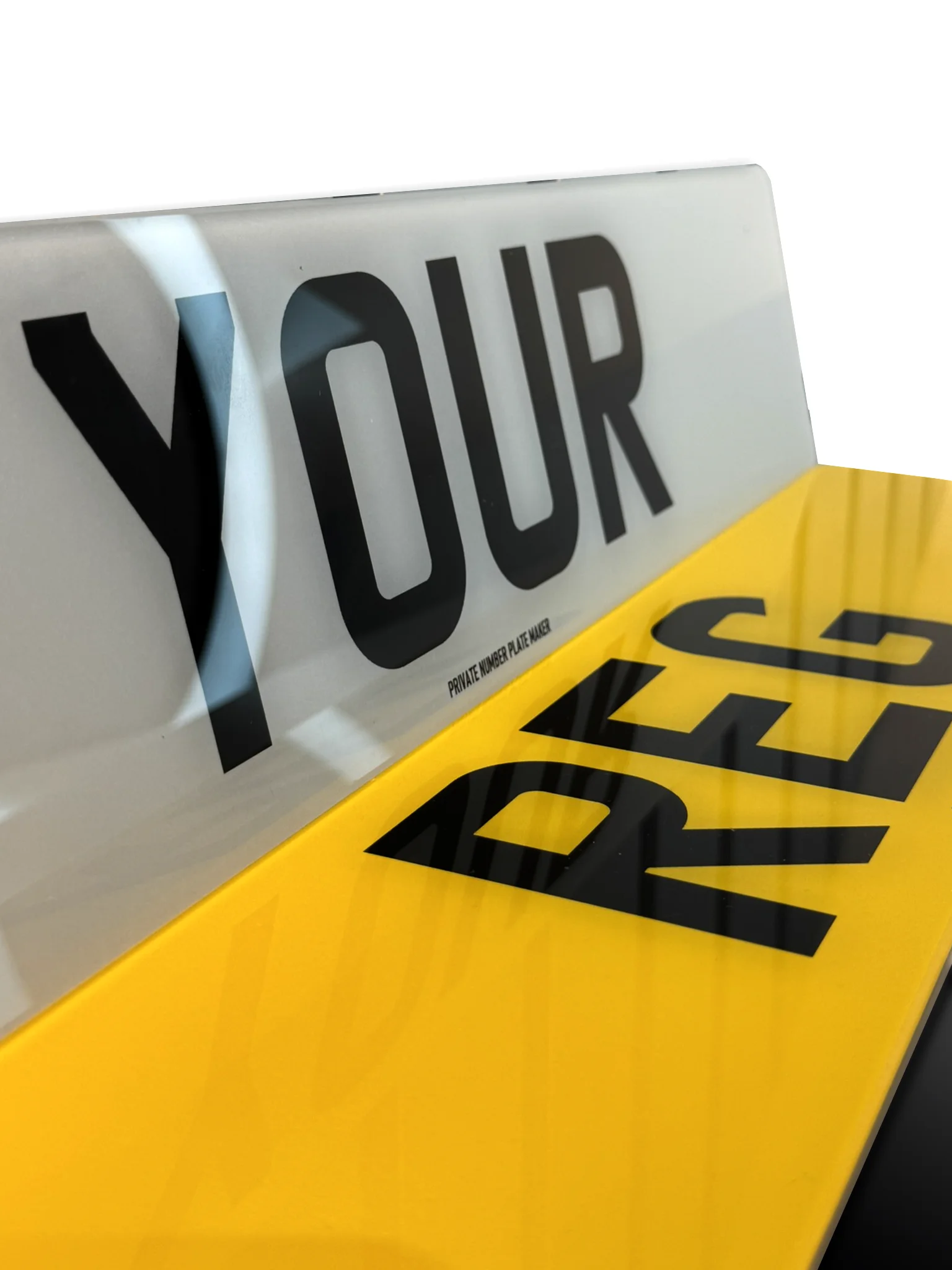
 Printed
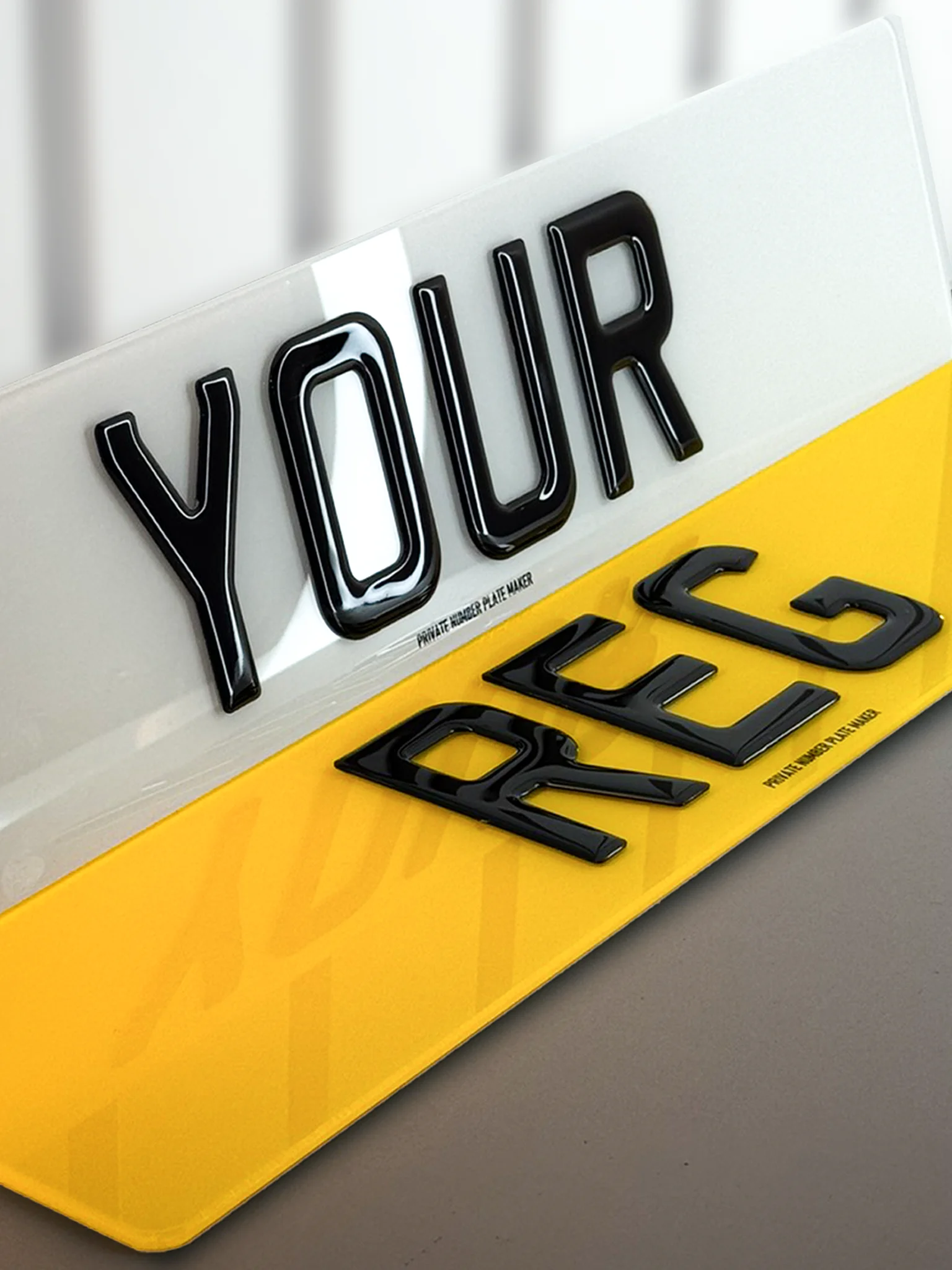 3D Plate
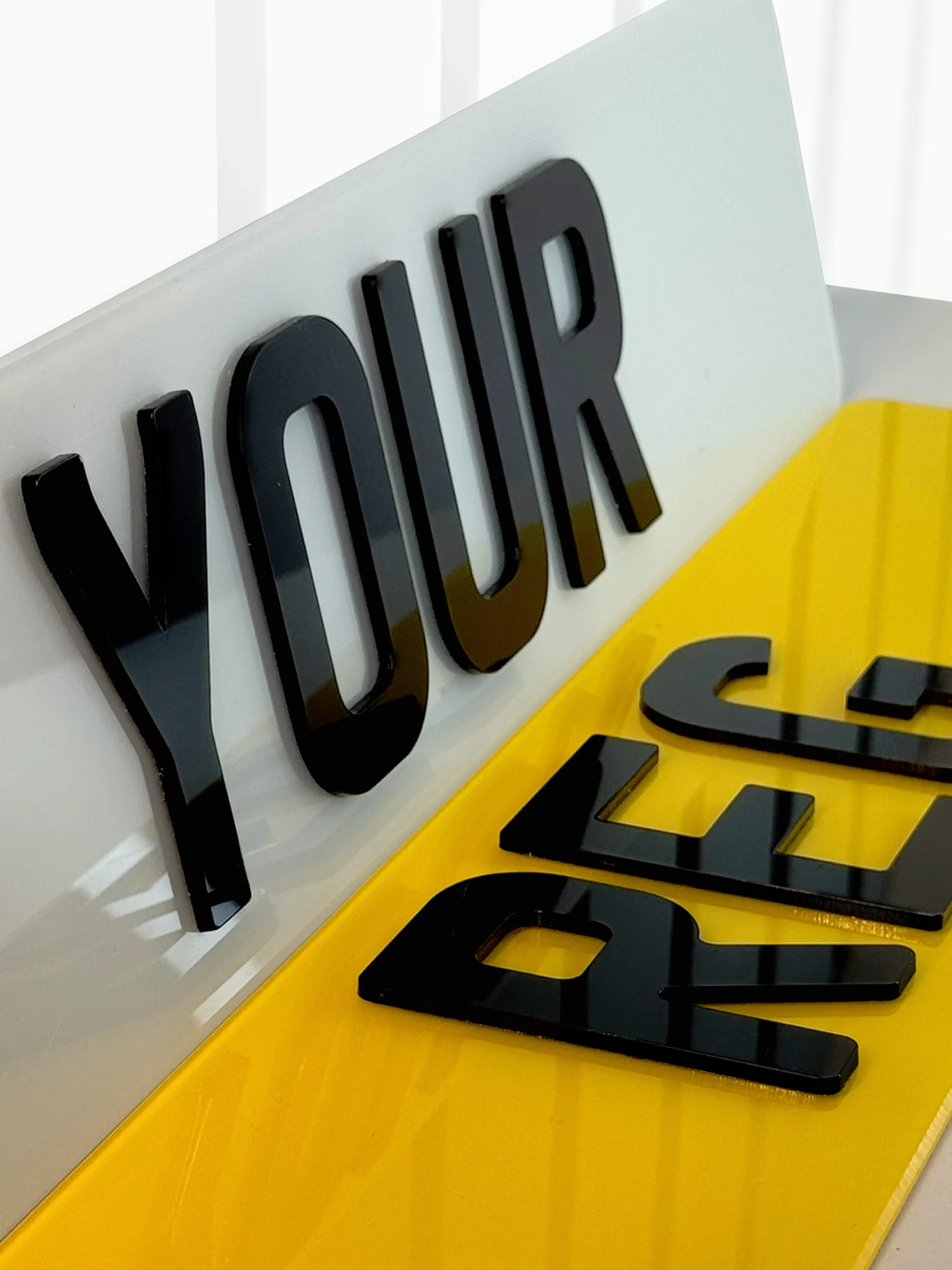 4D Plate
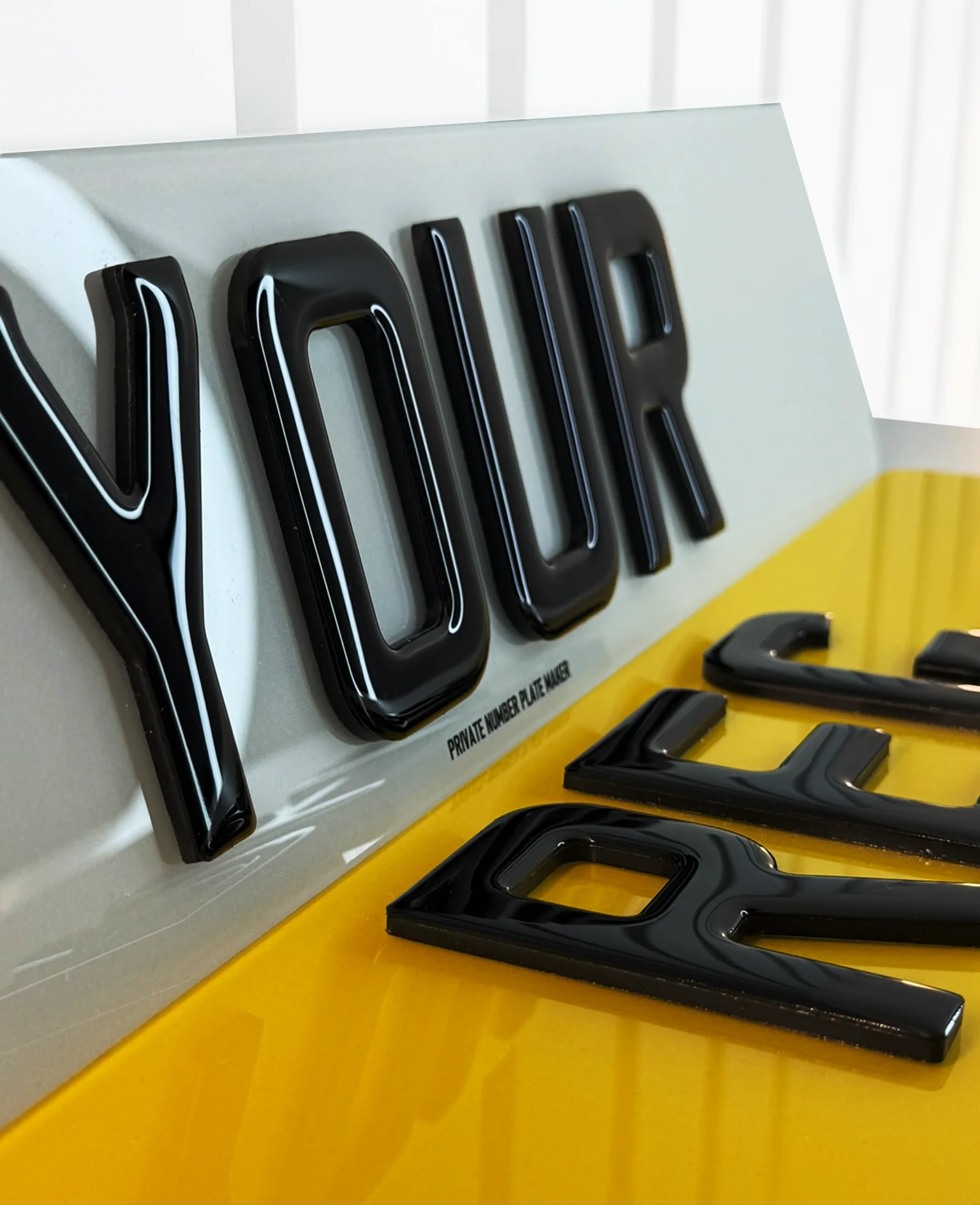 5D Plate
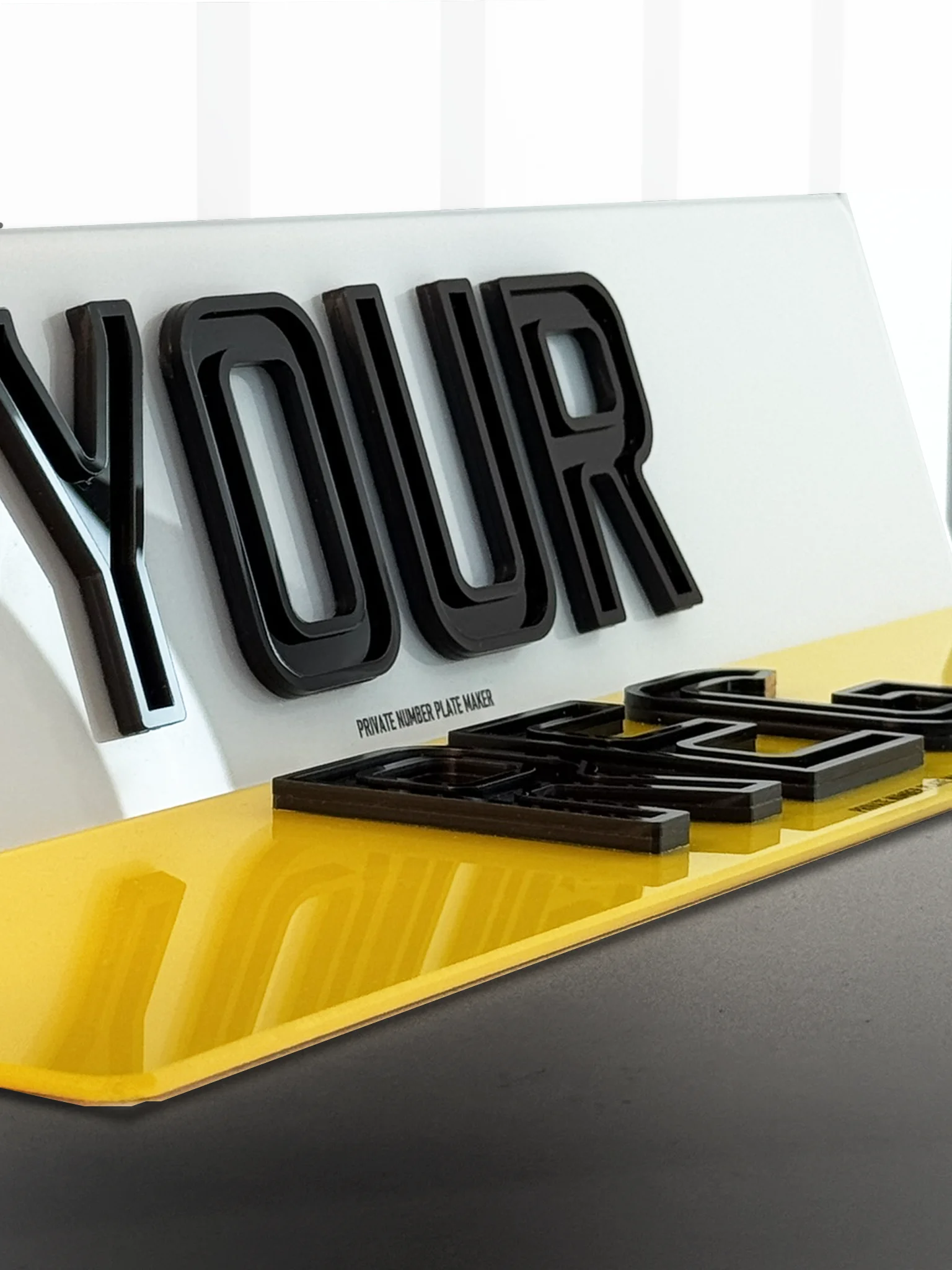 Ghost
Ghost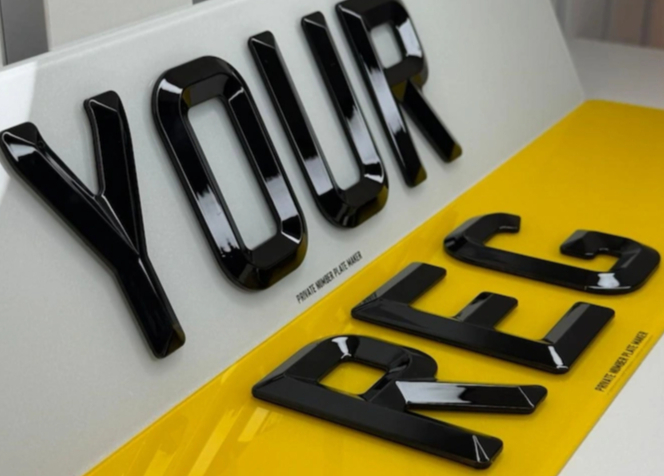 Bevel
BevelThe UV Curing Process: How 3D Gel Plates Are Made
Summary
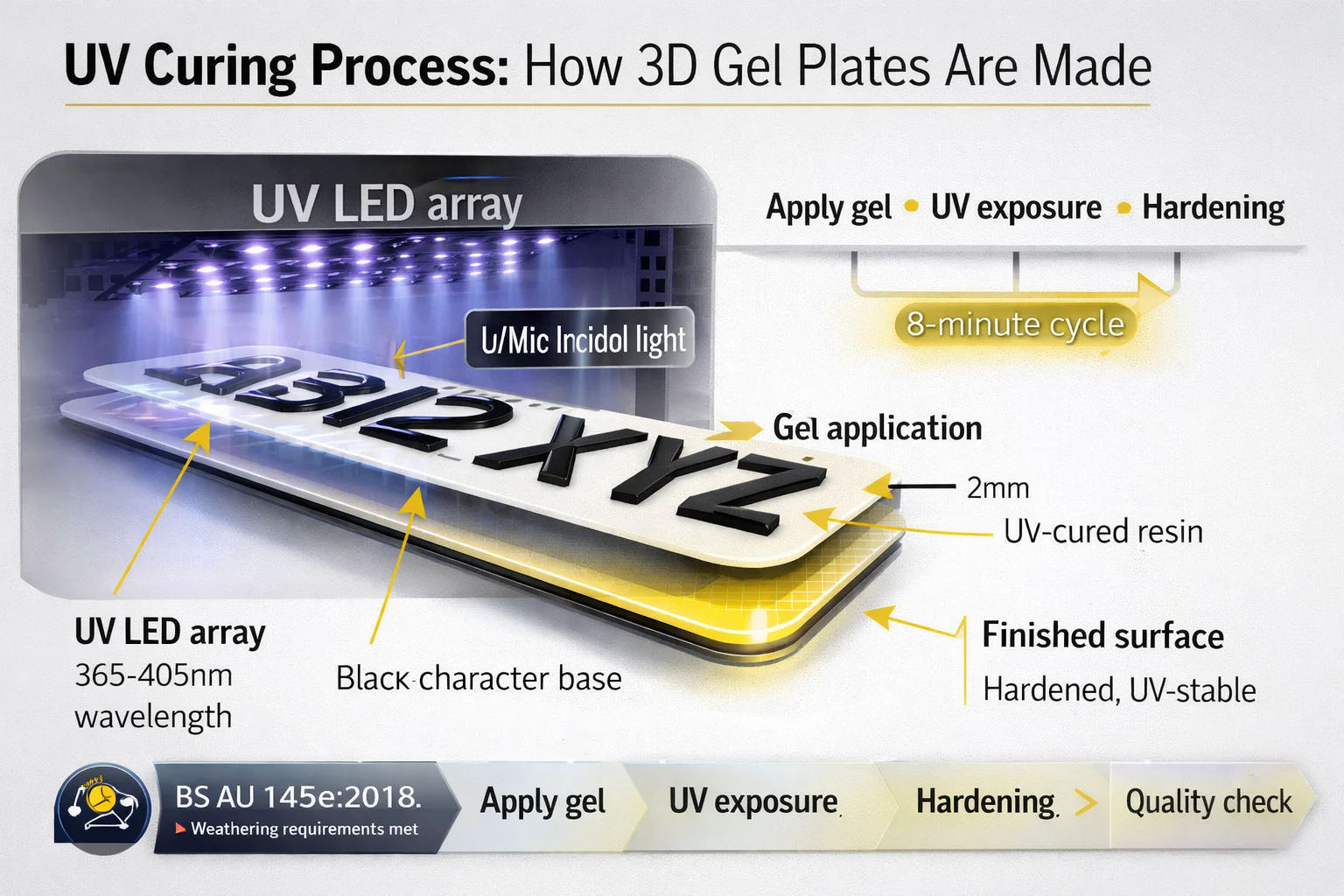
UV curing is the critical manufacturing process that transforms liquid resin gel into the durable, raised characters found on 3D gel number plates. During this process, UV-cured resin is applied to the character areas of the plate and exposed to ultraviolet light at specific wavelengths (typically 365-405 nanometres) for approximately 8 minutes, causing the resin to harden through photopolymerisation. This creates a protective layer that resists UV fading, stone chips, and weathering while maintaining the clear finish that allows the black character base to show through without highlighting effects.
The UV curing process is essential for BS AU 145e:2018 compliance, particularly the weathering requirement that mandates plates withstand 2,275 hours of UV exposure testing without significant deterioration. Properly cured gel protects the underlying characters from UV degradation, extends plate lifespan to 5-7 years under normal conditions, and ensures the plate remains ANPR-readable throughout its service life. At Private Number Plate Maker Ltd, we perform all UV curing on-site at our Ilford workshop using calibrated equipment that ensures consistent curing across every plate we manufacture.
This guide explains the complete UV curing process, why it matters for legal compliance and durability, the equipment and specifications involved, and how proper curing distinguishes compliant 3D gel plates from non-compliant alternatives. We reference BS AU 145e:2018 requirements and industry-standard manufacturing practices to ensure all technical information is accurate and verifiable.
3D Gel Number Plates Explained Guide | BS AU 145e Explained Guide
What Is UV Curing in Number Plate Manufacturing?
UV curing is a photopolymerisation process where ultraviolet light triggers a chemical reaction that transforms liquid resin into solid, durable material. In 3D gel number plate manufacturing, this process creates the raised character effect while simultaneously protecting the characters from environmental damage.
The Basic Process
- Black character base is applied to reflective substrate
- Clear UV-curable resin gel is applied over characters
- Plate enters UV curing chamber with LED arrays
- UV light at 365-405nm wavelength activates photoinitiators in resin
- Resin molecules cross-link and harden over 8-minute cycle
- Cured gel forms protective, transparent layer over characters
Unlike traditional air-drying methods, UV curing produces immediate hardening with consistent results across all plates. This consistency is critical for maintaining BS AU 145e compliance across production batches.
Why UV Curing Matters for BS AU 145e Compliance
BS AU 145e:2018 specifies four mandatory performance requirements that all number plates must meet:
1. Reflectivity
The cured gel must remain transparent enough to allow the reflective substrate to function properly. Over-curing can cause yellowing that reduces reflectivity, while under-curing leaves gel too soft and prone to damage.
2. Impact Resistance
Properly cured gel achieves the hardness necessary to withstand stone chips and minor impacts without cracking or peeling from the character base.
3. Weathering
This is where UV curing matters most. BS AU 145e requires plates to withstand 2,275 hours of UV exposure testing without significant fading, cracking, or deterioration. The cured gel layer protects the black character base from direct UV exposure, preventing the fading that causes non-compliance over time.
4. NIR Compatibility
The cured gel must not interfere with Near Infrared readability required for ANPR camera systems. Clear, properly cured gel maintains NIR transparency.
Do 3D Plates Work with ANPR Cameras Guide | 4D Plates ANPR Definitive Guide
The Complete UV Curing Process Step by Step
Step 1: Substrate Preparation
Before gel application, the reflective substrate must be clean and free from contaminants that could interfere with gel adhesion. Our Ilford workshop uses compressed air and lint-free cleaning to prepare each plate.
Quality Check:
- Substrate free from dust and oils
- Character base properly aligned
- BS AU 145e certification mark positioned correctly
Step 2: Gel Application
Clear UV-curable resin is applied to character areas using precision dispensing equipment. The gel depth is controlled to achieve approximately 2mm raised height above the plate surface.
Technical Specifications:
- Gel viscosity: Controlled for consistent flow
- Application temperature: 20-25?C for optimal flow
- Gel depth: 2mm nominal (varies slightly by character)
- Coverage: Complete character coverage without overflow
Step 3: UV Exposure
Plates enter the curing chamber where UV LED arrays expose the gel to ultraviolet light at specific wavelengths.
Curing Parameters:
- Wavelength: 365-405 nanometres (UV-A range)
- Exposure time: Approximately 8 minutes per plate
- LED intensity: Calibrated for consistent curing
- Temperature: Controlled to prevent substrate warping
Step 4: Hardening and Cross-Linking
During UV exposure, photoinitiators in the resin absorb UV energy and trigger molecular cross-linking. This transforms the liquid gel into a solid, durable layer bonded to the character base.
What Happens at Molecular Level:
- Photoinitiators absorb UV photons
- Free radicals form and initiate polymerisation
- Resin molecules cross-link into solid network
- Gel hardness increases throughout exposure cycle
Step 5: Quality Inspection
After curing, each plate undergoes inspection to verify gel quality and compliance.
Inspection Checklist:
- Gel hardness (Shore D scale measurement)
- Visual clarity (no yellowing or cloudiness)
- Adhesion (no peeling at character edges)
- Surface finish (smooth, consistent across all characters)
- BS AU 145e mark legibility
UV Curing Equipment and Specifications
Professional UV curing systems for number plate manufacturing include several key components:
| Component | Specification | Purpose |
|---|---|---|
| UV LED Arrays | 365-405nm wavelength | Triggers photopolymerisation |
| Curing Chamber | Enclosed, reflective interior | Contains UV light, ensures even exposure |
| Conveyor System | Variable speed control | Controls exposure time |
| Cooling System | Air circulation | Prevents substrate heat damage |
| Safety Interlocks | Automatic shutoff | Protects operators from UV exposure |
Safety Considerations
- UV light can damage eyes and skin - operators require protective equipment
- Ozone generation requires ventilation in curing area
- Equipment must meet UK electrical safety standards
At our Ilford workshop, we maintain calibrated curing equipment with regular intensity testing to ensure consistent results across all production runs.
Why Proper UV Curing Prevents Common Plate Failures
Yellowing Prevention
Uncured or under-cured gel can yellow over time when exposed to sunlight, reducing character contrast and potentially failing MOT inspection. Proper UV curing stabilises the resin against UV degradation.
How Curing Prevents Yellowing:
- Complete cross-linking eliminates reactive molecules
- UV stabilisers activated during curing process
- Hardened surface resists oxidation
Cracking Prevention
Under-cured gel remains too soft and can crack under temperature changes or impact. Over-cured gel becomes brittle and may chip. Proper curing achieves optimal hardness.
Optimal Hardness Range:
- Shore D 70-80 for number plate gel
- Hard enough to resist stone chips
- Flexible enough to withstand temperature expansion
Peeling Prevention
Poor adhesion between gel and character base causes peeling at character edges. Proper curing ensures complete bonding throughout the gel layer.
Adhesion Factors:
- Clean substrate before gel application
- Correct gel viscosity for surface wetting
- Complete curing through full gel depth
UV Curing vs Alternative Methods
Some manufacturers use alternative methods that do not achieve BS AU 145e compliance:
| Method | Curing Time | Durability | BS AU 145e Compliant |
|---|---|---|---|
| UV Curing | 8 minutes | High (5-7 years) | Yes |
| Air Drying | 24-48 hours | Low (2-3 years) | Often No |
| Heat Curing | 30-60 minutes | Medium (3-5 years) | Variable |
| No Curing | N/A | Very Low | No |
Why UV Curing Is Superior
- Consistent results across all plates
- Faster production without quality compromise
- Better UV stability for long-term weathering
- Controlled process with measurable parameters
How UV Curing Affects Plate Longevity
Properly cured 3D gel plates typically last 5-7 years under normal UK driving conditions. The cured gel layer provides several protective benefits:
UV Protection
- Gel shields black character base from direct sunlight
- Prevents fading that reduces character contrast
- Maintains ANPR readability over time
Physical Protection
- Hardened surface resists minor abrasion
- Reduces damage from car washes and cleaning
- Protects against road salt and chemicals
Weather Resistance
- Sealed surface prevents water ingress
- Resists cracking from temperature cycles
- Maintains appearance through UK weather conditions
Quality Control in UV Curing Process
At Private Number Plate Maker Ltd, we implement multiple quality control checkpoints throughout the UV curing process:
Pre-Curing Checks
- Gel viscosity verification
- Equipment calibration confirmation
- Substrate cleanliness inspection
During Curing
- UV intensity monitoring
- Exposure time verification
- Temperature control logging
Post-Curing Tests
- Hardness measurement (random sampling)
- Visual inspection for every plate
- Adhesion testing (batch sampling)
- Weathering test samples (quarterly)
Documentation
- Each batch recorded with curing parameters
- Equipment maintenance logs maintained
- Non-conforming plates quarantined and investigated
This systematic approach ensures every plate leaving our Ilford workshop meets BS AU 145e requirements regardless of production volume.
Common UV Curing Problems and Solutions
| Problem | Cause | Solution |
|---|---|---|
| Gel remains soft | Under-curing, low UV intensity | Increase exposure time, check LED output |
| Gel yellowing | Over-curing, wrong wavelength | Reduce exposure, verify wavelength range |
| Poor adhesion | Contaminated substrate | Improve cleaning process |
| Uneven curing | Incorrect gel depth | Adjust application equipment |
| Surface defects | Dust during curing | Improve cleanroom conditions |
Troubleshooting Protocol
- Identify defect type and frequency
- Check equipment calibration records
- Test UV intensity with radiometer
- Review gel batch specifications
- Adjust parameters and document changes
Environmental and Safety Considerations
UV curing is relatively environmentally friendly compared to solvent-based alternatives:
Environmental Benefits
- No solvent emissions during curing
- Minimal waste (uncured gel can be reused)
- Energy efficient (LED vs traditional UV lamps)
- No VOC (Volatile Organic Compound) release
Operator Safety
- UV exposure requires protective eyewear
- Skin protection for handling uncured resin
- Ventilation for any ozone generation
- Training on chemical handling procedures
Our Ilford workshop maintains safety protocols aligned with UK Health and Safety Executive guidance for UV equipment operation.
How UV Curing Supports Legal Compliance
The UV curing process directly supports compliance with multiple regulatory requirements:
Road Vehicles (Display of Registration Marks) Regulations 2001
Regulation 16 requires characters remain easily distinguishable. Proper curing prevents fading that would violate this requirement.
BS AU 145e:2018
- Weathering requirement (2,275 hours UV exposure) depends on proper curing
- Impact resistance requires adequate gel hardness from complete curing
- NIR compatibility requires clear, non-yellowed gel
MOT Requirements
Plates must remain readable throughout vehicle life. Cured gel maintains character contrast over time.
Why On-Site Curing Matters for Quality
As a DVLA-registered manufacturer (RNPS ID: 75449), we perform all UV curing on-site at our Ilford workshop rather than outsourcing. This provides several advantages:
Quality Control
- Direct oversight of every curing cycle
- Immediate correction of any issues
- Consistent standards across all production
Traceability
- Complete production records for each plate
- Batch tracking for quality investigations
- Documentation available for compliance audits
Speed
- Same-day collection possible for Ilford customers
- No shipping delays to external curing facilities
- Quick turnaround for urgent replacement plates
Drop-shippers and resellers cannot offer this level of control because they do not manufacture plates on-site. This is why document verification and quality assurance vary significantly across suppliers.
Same Day Number Plates Ilford Guide | Replacement Number Plates UK Complete Buying Guide
Technical Specifications Summary
| Parameter | Specification | Standard |
|---|---|---|
| UV Wavelength | 365-405nm | Industry standard |
| Exposure Time | 8 minutes | Our workshop standard |
| Gel Depth | 2mm nominal | Typical for 3D gel |
| Hardness | Shore D 70-80 | Optimal range |
| Weathering Test | 2,275 hours | BS AU 145e requirement |
| Operating Temperature | 20-25?C | Optimal for curing |
Note: Specific parameters may vary by equipment manufacturer and gel formulation. Our workshop maintains documented specifications for all production parameters.
Investing in Properly Cured Plates
The UV curing process is one factor that justifies the price difference between budget and premium 3D gel plates. Properly cured plates offer:
Long-Term Value
- 5-7 year lifespan vs 2-3 years for poorly cured alternatives
- Reduced replacement frequency
- Maintained appearance throughout ownership
Compliance Assurance
- BS AU 145e certification backed by proper manufacturing
- MOT compliance throughout plate life
- Reduced risk of penalties from non-compliant plates
Peace of Mind
- Documented manufacturing process
- Traceable production records
- Physical workshop you can visit for verification
When comparing plate suppliers, ask about their curing process and whether they manufacture on-site. This information helps distinguish legitimate manufacturers from resellers who cannot verify their production methods.
Frequently Asked Questions
At our Ilford workshop, the UV curing cycle for 3D gel number plates takes approximately 8 minutes per plate. During this time, UV LED arrays expose the applied resin gel to ultraviolet light at 365-405nm wavelengths, triggering photopolymerisation that hardens the gel into a durable, transparent protective layer. This controlled curing time ensures consistent results and BS AU 145e:2018 compliance across every plate we manufacture.
BS AU 145e:2018 mandates that number plates withstand 2,275 hours of UV exposure testing without significant deterioration. Proper UV curing creates a hardened gel layer that shields the black character base from UV degradation, maintaining reflectivity, impact resistance, and NIR compatibility required for ANPR readability. As a DVLA-registered manufacturer (RNPS ID: 75449), we verify curing parameters to ensure every plate meets these legal standards.
Professional number plate manufacturing uses UV-A light in the 365-405 nanometre wavelength range to cure resin gel. This specific spectrum activates photoinitiators in the resin, triggering molecular cross-linking that transforms liquid gel into a solid, UV-stable protective layer. Our Ilford workshop uses calibrated LED arrays to maintain consistent wavelength output, ensuring reliable curing and long-term durability for every 3D gel plate.
Properly cured 3D gel plates typically last 5-7 years under normal UK driving conditions. The hardened gel layer (Shore D 70-80 hardness) protects characters from UV fading, stone chips, road salt, and temperature fluctuations while maintaining ANPR readability. This durability stems from complete photopolymerisation during our 8-minute curing cycle, which eliminates reactive molecules that could cause yellowing or peeling over time.
Yes, Private Number Plate Maker Ltd manufactures all 3D gel plates on-site at our Ilford workshop in Ilford. As a DVLA-registered manufacturer (RNPS ID: 75449), we perform UV curing, quality inspection, and document verification in-house. This allows same-day collection for local customers and ensures full traceability of every plate we produce, distinguishing us from resellers who cannot verify their manufacturing processes.
This guide references the following official and verified sources:
British Standards Institution - BS AU 145e:2018
bsigroup.comRoad Vehicles (Display of Registration Marks) Regulations 2001
legislation.gov.ukBritish Number Plate Manufacturers Association (BNMA)
bnma.orgUV Curing Technology Industry Standards
radtech.orgHealth and Safety Executive - UV Equipment Guidance
hse.gov.uk