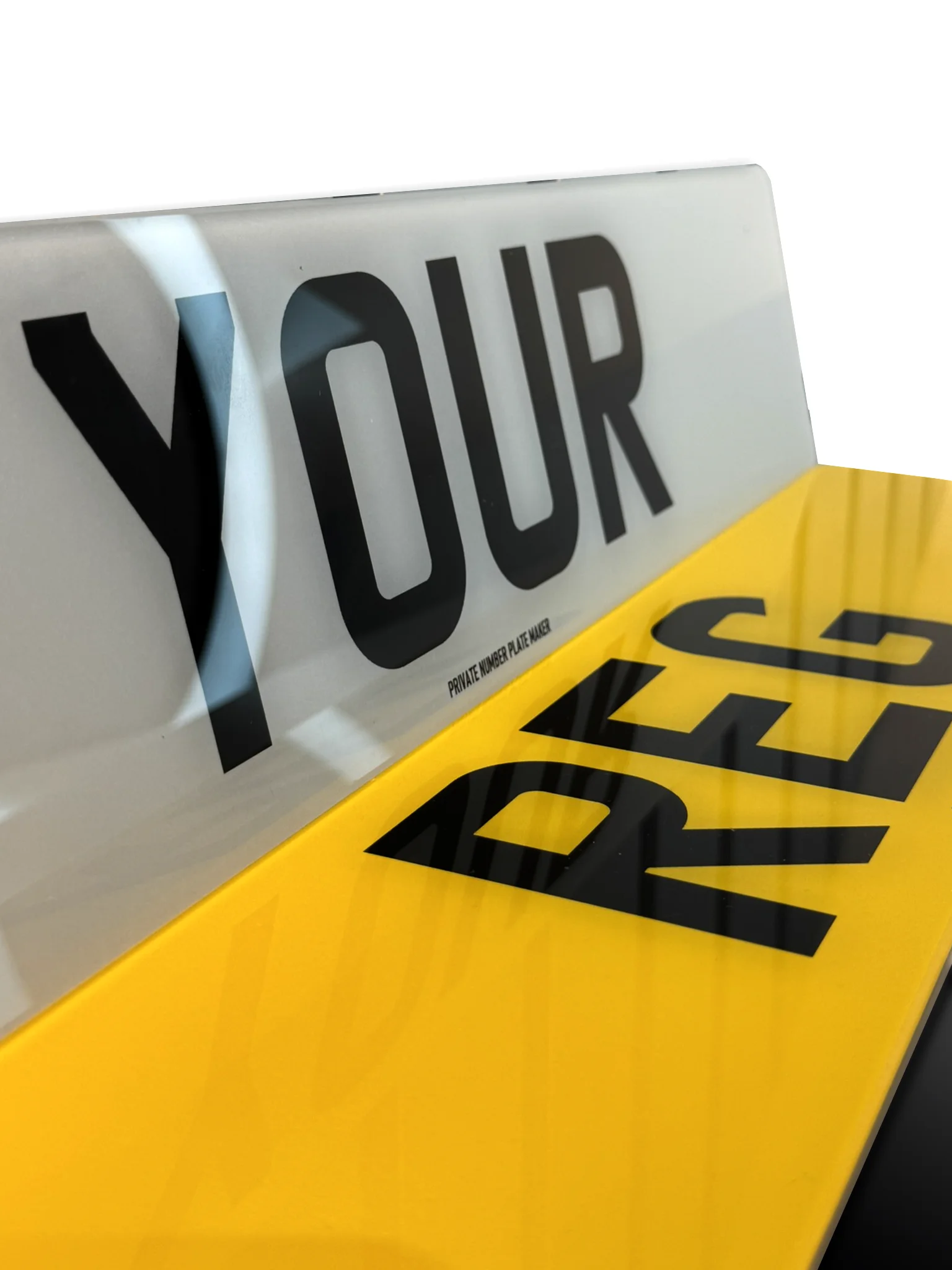
 Printed
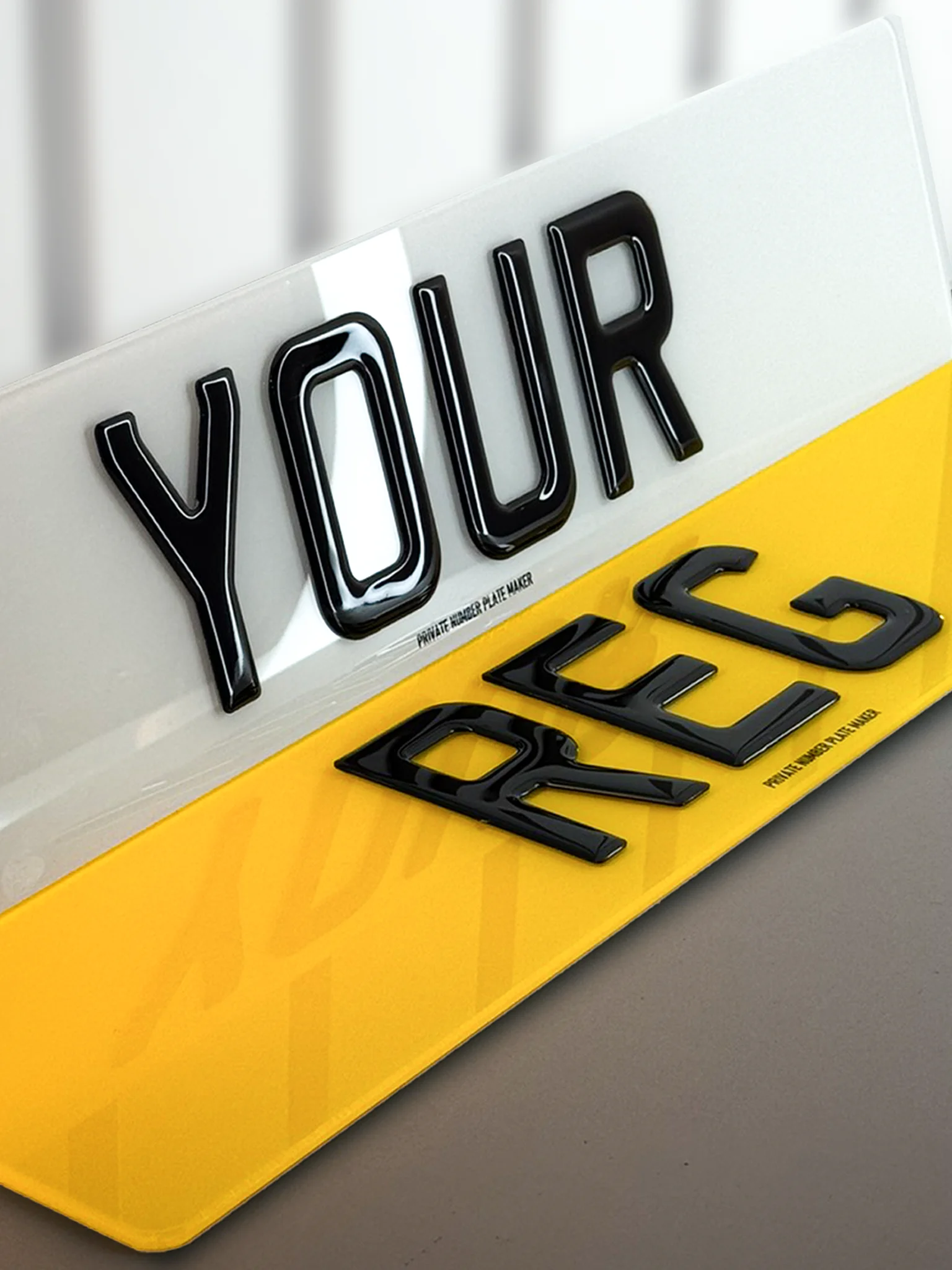 3D Plate
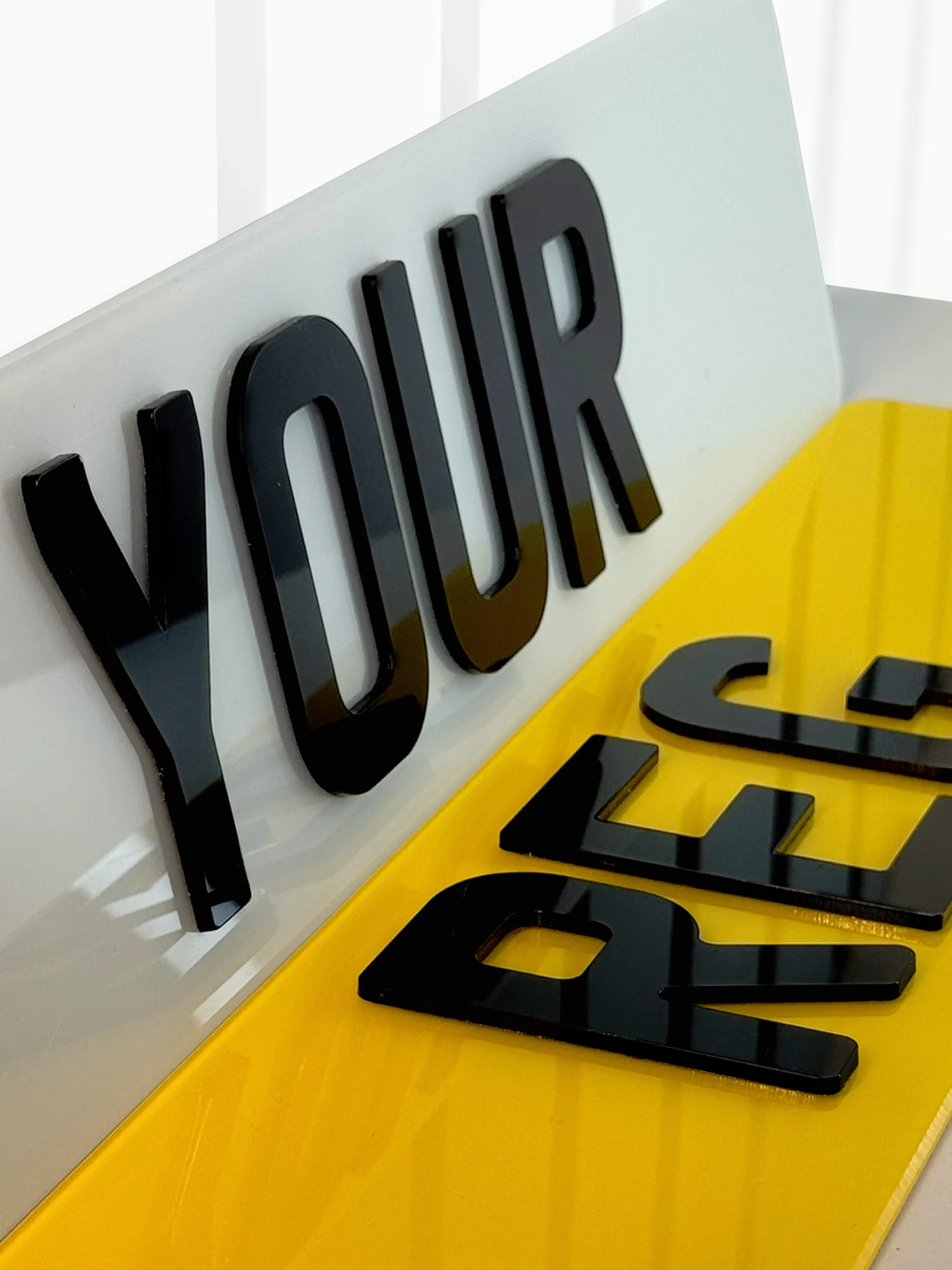 4D Plate
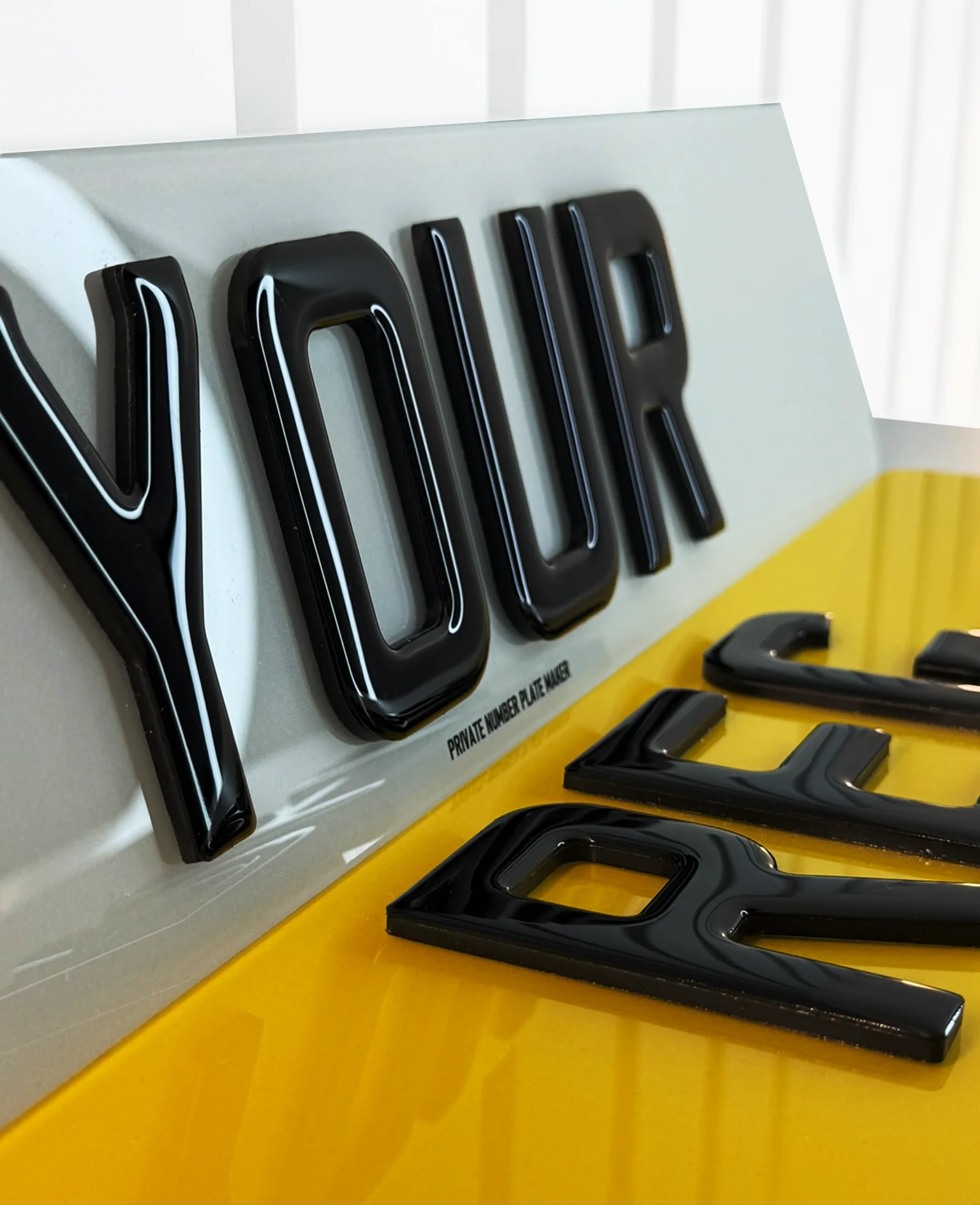 5D Plate
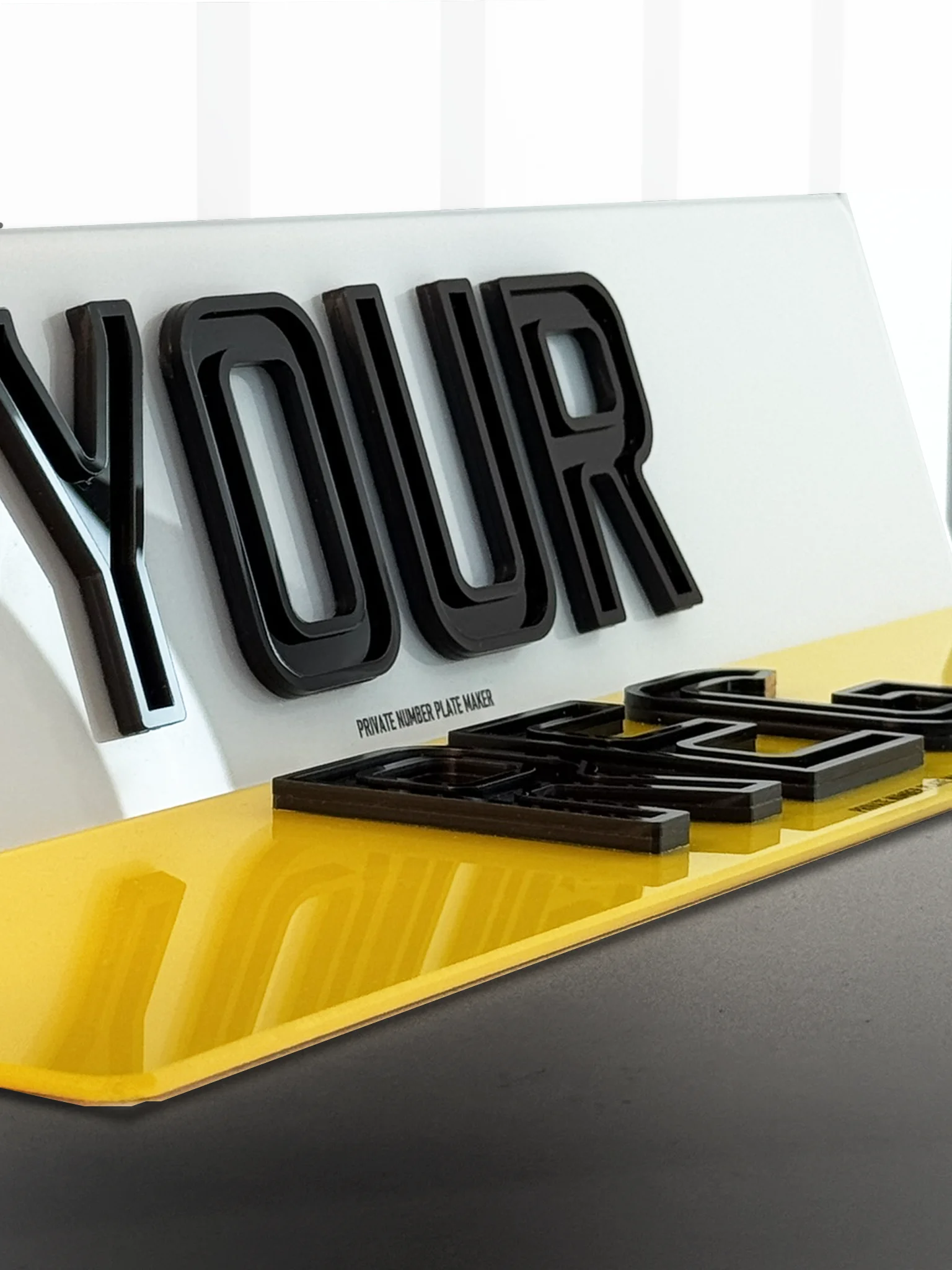 Ghost
Ghost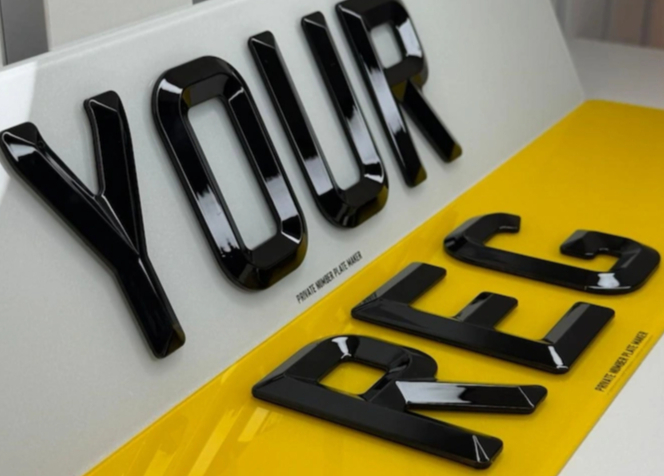 Bevel
BevelAre 3D Gel Plates Legal? 2026 UK Regulations Guide
Summary
Yes, 3D gel number plates are legal in the UK in 2026, provided they meet specific DVLA regulations and British Standard requirements. The key compliance factors are solid black characters without highlighting effects, the mandatory Charles Wright font, correct character spacing and dimensions, BS AU 145e-certified reflective materials, and proper supplier markings including the RNPS identification number. Plates manufactured before September 2021 under the previous BS AU 145d standard remain legal for existing vehicles, but all new plates from September 2021 onwards must comply with BS AU 145e:2018.
At Private Number Plate Maker Ltd, we manufacture every 3D gel plate on-site at our Ilford workshop using BS AU 145e-certified materials and the correct Charles Wright 2001 font. As a DVLA-registered number plate supplier (RNPS ID: 75449), we verify all required documents before production and ensure every plate meets the legal requirements for MOT compliance and ANPR readability. Our same-day collection service in Ilford and next-day UK delivery means you can get fully compliant 3D gel plates quickly without compromising on legality.
The Short Answer: Yes, 3D Gel Plates Are Legal in 2026
Despite rumours circulating on social media, 3D gel number plates remain 100% road-legal in the UK throughout 2026. The British Number Plate Manufacturers Association (BNMA) and DVLA have confirmed that 3D gel digits are legal under BS AU 145e, providing they create no highlighting or three-dimensional effects that interfere with readability. The critical distinction is between compliant 3D gel plates (solid black, UV-cured resin gel) and non-compliant plates (reflective coatings, ANPR-proof treatments, incorrect fonts).
Legal Framework: What the Regulations Actually Say
Road Vehicles (Display of Registration Marks) Regulations 2001
The primary legislation governing number plates in the UK is the Road Vehicles (Display of Registration Marks) Regulations 2001. Regulation 16 specifies that registration plates must not be treated in any way which renders the characters less easily distinguishable to the eye. This means:
- Characters must be solid black with no patterns, gradients, or highlighting effects
- The font must be the prescribed Charles Wright 2001 typeface
- Character spacing and dimensions must match the statutory requirements
- Background colours must be white (front) or yellow (rear) with no tints
BS AU 145e:2018 British Standard Requirements
From 1 September 2021, all new number plates must comply with BS AU 145e:2018. This standard specifies four key performance requirements that every plate must meet:
- Reflectivity - Plates must meet photometric requirements for visibility in all light conditions
- Impact Resistance - The plate must withstand stone chips and minor impacts without damage
- Weathering - Materials must resist fading, cracking, or deterioration from UV exposure (tested to 2,275 hours)
- NIR Compatibility - Near Infrared compatibility ensures ANPR cameras can read the plate accurately
What Makes 3D Gel Plates Legal vs Illegal
Compliant 3D Gel Plates (Legal)
Legal 3D gel plates have the following characteristics:
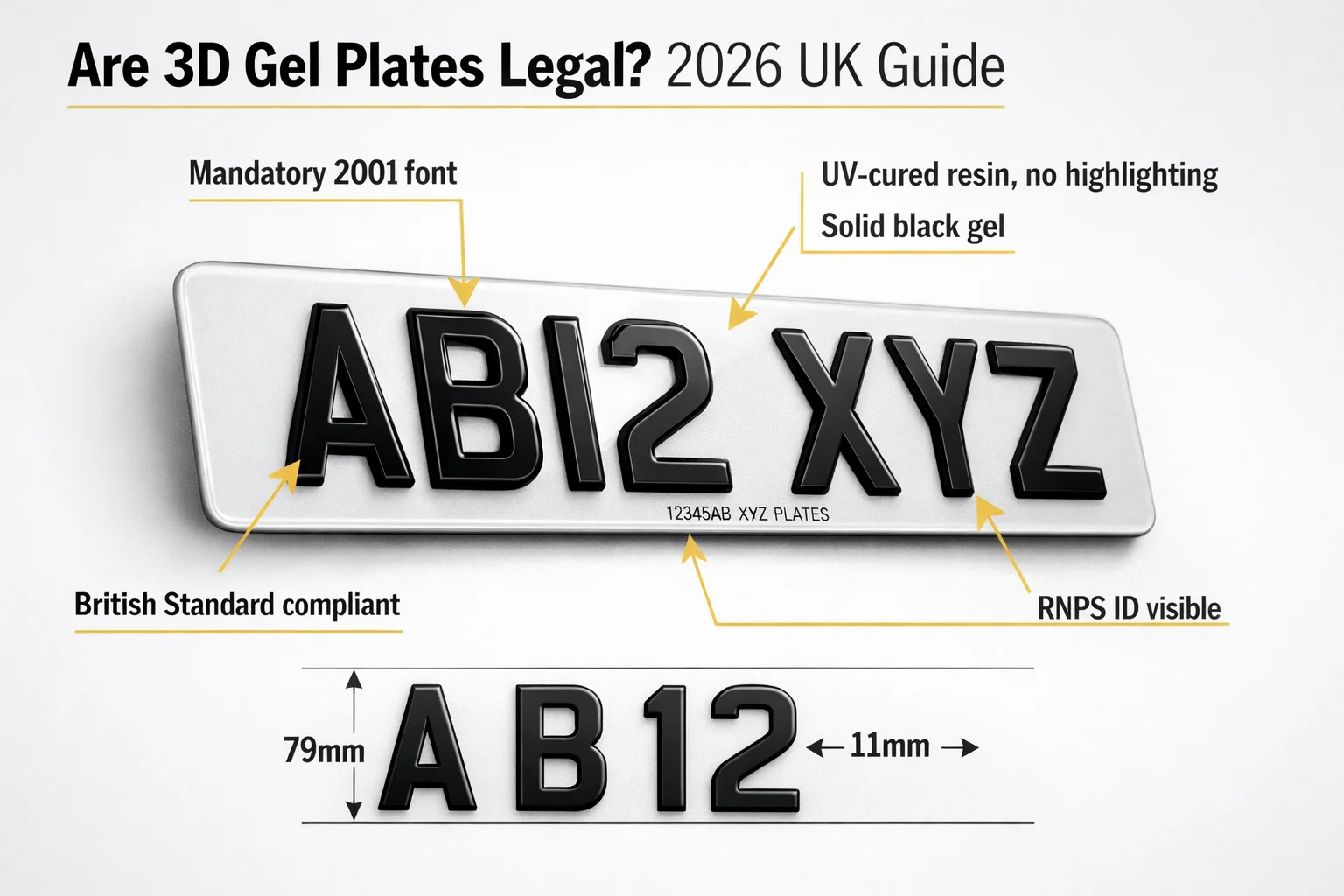
- Solid black gel characters - The UV-cured resin gel is clear, allowing the black acrylic base to show through without any highlighting effect
- Charles Wright 2001 font - The mandatory typeface introduced in 2001 for ANPR readability
- Correct dimensions - 79mm character height, 50mm width (excluding 'I' and '1'), 14mm stroke thickness, 11mm spacing between characters
- BS AU 145e certification - Plate carries the British Standard mark and supplier identification
- Proper margins - Minimum 11mm margins around all edges of the plate
- Reflective background - Front plates white reflective, rear plates yellow reflective
Non-Compliant 3D Gel Plates (Illegal)
Illegal 3D gel plates typically have one or more of these issues:
- Highlighting effects - Gel that creates a shadow or 3D appearance making characters harder to read
- Wrong font - Any typeface other than Charles Wright 2001
- Incorrect spacing - Characters too close together or too far apart
- Non-reflective materials - Plates that don't meet BS AU 145e reflectivity standards
- Missing supplier marks - No RNPS identification or BS AU 145e certification
- Tinted backgrounds - Any colour treatment other than standard white or yellow
Character Dimensions and Spacing Requirements
For standard car number plates, the following measurements are mandatory under the Road Vehicles Regulations 2001:
| Specification | Measurement |
|---|---|
| Character height | 79mm |
| Character width | 50mm (excluding 'I' and '1') |
| Stroke thickness | 14mm |
| Spacing between characters | 11mm |
| Age identifier gap | 33mm |
| Minimum margins | 11mm |
Motorcycle plates have different requirements (64mm character height) and are subject to separate regulations.
MOT Compliance for 3D Gel Plates
3D gel number plates can pass the MOT test if they meet all DVLA requirements. During the MOT inspection, testers check:
- Characters are easily readable from a reasonable distance
- Font matches the prescribed Charles Wright typeface
- No cracks, discolouration, or damage affecting legibility
- Supplier markings are present and visible
- Plate is securely attached to the vehicle
Plates that fail any of these checks will result in an MOT failure, and you'll need replacement plates before the vehicle can pass. Our plates are manufactured to exceed MOT requirements, using premium materials that maintain compliance throughout the plate's lifespan.
DVLA Document Requirements for 3D Gel Plate Purchases
Under Schedule 2 of the Road Vehicles Regulations 2001, all DVLA-registered suppliers must verify your identity and entitlement before manufacturing plates. At our Ilford workshop, we require one or more of the following documents:
- V5C Registration Certificate (logbook) - Shows you're the registered keeper
- V750 Certificate of Entitlement - For new private registrations
- V778 Retention Document - For registrations on retention
- V948 Authorisation Letter - From DVLA or auction house
- Valid driving licence - Photocard or paper licence with matching address
- Passport - As secondary identity verification
Important: Bank statements, utility bills, and screenshots are not accepted as proof of entitlement. We verify all documents in person at our Ilford workshop or through our secure encrypted upload system before production begins.
Penalties for Illegal Number Plates
The consequences of fitting non-compliant number plates are significant:
Fixed Penalty Notice
£100 fine for minor infringements
Maximum Statutory Fine
Up to £1,000 (Level 3 on the standard scale) under Section 42 of the Vehicle Excise and Registration Act 1994
MOT Failure
Vehicle cannot pass MOT with illegal plates
Vehicle Seizure
In serious cases, police can seize the vehicle
The DVLA announced tightened enforcement rules alongside the March 2026 '26' plate launch, with increased warnings about illegal plate formats. Trading Standards and police forces have stepped up enforcement following the 2026 Parliamentary report on number plate regulation.
How We Ensure Compliance at Private Number Plate Maker Ltd
As a DVLA-registered number plate manufacturer (RNPS ID: 75449), we take compliance seriously at our Ilford workshop. Here's how we ensure every 3D gel plate meets legal requirements:
On-Site Manufacturing
Every plate is made at our Ilford workshop, not drop-shipped or outsourced. This gives us complete control over materials, font accuracy, and quality checks.
BS AU 145e-Certified Materials
We use only reflective substrates and UV-cured resin gel that meet the British Standard requirements for reflectivity, impact resistance, weathering, and NIR compatibility.
Document Verification
We check all required documents before production begins, following DVLA guidance for registered suppliers. This protects both you and us from legal issues.
Font Accuracy
Our equipment is calibrated to produce the exact Charles Wright 2001 font with correct character dimensions and spacing.
Supplier Markings
Every plate includes our RNPS identification number and BS AU 145e certification mark as required by law.
Common Misconceptions About 3D Gel Plates
Myth: "3D Plates Were Banned in 2021"
Fact: 3D gel plates were never banned. The BS AU 145e update in September 2021 clarified that plates must have solid black characters without highlighting effects, but 3D gel construction itself remains legal.
Myth: "Only 2D Plates Are MOT Legal"
Fact: Both 3D gel and 4D laser-cut plates are MOT legal when manufactured correctly. The MOT inspection focuses on readability and compliance, not whether characters have gel or acrylic depth.
Myth: "Any DVLA-Registered Supplier Can Make Legal Plates"
Fact: Not all registered suppliers follow the rules. Some cut corners on document verification or use non-compliant materials. Always check for BS AU 145e markings and RNPS identification on your plates.
Myth: "3D Gel Plates Fail ANPR Cameras"
Fact: Compliant 3D gel plates with clear gel over solid black characters pass ANPR checks without issue. Problems only arise with illegal modifications like reflective sprays or tinted gel.
2026 Enforcement Context
The DVLA launched the '26' registration series on 1 March 2026 alongside new warnings about illegal plate formats. This increased enforcement focus means:
- More roadside checks by police and ANPR systems
- Stricter MOT testing for plate compliance
- Higher penalties for repeat offenders
- Increased Trading Standards investigations of non-compliant suppliers
This makes it more important than ever to ensure your 3D gel plates are fully compliant from a legitimate DVLA-registered manufacturer.
Choosing Between 3D, 4D, and 5D Plates
If you're considering 3D gel plates, you may also be looking at 4D or 5D options. Here's a quick comparison:
| Feature | 3D Gel | 4D Laser-Cut | 5D Dual-Layer |
|---|---|---|---|
| Construction | UV-cured resin gel over black acrylic | 3mm laser-cut acrylic characters | 3mm acrylic + 2mm gel (5mm total) |
| Legal Status | Legal when compliant | Legal when compliant | Legal when compliant |
| Durability | High - gel resists UV fading | Very high - solid acrylic | Highest - combines both methods |
| Appearance | Subtle raised effect | Bold, sharp edges | Maximum depth and definition |
| Price Range | Mid-range | Premium | Highest |
All three options are legal when manufactured to BS AU 145e standards with correct font, spacing, and supplier markings.
Frequently Asked Questions
Yes, 3D gel number plates remain fully legal in the UK throughout 2026, provided they comply with DVLA regulations and the BS AU 145e:2018 British Standard. The key requirements are solid black characters without highlighting effects, the mandatory Charles Wright 2001 font, correct character dimensions (79mm height, 50mm width), and proper supplier markings including your RNPS identification number. At Private Number Plate Maker Ltd (RNPS ID: 75449), we manufacture every 3D gel plate on-site at our Ilford workshop using BS AU 145e-certified materials to ensure full legal compliance. BS AU 145e Explained →
Compliant 3D gel plates must meet several specific requirements under the Road Vehicles (Display of Registration Marks) Regulations 2001 and BS AU 145e:2018. Characters must be solid black UV-cured resin gel with no highlighting or shadow effects, use the Charles Wright 2001 font, have correct spacing (11mm between characters), and be mounted on reflective backgrounds (white front, yellow rear). The plate must also display the BS AU 145e certification mark and the supplier's RNPS ID. We verify all documents before production at our Ilford workshop to ensure every plate meets these standards. BS AU 145e Explained →
Yes, 3D gel plates will pass the MOT inspection if they're manufactured to DVLA-compliant specifications. MOT testers check that characters are easily readable, the font matches Charles Wright 2001, there's no damage affecting legibility, and supplier markings are visible. Non-compliant plates with highlighting effects, incorrect fonts, or missing BS AU 145e certification will fail. Our Ilford workshop produces 3D gel plates using premium materials that maintain compliance throughout their lifespan, giving you confidence at your next MOT. Number Plate Fitting Guide →
Fitting non-compliant number plates can result in a £100 Fixed Penalty Notice for minor infringements, or up to a £1,000 statutory fine under Section 42 of the Vehicle Excise and Registration Act 1994. More seriously, illegal plates will cause an MOT failure, and in extreme cases police can seize the vehicle. With increased DVLA enforcement around the 2026 '26' plate launch, it's essential to source plates only from DVLA-registered suppliers like us (RNPS ID: 75449) who verify documents and use BS AU 145e-certified materials. Number Plate Fines UK →
Yes, under Schedule 2 of the Road Vehicles Regulations 2001, all DVLA-registered suppliers must verify your identity and entitlement before manufacturing plates. At our Ilford workshop, we require documents such as your V5C logbook, V750/V778 certificate, or V948 authorisation letter, plus valid ID. We verify these in person or via secure upload before production begins. This legal requirement protects both you and us, ensuring plates are only made for authorised keepers. DVLA Document Requirements →
This guide references the following official and verified sources:
Road Vehicles (Display of Registration Marks) Regulations 2001
legislation.gov.ukBritish Standards Institution: BS AU 145e:2018
knowledge.bsigroup.comBritish Number Plate Manufacturers Association (BNMA)
bnma.orgVehicle Excise and Registration Act 1994
legislation.gov.ukDVLA INF104 Vehicle Registration Numbers and Number Plates
gov.uk