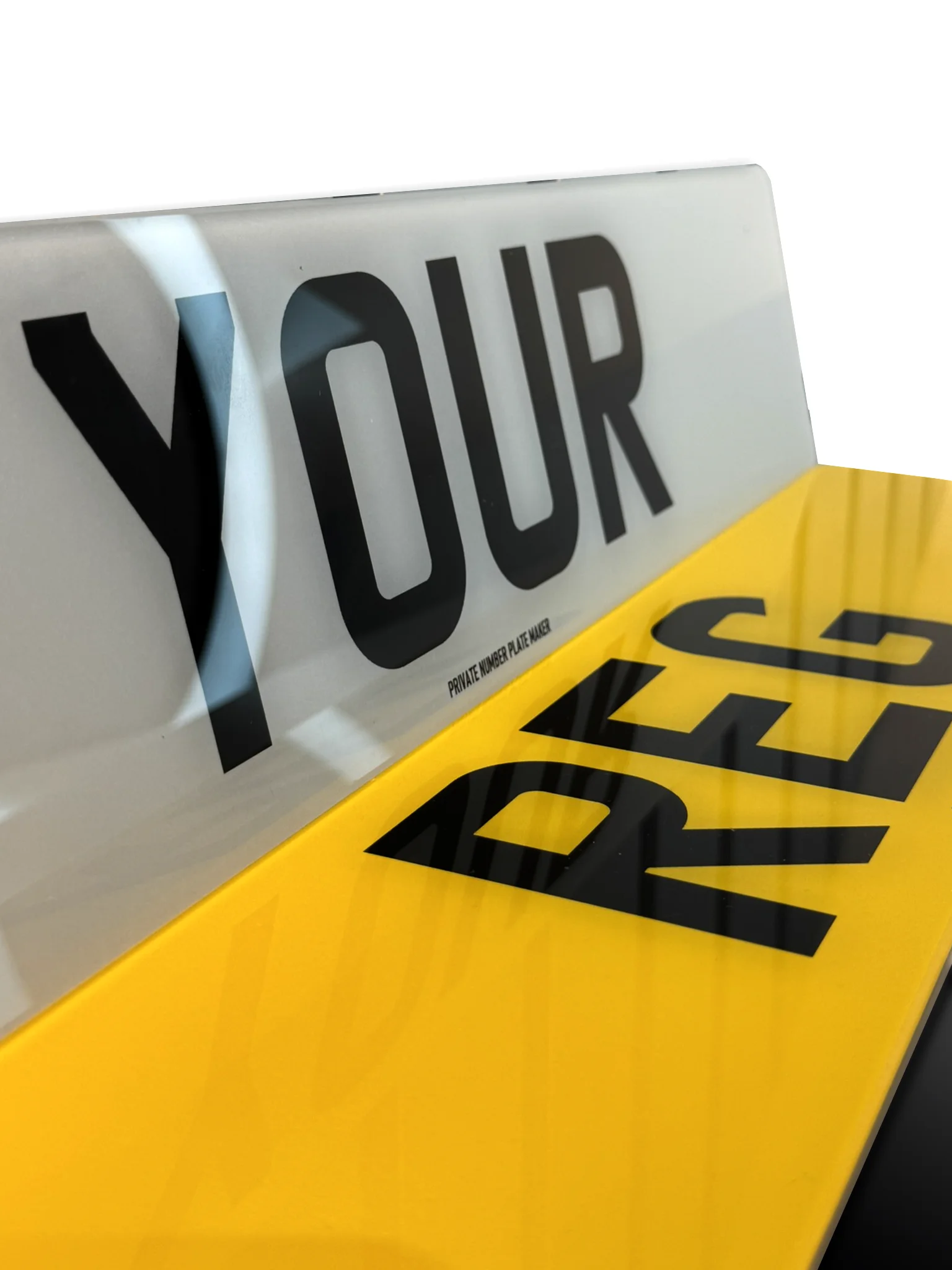
 Printed
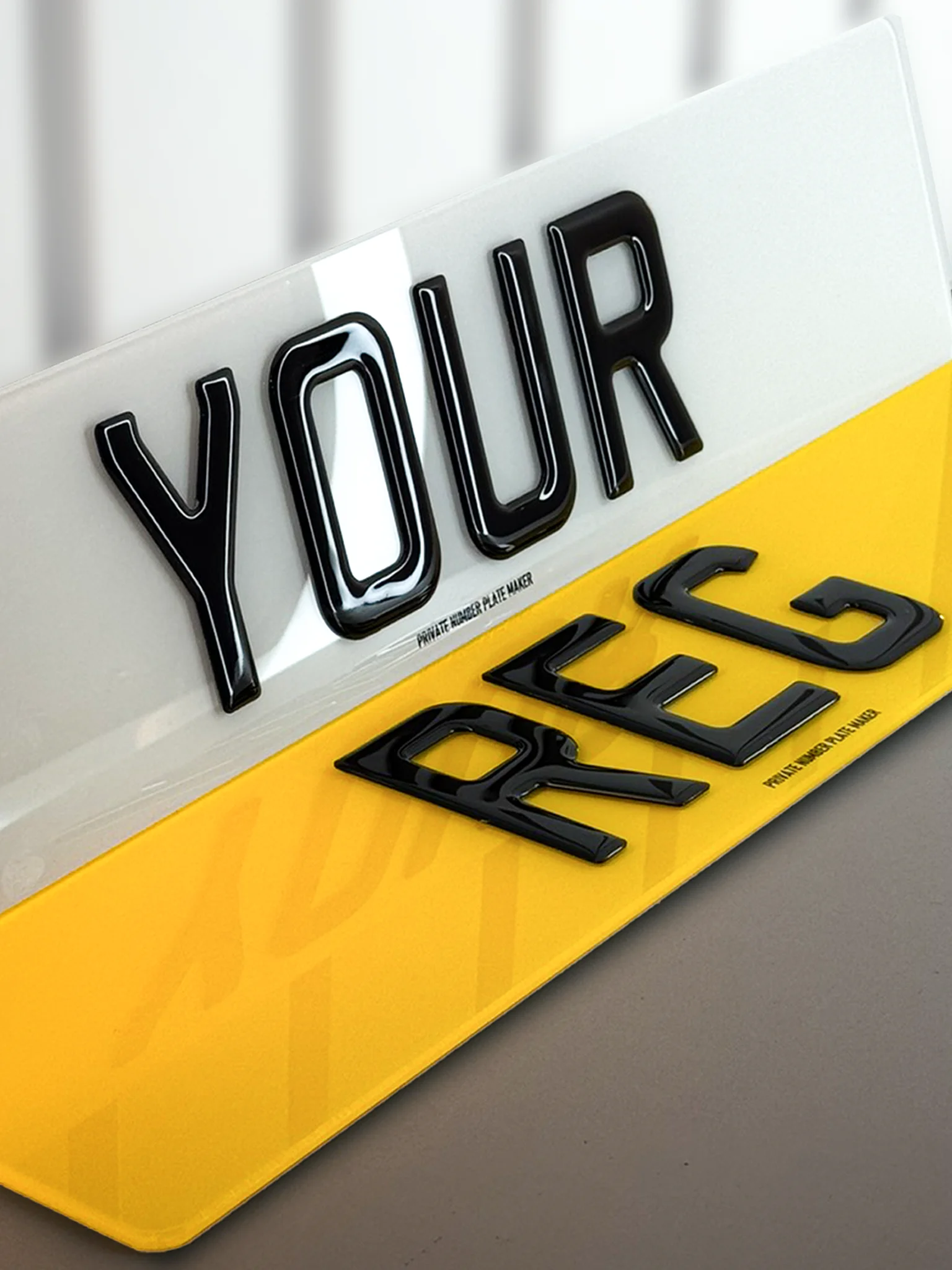 3D Plate
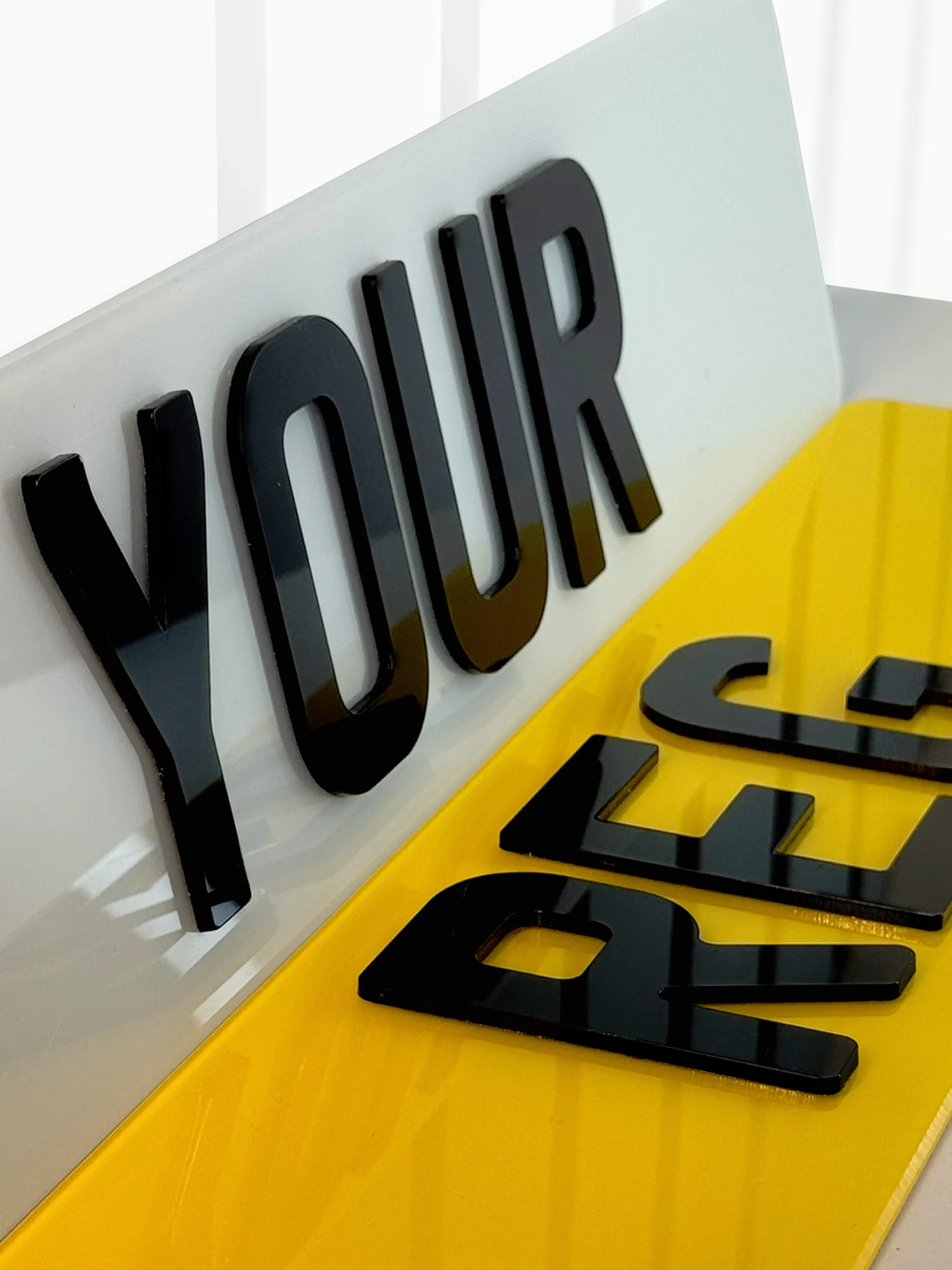 4D Plate
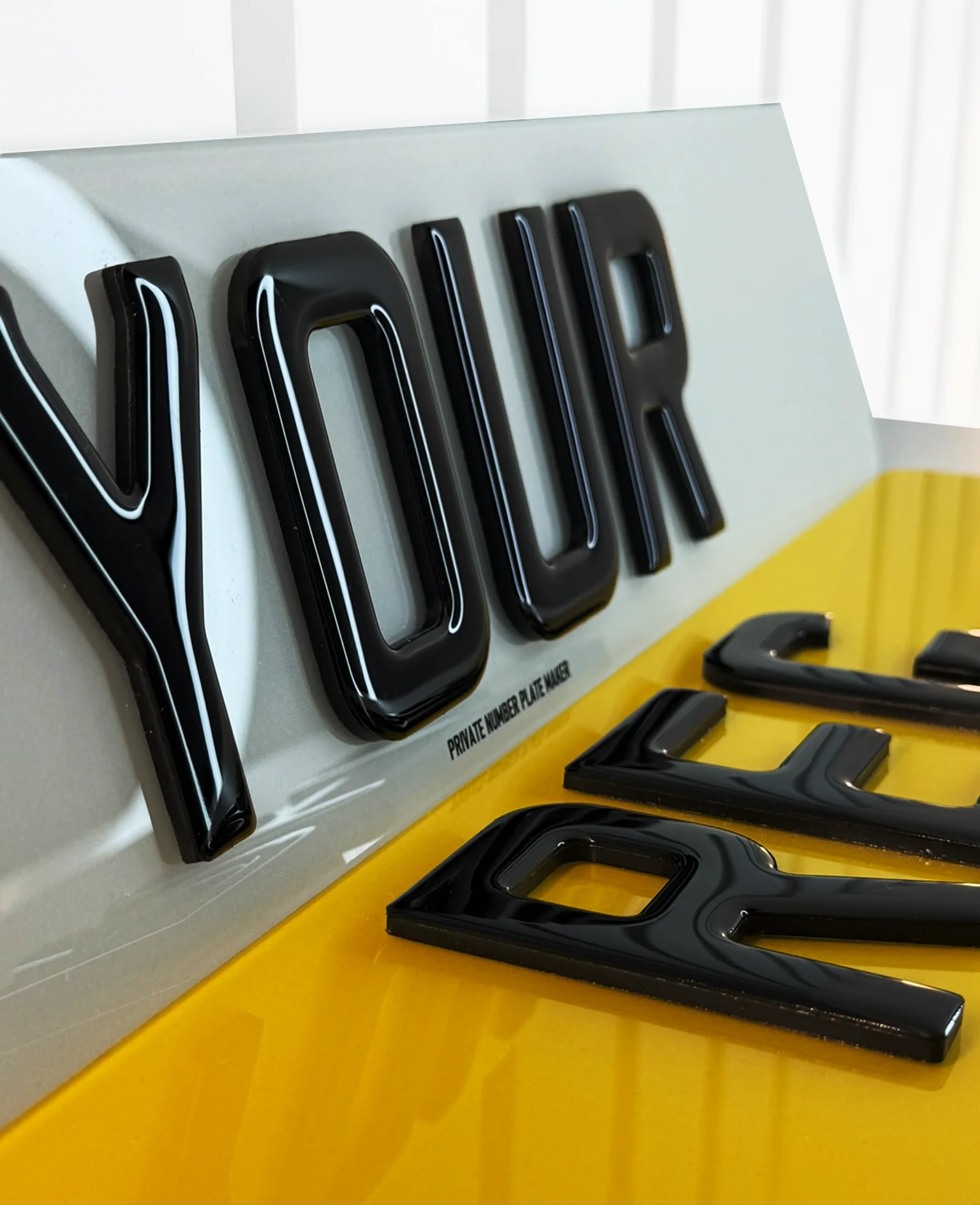 5D Plate
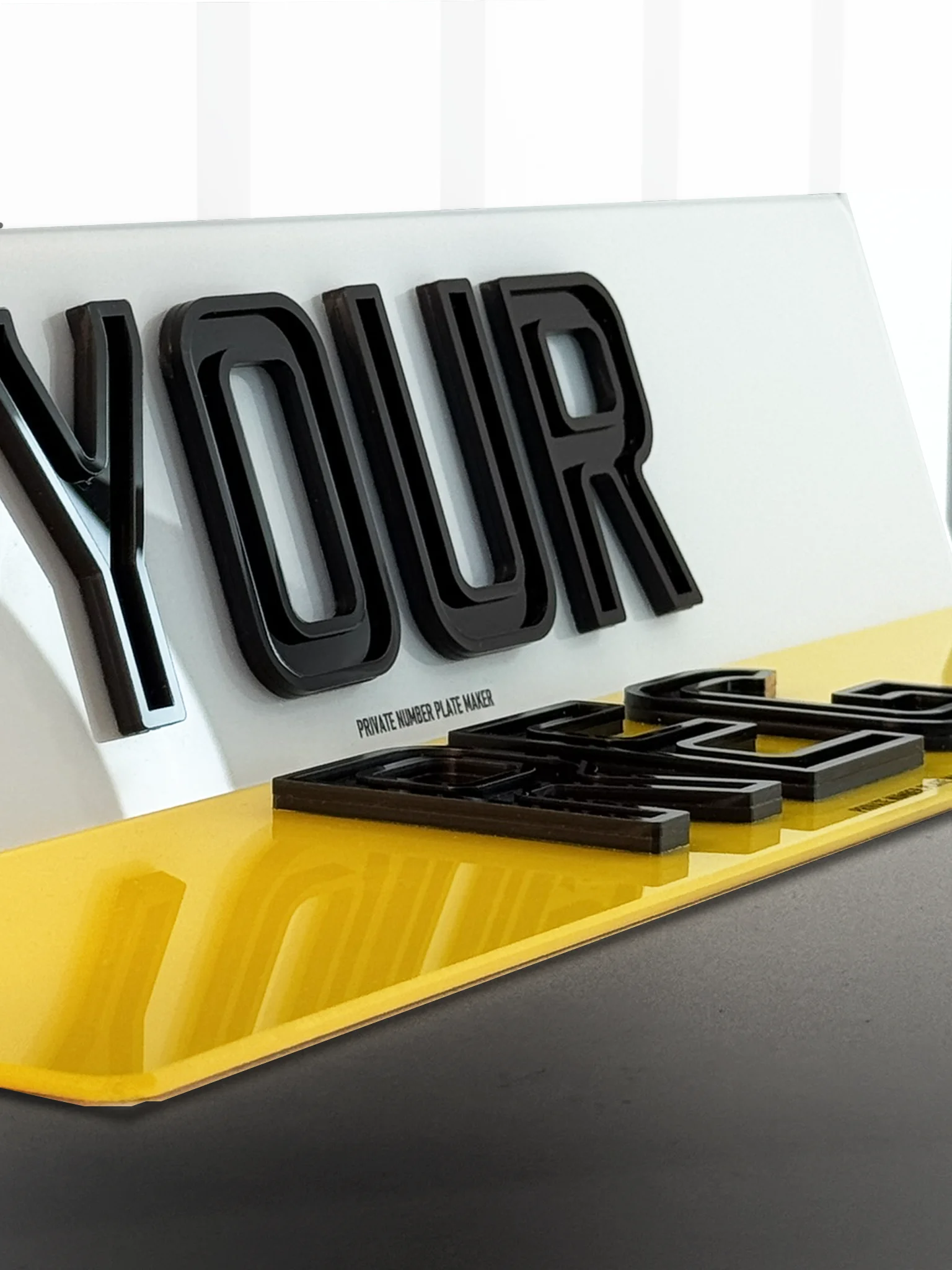 Ghost
Ghost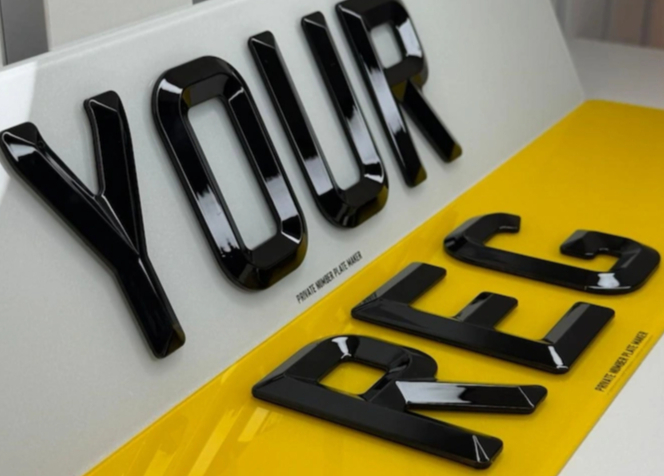 Bevel
BevelAre 5D Number Plates Legal? 2026 UK Regulations & Thickness Guide
Summary
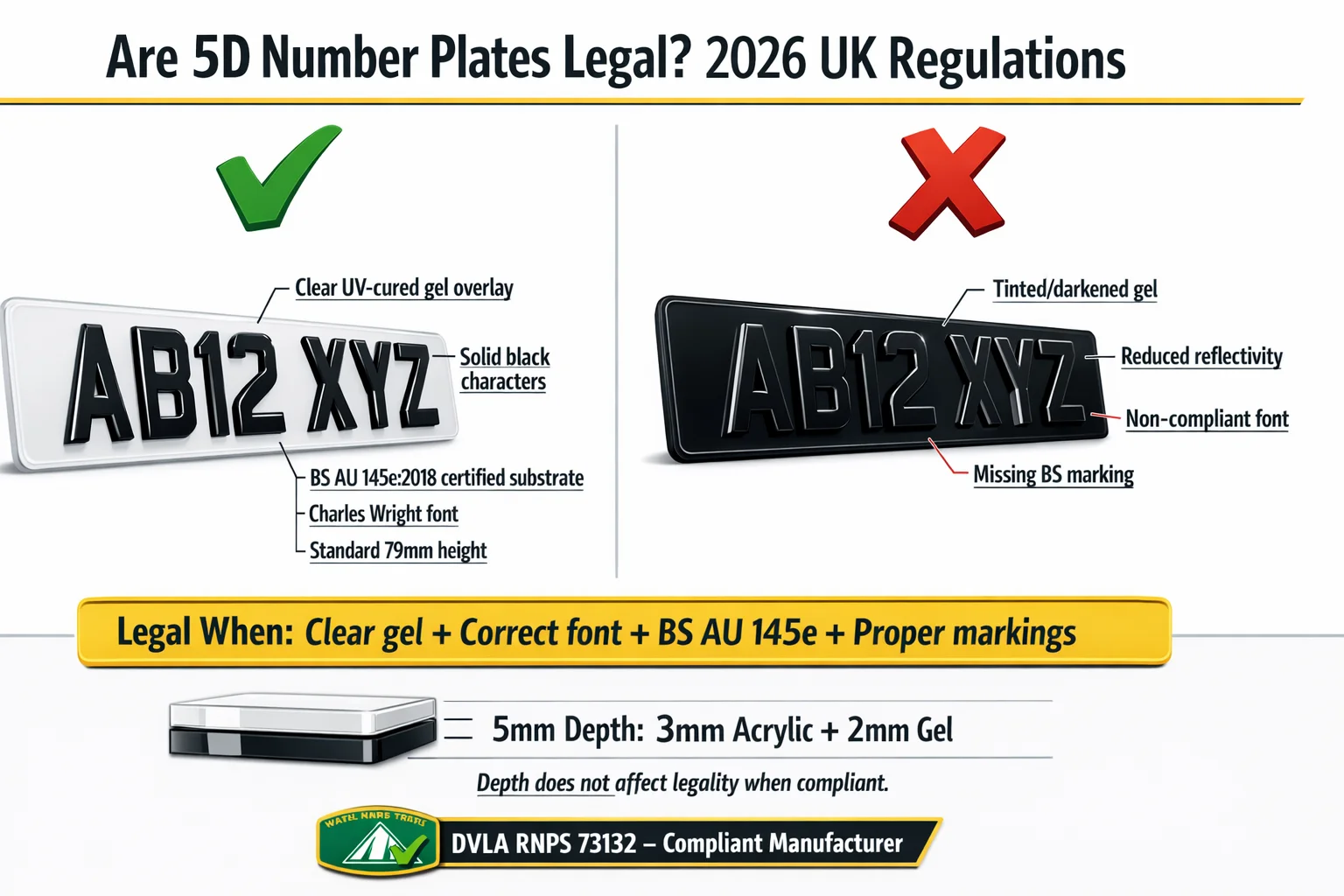
Yes, 5D number plates are legal in the UK when manufactured to meet all requirements of the Road Vehicles (Display of Registration Marks) Regulations 2001 and using BS AU 145e:2018 certified materials. The dual-layer construction - 3mm laser-cut acrylic base plus 2mm UV-cured gel overlay creating 5mm total character depth - does not affect legality provided the gel overlay is clear (not tinted), characters are solid black, the mandatory Charles Wright font is used, standard dimensions are maintained (79mm height, 50mm width, 11mm spacing), and full retroreflective performance is preserved for ANPR readability.
5D Number Plates Explained Guide
The critical compliance factors for 5D plates are identical to all UK number plates: certified substrate, correct font, proper dimensions, maintained reflectivity, and required markings. The 5mm character depth itself is not regulated; what matters is that raised elements do not obscure characters, interfere with reflectivity, or breach spacing requirements. Plates manufactured with tinted gel, incorrect fonts, or non-certified materials are illegal regardless of the "5D" designation.
What Are 5D Number Plates?
Before addressing legality, it is helpful to understand what defines a 5D number plate.
Dual-Layer Construction Explained
5D number plates feature characters constructed from two distinct layers:
Base Layer: 3mm Laser-Cut Acrylic
- Precision-cut from polymethyl methacrylate (PMMA) sheet
- Forms the foundational character shape using the Charles Wright font
- Provides sharp, geometric edge definition
- Bonded securely to the reflective substrate
Overlay Layer: 2mm UV-Cured Gel
- Transparent UV-cured polyurethane resin applied over the acrylic base
- Creates a glossy, domed finish that enhances light reflection
- Adds protective coating resistant to minor abrasion
- Cured to form a durable, optically clear surface
Combined Specification: 5mm Total Depth
- Characters stand 5mm proud of the plate substrate
- Merges 4D-style sharp edges with 3D-style glossy finish
- Delivers maximum visual prominence while maintaining compliance
Marketing Terminology Note
The "5D" designation is a marketing term, not a regulatory classification. You may encounter the same specification listed as "4D 5mm number plates", "Dual-layer 4D plates", or "4D with gel overlay". Always confirm the actual construction details rather than relying solely on the product name.
The Short Answer: Yes, 5D Plates Can Be Legal
5D number plates are legal in the UK when they meet all standard number plate requirements. The dual-layer construction itself does not breach any regulation. Legality depends entirely on manufacturing quality and compliance with existing standards, not on the number of layers or total character depth.
Key Compliance Checklist for Legal 5D Plates
- YesBS AU 145e:2018 certified substrate - The reflective base material must meet current British Standard requirements
- YesCharles Wright font - Mandatory typeface introduced in 2001, required for all characters
- YesStandard character dimensions - 79mm height (cars), 50mm width, 14mm stroke, 11mm spacing
- YesClear, untinted gel overlay - The 2mm gel must not reduce reflectivity or obscure characters
- YesSolid black characters - No gradient, translucent, or coloured characters on standard plates
- YesCorrect background colours - White front plates, yellow rear plates
- YesRequired markings - BS AU 145e:2018 marking, supplier name, postcode, and RNPS ID
- YesANPR readability - Plates must remain detectable by Automatic Number Plate Recognition cameras
If any of these requirements are not met, the plate is illegal regardless of whether it is labelled "5D", "4D", or any other designation.
Legal Framework: Regulations Governing 5D Plates
Understanding the specific regulations helps clarify why 5D plates can be compliant when manufactured correctly.
Road Vehicles (Display of Registration Marks) Regulations 2001
This statutory instrument sets the fundamental requirements for all number plates used on UK roads.
Regulation 13: Character Requirements
Mandates that characters must be:
- Clearly visible and legible
- Formed in the prescribed font (Charles Wright)
- Of specified dimensions: 79mm height for cars, 50mm width (excluding 'I' and '1'), 14mm stroke thickness
- Spaced 11mm apart between characters, with 33mm gap for age identifiers
- Positioned with minimum 11mm margins around plate edges
Regulation 16: Material Requirements
Requires that plates must:
- Be made of reflective material
- Meet performance standards for retroreflection
- Not be treated with substances that reduce reflectivity
- Comply with applicable British Standard specifications
Relevance to 5D Plates
The dual-layer construction of 5D plates complies with these regulations when the acrylic base is cut to Charles Wright font specifications, character dimensions remain within required tolerances despite added depth, the gel overlay is clear and does not reduce substrate reflectivity, and spacing and margins are maintained without obstruction from raised elements.
BS AU 145e:2018 British Standard
All number plates for UK road use must use substrates certified to BS AU 145e:2018, which mandates four critical performance requirements:
- Retroreflectivity - Adequate light reflection back to source for camera and driver visibility
- Impact Resistance - Ability to withstand stone chips and minor impacts without cracking
- Weathering - Resistance to UV radiation, rain, snow, and temperature extremes without fading or deterioration
- NIR Compatibility - Detectability by near-infrared wavelengths used by ANPR cameras
How 5D Construction Maintains BS AU 145e Compliance
- The certified substrate forms the foundation; acrylic and gel are applied only to character areas
- Clear gel overlay allows underlying reflectivity to function unimpeded
- Raised elements do not interfere with NIR detection when materials are properly selected
- Impact resistance may be enhanced by the layered acrylic and gel construction
Key Compliance Requirements for 5D Plates
Charles Wright Font Requirement
The mandatory Charles Wright font, introduced in 2001, must be used for all characters on 5D plates. This specific typeface is required because:
- Its character shapes are optimised for ANPR pattern recognition
- Stroke widths and spacing ensure consistent readability across camera systems
- Deviations (decorative fonts, condensed variants, custom modifications) breach Regulation 13
For 5D Plates: The acrylic base layer must be cut to exact Charles Wright specifications, gel overlay must not distort or obscure the underlying font shape, and character profiles must remain clearly recognisable despite the glossy finish.
Character Dimensions and Spacing
Standard dimensions apply regardless of character depth:
| Specification | Requirement | Application to 5D Plates |
|---|---|---|
| Character height | 79mm (cars), 64mm (motorcycles) | Acrylic base cut to exact height |
| Character width | 50mm (excluding 'I' and '1') | Laser-cutting ensures precision |
| Stroke thickness | 14mm | Maintained in acrylic layer |
| Character spacing | 11mm between characters | Gel application must not encroach on spacing |
| Age identifier gap | 33mm | Preserved in layout design |
| Margins | 11mm minimum | Raised elements must not extend into margin areas |
Critical Point:
The 5mm total character depth does not alter these dimensional requirements. Depth is measured perpendicular to the plate surface; regulations govern planar dimensions (height, width, spacing).
Reflectivity and BS AU 145e:2018 Compliance
The most common compliance issue with premium plates involves reflectivity. For 5D plates to remain legal:
Gel Overlay Must Be Clear and Untinted
- Transparent UV-cured resin allows light to reach and reflect from the certified substrate
- Tinted, smoked, or darkened gel reduces reflectivity and breaches Regulation 16
- Any coating designed to reduce visibility is illegal regardless of marketing claims
Reflective Substrate Must Remain Functional
- Gel and acrylic are applied only to character areas
- The reflective substrate between characters must remain fully exposed and functional
- BS AU 145e:2018 marking must be visible and legible
Testing Reflectivity
A simple torch test can help verify compliance: in dim light, shine a light at the plate from camera angle (15-30 degrees). Legal plates will reflect light clearly back toward the source across the entire surface.
Required Markings on 5D Plates
All legal number plates must display specific permanent markings:
BS AU 145e:2018 Standard Marking
- Must be present, typically bottom left or centre
- Must be embedded in the plate material, not applied as a sticker
- Must remain legible despite raised character elements
Supplier Identification
- Manufacturer name and postcode
- RNPS (Registered Number Plate Supplier) ID number
- Our plates display "RNPS 75449" as proof of DVLA registration
Placement Considerations for 5D Plates
- Markings must not be obscured by gel overflow or acrylic edges
- Raised elements should not interfere with marking legibility
- Quality manufacturing ensures markings remain clear and permanent
Thickness Considerations: Does 5mm Depth Affect Legality?
A common question is whether the 5mm character depth of 5D plates breaches any regulation.
No Regulatory Limit on Character Depth
The regulations specify planar dimensions, not perpendicular depth:
- Character height (79mm), width (50mm), spacing (11mm) are regulated
- Character depth (how far characters stand proud of the substrate) is not specified
- Therefore, 2mm (3D), 3mm (4D), or 5mm (5D) depths are all permissible
Practical Considerations
- Excessive depth could theoretically interfere with vehicle design or plate fitting
- However, 5mm is well within practical limits for standard number plate fixings
- No enforcement action has been taken against compliant 5mm-depth plates
Potential Issues to Avoid
Gel Overflow
If gel application extends beyond character boundaries, it could encroach on required spacing. Quality manufacturing controls gel dispensing to prevent overflow.
Character Distortion
If gel application distorts the underlying acrylic font shape, characters may become non-compliant. Proper curing and application techniques preserve font integrity.
Mounting Interference
In rare cases, very deep characters could interfere with plate brackets or surrounds. Standard 5mm depth rarely causes fitting issues; verify compatibility with your vehicle.
ANPR Compatibility: How 5D Plates Work with Cameras
Automatic Number Plate Recognition (ANPR) systems are central to UK traffic enforcement. Understanding how 5D plates interact with these systems addresses a key compliance concern.
How ANPR Detection Works
Multi-Spectrum Imaging
Modern ANPR cameras use:
- Visible light imaging for character shape recognition
- Near-infrared (NIR) wavelengths (700-1000nm) to detect retroreflective materials
- Pattern recognition algorithms trained on millions of plate images
BS AU 145e:2018 NIR Compatibility
Certified substrates are engineered to reflect NIR wavelengths specifically for camera detection. This requirement is independent of character construction method.
Why Compliant 5D Plates Work with ANPR
Clear Gel Preserves NIR Transmission
- Transparent UV-cured resin allows NIR wavelengths to pass through to the reflective substrate
- Light reflects back through the gel to the camera sensor
- No signal loss occurs when materials are properly selected
Character Definition Remains Clear
- Sharp acrylic edges provide well-defined character boundaries for pattern recognition
- Gel dome enhances light interaction without obscuring character shapes
- Algorithms recognise characters reliably when font and spacing are correct
Reflective Substrate Functions Fully
- The BS AU 145e:2018 substrate between characters remains fully exposed
- NIR reflection from these areas aids camera detection and plate localisation
- Overall plate reflectivity meets required thresholds
Testing ANPR Readability
Drive-Through Test
If possible, drive through a known ANPR location (car park entry, toll booth, speed camera zone). Legal 5D plates should be read consistently by the system.
Professional Verification
Some suppliers offer ANPR readability testing as part of quality control. Ask whether your plates have been tested before dispatch.
Red Flag:
If your plates consistently fail to register while others are read successfully, this may indicate non-compliance (tinted gel, incorrect font, poor reflectivity).
MOT Compliance: Will 5D Plates Pass Inspection?
Vehicles with compliant 5D plates pass MOT inspection without issue. Understanding the inspection criteria helps ensure your plates meet tester expectations.
MOT Inspection Points for Number Plates
Under the MOT Inspection Manual, testers check:
- Reflectivity - Plates must be made of reflective material meeting BS AU 145e:2018. Testers may use visual inspection or reflectivity meters. Clear gel overlay does not impair this requirement.
- Character Formation - Characters must be correctly formed using Charles Wright font. Dimensions and spacing must meet regulatory specifications. Raised elements must not distort character shapes.
- Condition - Plates must not be obscured, faded, cracked, or deteriorated. Gel surface should remain clear without yellowing or clouding. Acrylic edges should not be chipped to the point of character distortion.
- Markings - BS AU 145e:2018 marking and supplier details must be present and legible. Markings must be permanent, not applied as removable stickers.
Common 5D Plate MOT Failures (and How to Avoid Them)
-
No
Tinted or Darkened Gel
Failure reason: Reduced reflectivity breaches BS AU 145e requirements
Prevention: Ensure gel overlay is clear and untinted -
No
Gel Delamination or Cracking
Failure reason: Damaged characters affect legibility
Prevention: Choose quality manufacturing; avoid abrasive cleaning -
No
Missing or Obscured Markings
Failure reason: Required markings not visible
Prevention: Verify markings are present and legible before fitting -
No
Incorrect Font or Dimensions
Failure reason: Characters do not meet Regulation 13 specifications
Prevention: Purchase only from DVLA-registered suppliers who verify compliance
If your 5D plates fail MOT, you cannot legally drive the vehicle except to pre-booked repair facilities or your home address (if current certificate has not expired). Replacement with compliant plates is required before retest.
Common Misconceptions About 5D Plate Legality
Myth: "5D plates are illegal because they are too thick"
Fact: Regulations specify character height, width, and spacing - not depth. 5mm character depth is permissible when other requirements are met.
Myth: "Gel overlays always reduce reflectivity"
Fact: Clear, transparent UV-cured gel allows light to reach and reflect from the certified substrate. Only tinted or opaque coatings reduce reflectivity and breach regulations.
Myth: "Premium plates cannot be MOT compliant"
Fact: 3D, 4D, and 5D plates all pass MOT inspection when manufactured to BS AU 145e:2018 standards with correct font, dimensions, and markings.
Myth: "ANPR cameras cannot read raised characters"
Fact: ANPR systems detect the reflective substrate and character shapes. Compliant 5D plates maintain full NIR compatibility and character definition.
Myth: "If it looks different, it must be illegal"
Fact: Aesthetic variations (glossy finish, raised depth) do not determine legality. Compliance depends on meeting specific regulatory requirements, not appearance alone.
How to Verify Your 5D Plates Are Compliant
Use this practical checklist to assess your 5D plates before fitting or if questioned about compliance.
Supplier Verification
- YesDVLA RNPS Registration - Ask for the supplier's Registered Number Plate Supplier ID. Our RNPS ID is 75449. Verify they hold current registration.
- YesPhysical Workshop - Legitimate manufacturers have verifiable business addresses. We manufacture at our Castleview Gardens, Ilford workshop.
- YesDocument Verification - They must request and check your entitlement documents (V5C, V750, V778, etc.) before manufacturing.
Plate Inspection
- YesReflectivity Test - In dim light, shine a torch at the plate from camera angle. Legal plates reflect light clearly back toward the source.
- YesFont Check - Characters must use the mandatory Charles Wright typeface. Compare with official font samples online.
- YesDimension Verification - Measure character height (79mm), width (50mm), spacing (11mm). Raised depth does not alter these planar measurements.
- YesMarking Verification - Confirm BS AU 145e:2018 marking, supplier name, postcode, and RNPS ID are present and legible.
- YesGel Clarity - Ensure the gel overlay is clear and untinted. Any darkening or opacity indicates non-compliance.
Number Plate Maintenance Guide
Documentation
- YesRetention of Records - Keep purchase receipts, order confirmations, and supplier details. These provide evidence of compliance if questioned.
- YesCertification Requests - Ask suppliers for BS AU 145e:2018 batch certification documentation. Legitimate manufacturers can provide this.
Our Manufacturing Approach: Ensuring 5D Compliance at Our Ilford Workshop
At Private Number Plate Maker Ltd (RNPS ID: 75449), we manufacture compliant 5D plates on-site at our Castleview Gardens, Ilford workshop, ensuring full control over quality and regulatory adherence.
On-Site Production Controls
Substrate Verification
Every plate begins with BS AU 145e:2018 certified substrate from approved suppliers. We retain batch certification documentation for audit purposes.
Precision Laser-Cutting
Acrylic characters are cut using calibrated CNC equipment that follows digital templates of the Charles Wright font, ensures exact character dimensions and spacing, and creates clean edges without burrs or distortion.
Controlled Gel Application
Our UV-cured gel dispensing system deposits precise volumes to achieve consistent 2mm overlay, prevents overflow beyond character boundaries, and maintains optical clarity without bubbles or imperfections.
Quality Inspection
Every 5D plate undergoes checks for character dimensions and font accuracy, gel clarity and finish quality, reflectivity performance under controlled lighting, ANPR readability where test equipment is available, and correct placement of required markings.
Document Verification Process
Under Schedule 2 of the Road Vehicles Regulations 2001, we verify your identity and entitlement before manufacturing:
Accepted Documents
- V5C Registration Certificate, V750, V778, V948, or new vehicle supplement
- Plus valid UK driving licence or passport for identity verification
Verification Methods
- In-person verification for same-day collection at our Ilford workshop
- Secure encrypted upload for delivery orders
Record Retention
We retain verification records as required by DVLA RNPS regulations, ensuring accountability and traceability.
Same-Day Collection and Next-Day Delivery
Ilford Workshop Collection
Visit our Ilford location for face-to-face document verification, view 5D plate samples in person, watch your plates being manufactured, and immediate collection once production is complete.
UK-Wide Delivery
For customers outside East London: secure encrypted document upload for remote verification, plates manufactured to order and quality-checked, dispatched via tracked next-day delivery service, with packaging designed to protect raised elements during transit.
Frequently Asked Questions
Yes, 5D plates are legal when manufactured to meet Road Vehicles Regulations 2001 requirements and using BS AU 145e:2018 certified materials. The dual-layer construction itself does not affect legality.
No. Regulations specify character height, width, and spacing - not perpendicular depth. 5mm depth is permissible when other requirements are met.
No. Any gel overlay that reduces reflectivity or obscures characters breaches Regulation 16. Only clear, transparent gel is compliant.
Yes, compliant 5D plates pass MOT inspection. Testers check reflectivity, character formation, spacing, and required markings - all of which legal 5D plates satisfy.
Yes, when manufactured correctly. Clear gel allows NIR wavelengths to reach the reflective substrate, and sharp acrylic edges provide clear character definition for pattern recognition.
Verify: BS AU 145e:2018 marking present, clear untinted gel, Charles Wright font, standard dimensions, supplier RNPS ID, and successful reflectivity test.
Yes, you can fit 5D plates yourself using standard fixings. Ensure plates are positioned correctly (front: white; rear: yellow) and secured without obscuring markings.
Minor surface marks on gel may be polished carefully. If characters are cracked, gel is delaminating, or reflectivity is compromised, replacement with compliant plates is recommended.
Yes, 5D construction is compatible with the integrated green flash required for eligible pure electric vehicles. The green flash is incorporated into the substrate design.
£100 Fixed Penalty Notice, or up to £1,000 if prosecuted in court under Section 42 of the Vehicle Excise and Registration Act 1994, plus MOT failure and potential vehicle seizure.
Conclusion
5D number plates are legal in the UK when manufactured to meet all regulatory requirements. The dual-layer construction - 3mm laser-cut acrylic plus 2mm clear UV-cured gel creating 5mm total character depth - does not breach any regulation when:
- BS AU 145e:2018 certified substrate is used
- Charles Wright font and standard dimensions are maintained
- Gel overlay is clear and untinted
- Full reflectivity and ANPR readability are preserved
- Required markings are present and legible
The critical factor is manufacturing quality, not the "5D" designation itself. Purchase only from DVLA-registered suppliers who verify documents and guarantee compliance.
At Private Number Plate Maker Ltd (RNPS ID: 75449), we manufacture compliant 5D plates at our Ilford workshop, combining premium aesthetics with full legal compliance. Choose quality. Choose compliance. Choose confidence.
Is 5D Worth the Investment Guide | Replacement Number Plates UK Guide
This guide references the following official and verified sources:
Road Vehicles (Display of Registration Marks) Regulations 2001
Statutory instrument governing registration mark display
www.legislation.gov.ukVehicle Excise and Registration Act 1994 - Section 42
Enforcement powers and penalty provisions
www.legislation.gov.ukBritish Standards Institution - BS AU 145e:2018
Specification for Retroreflecting Number Plates
knowledge.bsigroup.comDVLA Official Guidance - Displaying Number Plates Rules
Official government guidance on number plate display requirements
DVLA Registered Number Plate Supplier (RNPS) Requirements
Official DVLA requirements for number plate suppliers
Manufacturer Technical Specifications
Technical datasheets for acrylic (PMMA) and UV-cured polyurethane resin materials
www.bnma.org