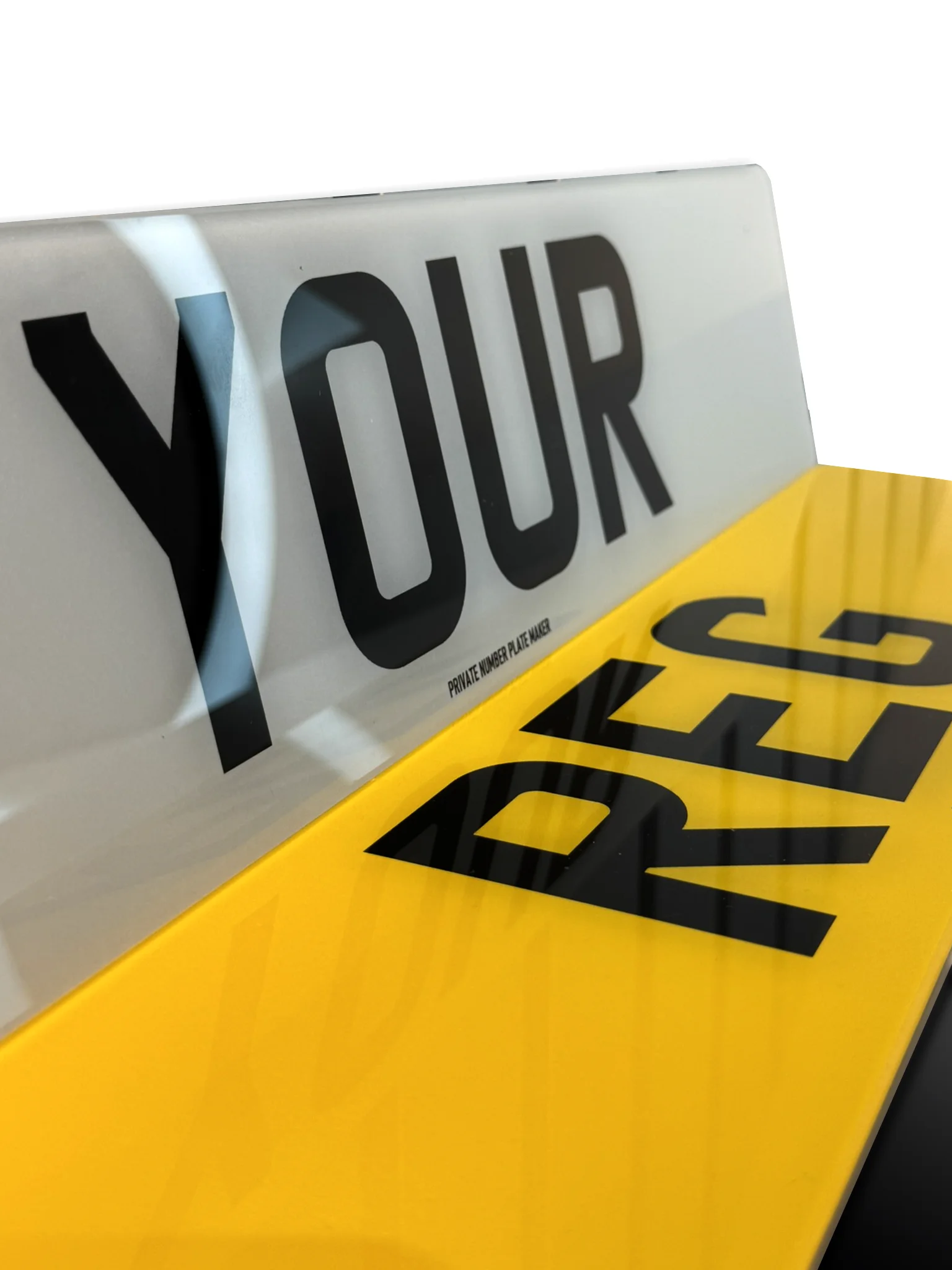
 Printed
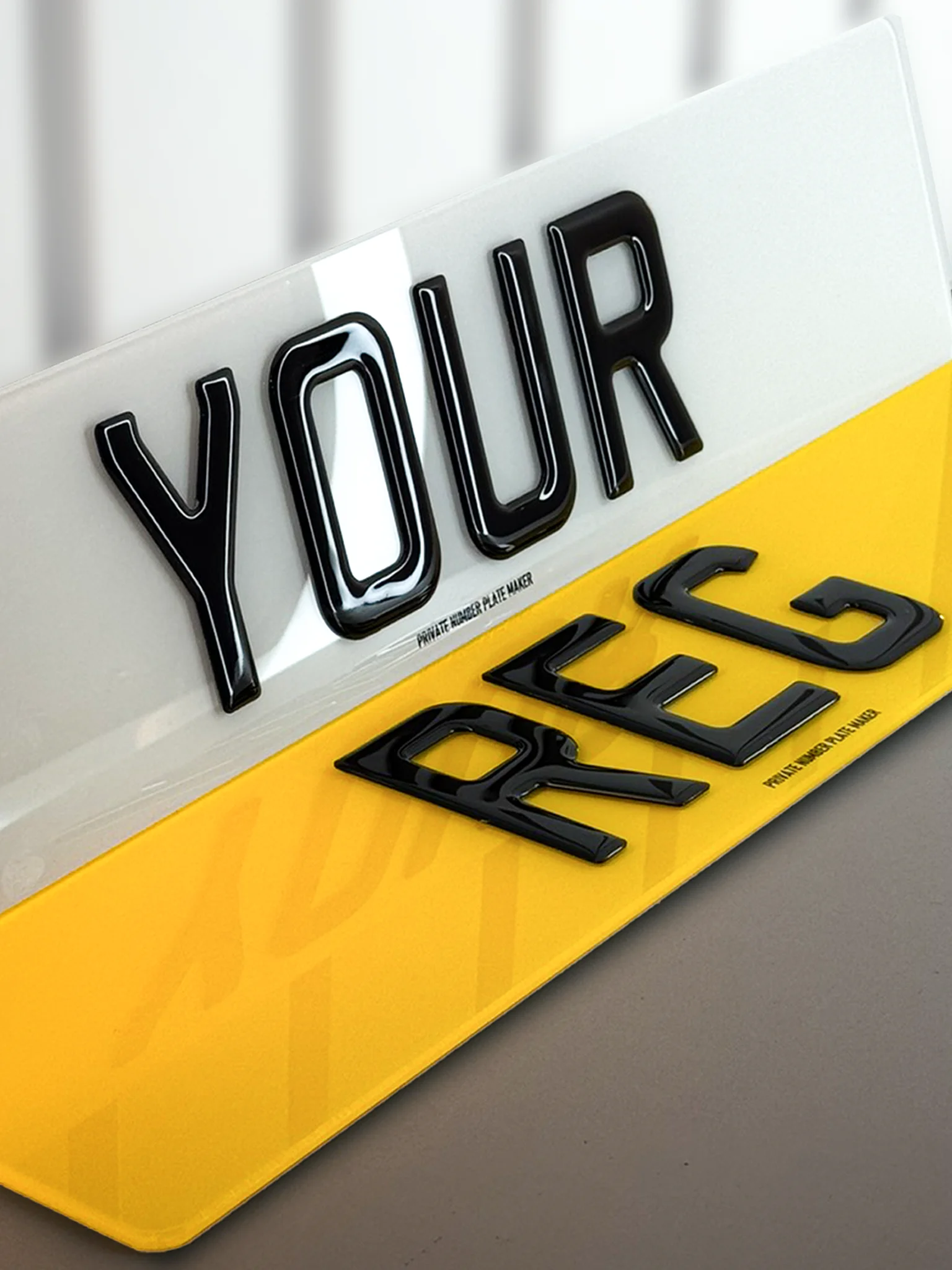 3D Plate
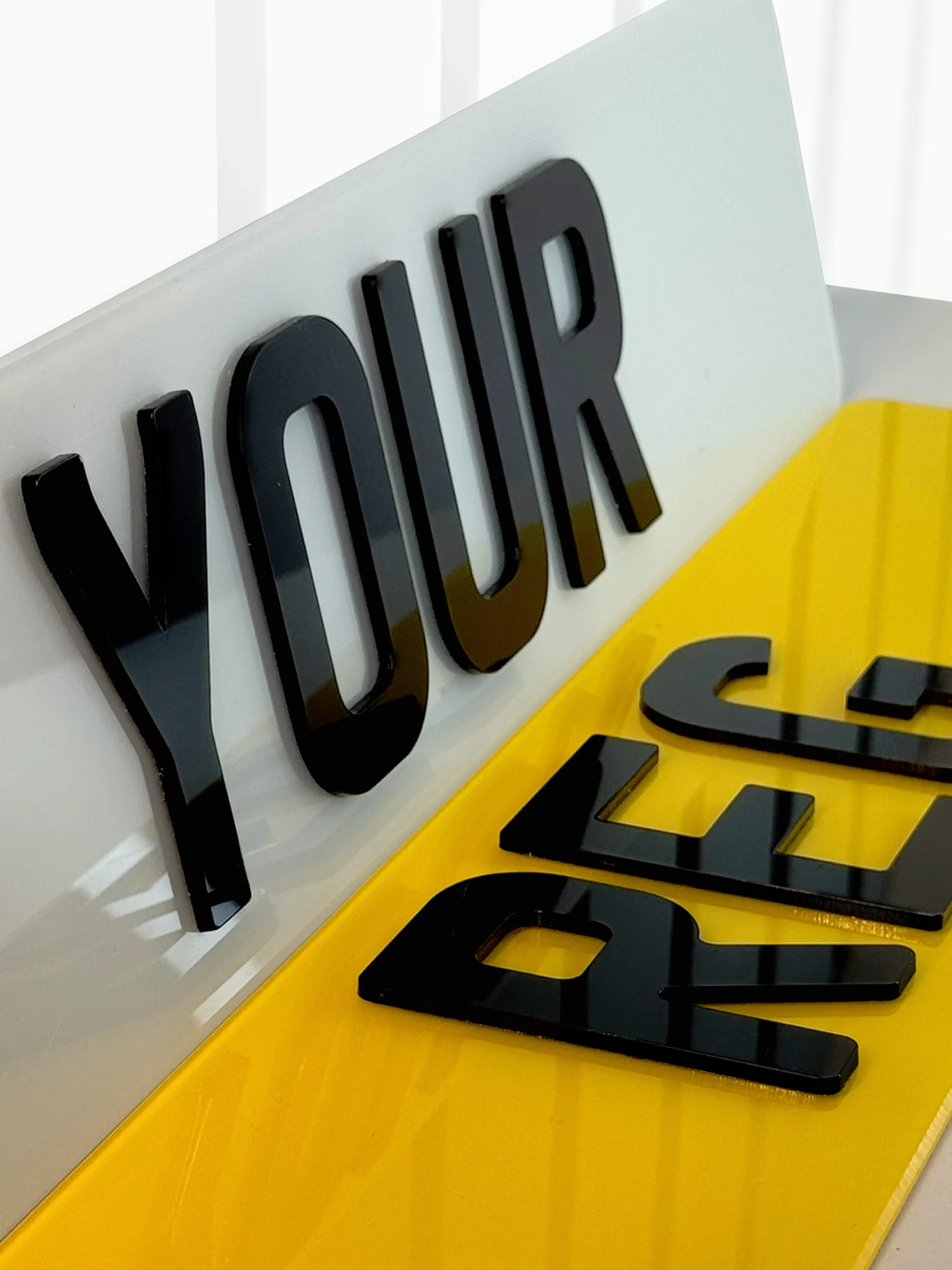 4D Plate
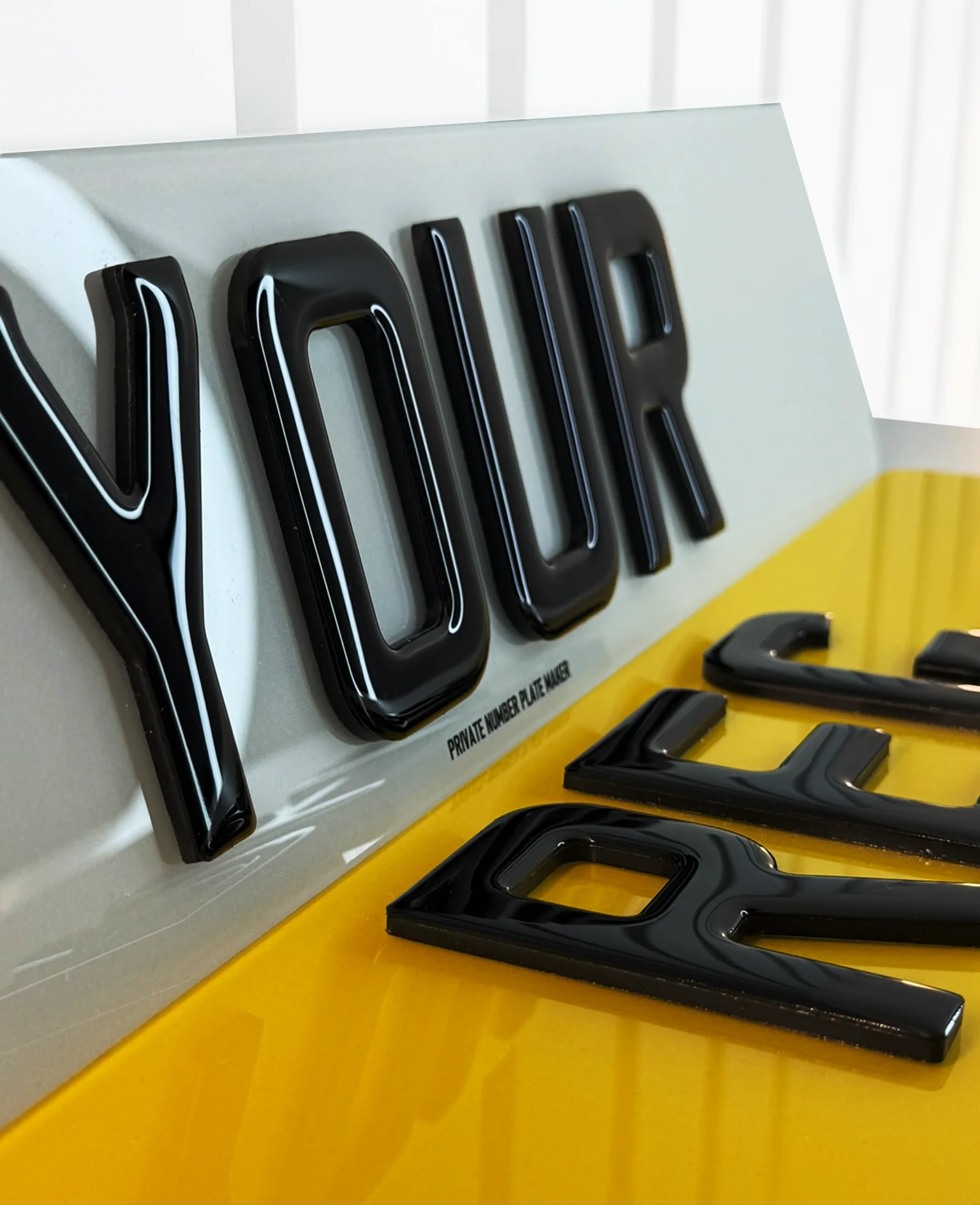 5D Plate
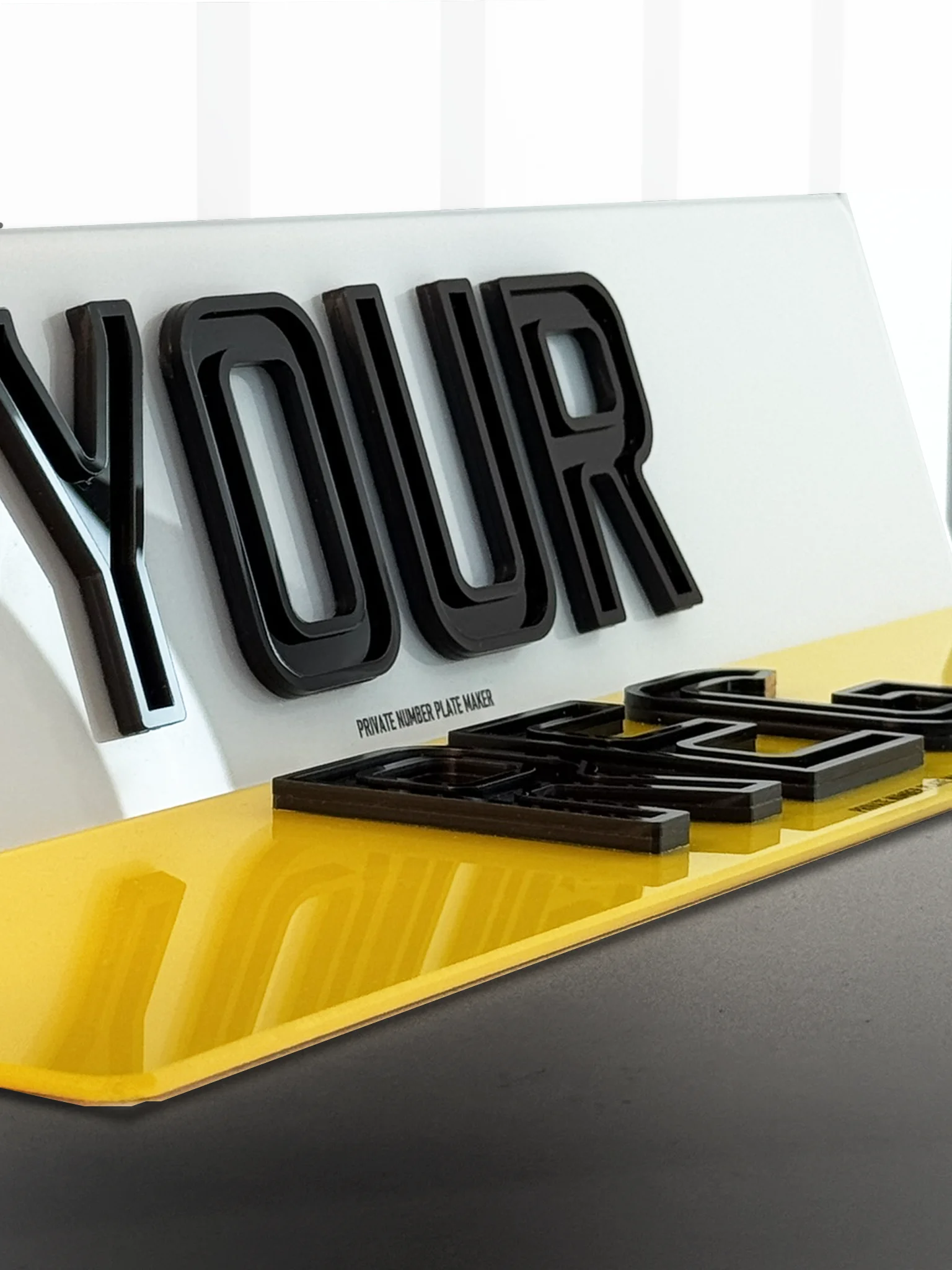 Ghost
Ghost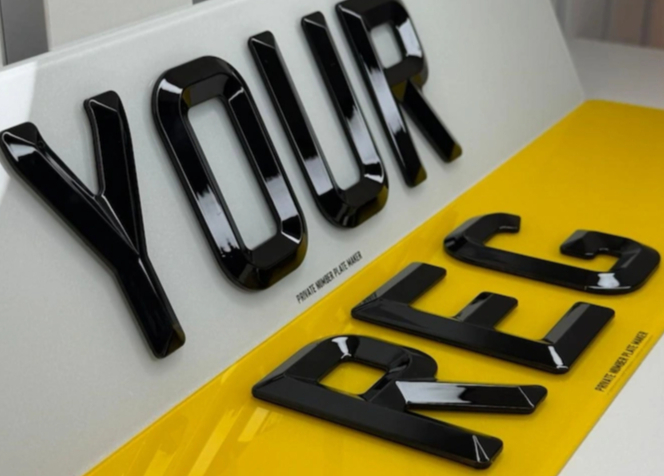 Bevel
Bevel5mm 4D Plates vs 5D Plates: What's the Real Difference?
Summary
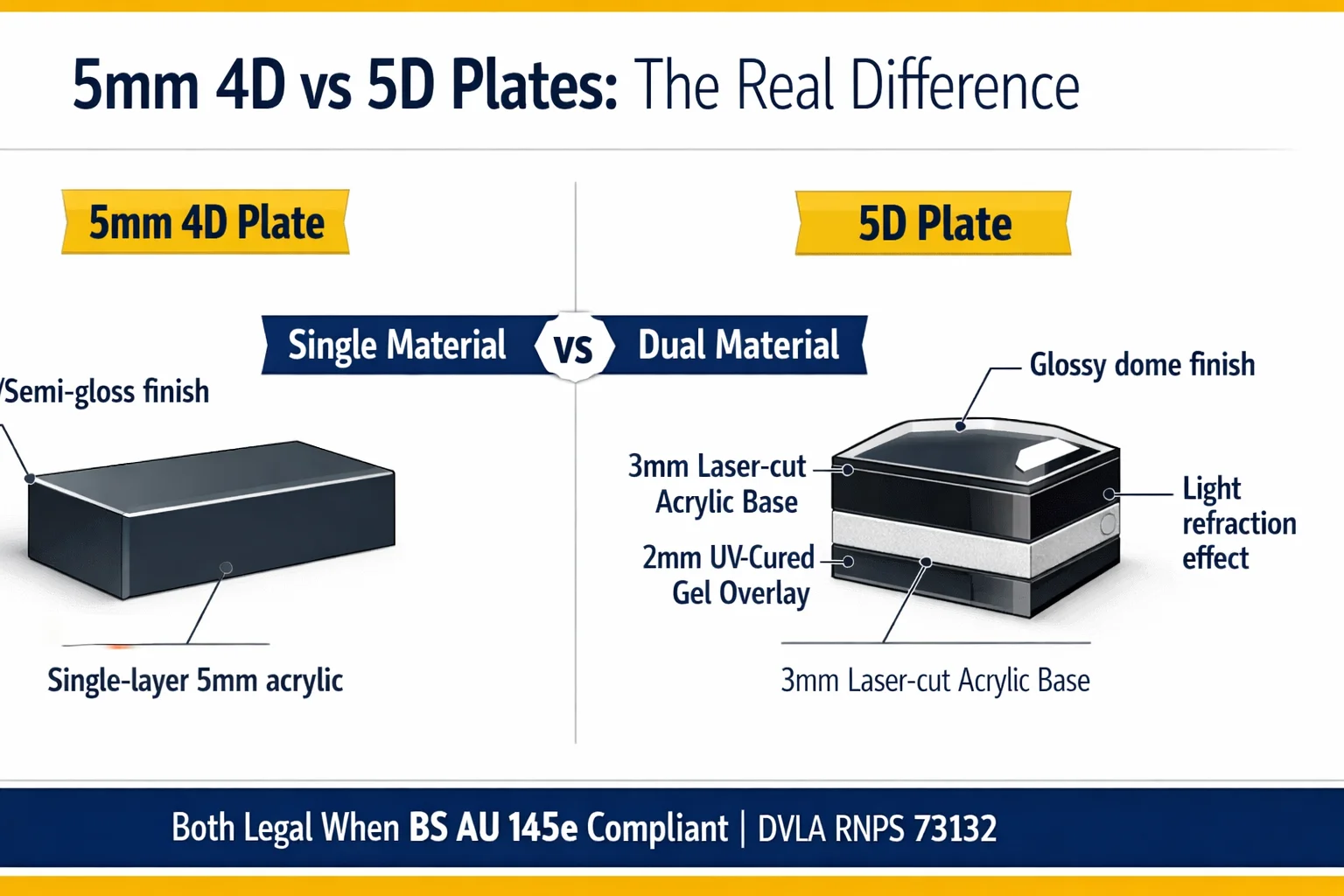
The primary difference between "5mm 4D" plates and true "5D" plates lies in their construction method and material composition, not just their total height. A "5mm 4D" plate typically consists of a single, solid layer of 5mm thick laser-cut acrylic, offering a uniform matte or semi-gloss finish throughout the character depth. In contrast, a true "5D" plate features a dual-layer construction: a 3mm laser-cut acrylic base bonded to the substrate, topped with a separate 2mm layer of clear UV-cured gel, creating a distinctive glossy dome effect that refracts light differently than solid acrylic.
5D plates explained Guide | 4D plates explained Guide | Dual-layer construction Guide
While both options can be fully legal for UK road use when manufactured to BS AU 145e:2018 standards using the mandatory Charles Wright font and correct dimensions, they offer different aesthetic profiles. The single-layer 5mm acrylic provides sharp, architectural definition with a consistent texture, whereas the dual-layer 5D design combines that sharpness with a high-gloss, liquid-like finish that enhances visual depth. Understanding this distinction helps you choose the premium look that best suits your vehicle, rather than being misled by marketing terminology that often conflates the two.
BS AU 145e:2018 explained Guide | Charles Wright font Guide | Are 5D plates legal Guide
As a DVLA-registered manufacturer (RNPS ID: 75449) based in Ilford, we produce both single-layer thick acrylic plates and dual-layer 5D plates on-site. This guide clarifies the technical differences, explains the manufacturing processes involved, and helps you verify exactly what you are buying to ensure you get the specific finish and durability you expect.
DVLA document requirements Guide | Same-day plates in Ilford Guide
Defining the Terms: Clearing Up the Confusion
The number plate market is rife with overlapping terminology that often confuses buyers. Suppliers frequently use "4D", "5D", "4D 5mm", and "thick 4D" interchangeably, yet they can refer to distinctly different products.
What is a "5mm 4D" Plate?
In industry terms, a "5mm 4D" plate (sometimes called "Thick 4D") refers to a single-material construction.
- Composition: A single sheet of polymethyl methacrylate (PMMA) acrylic, cut to a thickness of 5mm.
- Formation: Characters are laser-cut from this solid block and bonded directly to the reflective substrate.
- Finish: The surface finish is uniform across the entire 5mm depth. It is typically matte or semi-gloss, determined by the original acrylic sheet's texture. There is no additional coating.
- Visual Profile: Sharp, geometric edges with a consistent appearance from top to bottom.
What is a "5D" Plate?
A true "5D" plate refers to a dual-layer construction.
- Composition: Two distinct materials. A base layer of 3mm laser-cut acrylic, topped with a separately applied layer of 2mm UV-cured polyurethane gel.
- Formation: The acrylic base is cut and bonded first. Then, the gel resin is dispensed onto the acrylic and cured under UV light to form a dome.
- Finish: The surface features a high-gloss, domed finish created by the gel layer, which sits atop the sharp acrylic edges.
- Visual Profile: Combines the sharp definition of the acrylic base with the light-refracting, liquid-like gloss of the gel overlay.
Why the Confusion Exists
Marketing teams often blur these lines. Some sellers label any plate with 5mm of height as "5D" to imply superior technology, even if it is just a single block of thick acrylic. Conversely, some describe dual-layer plates as "4D 5mm" to emphasise the total depth. The critical factor is not the name, but the construction method: single-layer solid acrylic vs. dual-layer acrylic plus gel.
Construction Breakdown: Single-Layer vs Dual-Layer
Understanding the physical build of each plate type explains their differing appearances and performance characteristics.
5mm 4D: The Single-Layer Monolith
Material Uniformity
The entire character is made of one material: 5mm acrylic. This means the optical and mechanical properties are consistent from the substrate bond to the top surface.
Manufacturing Process
- Sourcing: 5mm thick PMMA acrylic sheets are sourced.
- Cutting: CNC lasers cut the Charles Wright font shapes directly from the 5mm sheet.
- Bonding: The solid 5mm characters are adhered to the BS AU 145e:2018 substrate.
- Finishing: No further processing is needed; the surface finish is inherent to the acrylic sheet used.
Key Characteristic
The edge and the top surface are the same material. If you chip the top, you expose the same acrylic underneath.
Charles Wright font Guide | BS AU 145e:2018 explained Guide
5D: The Dual-Layer Composite
Material Stratification
The character is a composite of two materials with different properties: rigid acrylic for structure and flexible gel for aesthetics and protection.
Manufacturing Process
- Base Creation: 3mm acrylic sheets are laser-cut to form the base characters.
- Base Bonding: These 3mm characters are bonded to the substrate.
- Gel Application: A precise volume of liquid UV-curable resin is dispensed onto each acrylic character.
- Curing: UV light hardens the resin into a 2mm solid gel dome, bonding it to the acrylic base.
Key Characteristic
The top 2mm is chemically distinct from the bottom 3mm. This allows for a glossy finish on top of a sharp structural base.
Visual and Aesthetic Differences
For most buyers, the decision comes down to looks. The construction difference creates distinct visual signatures.
Surface Finish and Light Interaction
5mm 4D (Single-Layer)
- Texture: Uniform matte or semi-gloss. Light reflects evenly off the flat top surface.
- Edge Definition: Extremely sharp and crisp. The 5mm depth creates a strong shadow, giving a bold, architectural look.
- Depth Perception: The depth is visible through shadow casting, but the material itself looks solid and opaque.
5D (Dual-Layer)
- Texture: High-gloss, "wet look" surface. The gel dome acts like a lens, refracting light and creating highlights that move as the viewing angle changes.
- Edge Definition: Retains the sharpness of the 3mm acrylic base, but the gel overlay softens the very top edge slightly into a dome shape.
- Depth Perception: The clear gel adds an element of optical depth. Light travels through the gel, hits the acrylic, and reflects back, creating a richer, more three-dimensional appearance than solid acrylic alone.
Colour Consistency
5mm 4D
Since the entire block is one piece of coloured acrylic (usually black), the colour is consistent throughout. If the edge is viewed from the side, it matches the top perfectly.
5D
The black colour comes from the acrylic base. The gel overlay is clear. This means the black appears slightly deeper because you are looking through a clear layer to the black base, enhancing the contrast against the reflective background.
Durability and Performance Comparison
Does the extra complexity of 5D plates offer functional benefits, or is it purely aesthetic?
Impact Resistance
5mm 4D (Solid Acrylic)
- Strengths: 5mm acrylic is rigid and robust. It resists bending and cracking under normal road conditions.
- Weaknesses: Acrylic can be brittle. A direct, sharp impact (e.g., a stone chip at high speed) might cause a crack that propagates through the entire 5mm thickness.
5D (Acrylic + Gel)
- Strengths: The gel overlay is flexible and shock-absorbent. It can absorb minor impacts (like car wash brushes or small debris) that might otherwise scratch or chip the acrylic. It acts as a sacrificial layer.
- Weaknesses: If the bond between the gel and acrylic fails (delamination), the top layer could peel. However, high-quality UV curing prevents this.
Weathering and UV Stability
5mm 4D
High-quality PMMA acrylic has excellent UV stability. However, over many years, the surface may eventually dull or oxidise slightly, requiring polishing to restore the original finish.
5D
The UV-cured gel is specifically formulated with UV inhibitors. It protects the underlying acrylic from direct exposure. The gel surface is also smoother, making it harder for dirt and grime to adhere, which can help maintain the "new" look for longer.
Maintenance Requirements
5mm 4D
Easy to clean. If the surface becomes scratched or dull over time, it can potentially be polished back to clarity using acrylic polishing compounds.
5D
Also easy to clean, often easier due to the slick gel surface. However, you cannot polish the gel layer aggressively; doing so might remove the dome effect or cloud the clear coat. Gentle washing is recommended.
Legal Compliance: Are Both Legal?
Yes, both 5mm 4D (single-layer) and 5D (dual-layer) plates are legal in the UK, provided they meet the strict requirements of the Road Vehicles (Display of Registration Marks) Regulations 2001.
The Regulatory Checklist
For either plate type to be road-legal, it must satisfy:
BS AU 145e:2018 Certification
The reflective substrate must meet the current British Standard. The added thickness of the characters does not negate this requirement.
Charles Wright Font
The font shape must be exact. Laser cutting (used for both types) ensures this precision.
Dimensions
- Character Height: 79mm (cars)
- Character Width: 50mm (excluding 'I' and '1')
- Stroke Thickness: 14mm
- Spacing: 11mm between characters
Note: The regulations specify planar dimensions (height/width), not perpendicular depth. Therefore, 3mm, 4mm, 5mm, or even thicker characters are legal as long as the face dimensions are correct.
Reflectivity
The raised characters must not obscure the reflective background between them. Both single-layer and dual-layer constructions leave the substrate exposed in the gaps.
Markings
The plate must display the BS AU 145e:2018 mark, the supplier's name/postcode, and their RNPS ID.
Are 5D plates legal Guide | UK number plate fines Guide
Potential Pitfalls
Tinted Gel
If a 5D plate uses a tinted or smoked gel overlay that reduces reflectivity, it becomes illegal. The gel must be clear.
Incorrect Font
Some manufacturers of thick plates might inadvertently alter the font stroke width during the cutting process. Precision is key.
Overhanging Gel
In poor quality 5D manufacturing, the gel might overflow the acrylic edges, encroaching on the 11mm spacing rule. Quality control prevents this.
Tinted vs ghost plates legality Guide | Illegal plates penalties Guide
Price and Value Analysis
Why is there a price difference, and which offers better value?
Cost Drivers
5mm 4D Plates
- Material Cost: 5mm acrylic sheet is more expensive per square metre than 3mm sheet.
- Processing: Cutting 5mm acrylic requires higher laser power and slower speeds, increasing machine time and energy costs.
- Labour: Simpler process (cut and bond), potentially lower labour time than dual-layer.
5D Plates
- Material Cost: Uses less acrylic (3mm) but adds the cost of specialised UV gel resin.
- Processing: Requires two distinct manufacturing stages (cutting/bonding + dispensing/curing).
- Equipment: Requires UV curing chambers and precision dispensing robots, representing a higher capital investment.
- Labour: More complex quality control checks for gel clarity and bonding.
Typical Price Ranges (Indicative)
| Plate Type | Typical Price Range | Value Proposition |
|---|---|---|
| Standard 2D | £20 - £40 | Basic compliance, functional |
| 4D (3mm Acrylic) | £50 - £85 | Sharp definition, standard premium |
| 5mm 4D (Thick Acrylic) | £60 - £95 | Extra boldness, solid durability |
| 5D (Dual-Layer) | £70 - £110 | Maximum gloss, optical depth, premium finish |
Prices vary by supplier and vehicle type.
Which is Better Value?
Choose 5mm 4D if:
- You prefer a matte/satin finish
- Want maximum structural rigidity without a glossy coat
- Like the look of a solid block of material
- It is often slightly cheaper than true 5D
Choose 5D if:
- You want the highest possible gloss
- The "wet look" aesthetic
- The added protective benefit of the gel layer
- The visual impact is generally considered superior for show cars
Are 5D plates worth the investment Guide | Cheap number plates online Guide
How to Verify What You Are Buying
Since sellers often misuse terms, how can you ensure you are getting the specific product you want?
Questions to Ask the Supplier
"Is this a single layer of 5mm acrylic, or is it 3mm acrylic with a gel top?"
- If they say "solid 5mm acrylic", it is a 5mm 4D plate.
- If they say "acrylic base with gel overlay", it is a 5D plate.
"What is the finish on the top of the characters?"
- "Matte" or "Satin" usually indicates single-layer acrylic.
- "High Gloss" or "Domed" indicates a gel overlay (5D).
"Can I see a close-up photo of the character edge?"
- A single continuous material edge = 5mm 4D.
- A visible line separating the base and the top dome = 5D.
Physical Inspection (If Collecting)
Touch Test
Run your finger over the character.
- 5mm 4D feels like hard plastic all the way across.
- 5D feels like hard plastic at the sides, but the top feels slightly softer/warmer (gel) and perfectly smooth/domed.
Reflection Test
Shine a light on the plate.
- 5mm 4D will have a diffuse reflection if matte, or a sharp reflection if polished acrylic.
- 5D will have a deep, refracted reflection due to the gel lens effect.
Our Manufacturing Approach: Precision in Ilford
At Private Number Plate Maker Ltd (RNPS ID: 75449), we manufacture both 5mm single-layer acrylic plates and true dual-layer 5D plates at our Ilford workshop. We believe in transparency about construction.
Our Process for 5mm 4D Plates
We source premium 5mm cast acrylic, ensuring optical clarity and UV stability. Our laser cutters are calibrated specifically for this thickness to prevent edge burning, ensuring every character has crisp, clean lines before being bonded to BS AU 145e:2018 substrates.
Our Process for 5D Plates
We use a precise 3mm acrylic base for structural integrity. Our automated gel dispensing system applies the exact volume of UV resin needed to create a perfect 2mm dome. Each plate passes through our UV curing tunnel to ensure the gel is fully hardened and chemically bonded to the acrylic, preventing delamination.
Commitment to Compliance
Regardless of whether you choose 5mm 4D or 5D, every plate we produce undergoes rigorous checks for font accuracy, spacing, and reflectivity. We verify your documents in person or via secure upload, ensuring every plate leaving our Ilford workshop is fully road-legal.
Same-day plates in Ilford Guide | Replacement plates buying Guide
Frequently Asked Questions
No. A 5mm 4D plate is made from a single solid block of 5mm acrylic. A 5D plate is made from a 3mm acrylic base with a separate 2mm gel overlay. The finish and light interaction are different.
5D gel vs standard 4D Guide | 5D vs 4D vs 3D comparison Guide
Both are very durable. 5mm 4D is rigid and solid. 5D has a flexible gel top that can absorb minor scratches and impacts better, potentially keeping the "new" look longer.
Yes, both are legal provided they use the correct Charles Wright font, proper spacing, and BS AU 145e:2018 substrates. The thickness of the character does not affect legality.
It is often a marketing shortcut. Because the plate is 5mm thick, they use the "5D" label to imply it is the latest premium version. Always ask about the construction (single layer vs. gel overlay) to be sure.
Conclusion
The real difference between "5mm 4D" and "5D" plates is fundamental: material composition. 5mm 4D plates are single-layer solid acrylic, offering a bold, uniform, and often matte finish. 5D plates are dual-layer composites of acrylic and gel, delivering a unique high-gloss, refractive finish that mimics a liquid drop.
Both are legal, durable, and premium options that far exceed standard 2D plates in visual impact. Your choice should depend on your aesthetic preference: do you prefer the solid, architectural look of thick acrylic, or the deep, glossy shine of a gel-topped plate?
At Private Number Plate Maker Ltd, we manufacture both types with precision in our Ilford workshop. We encourage you to ask questions about construction to ensure you get exactly the finish you desire. Whether you choose the solid strength of 5mm 4D or the glossy depth of 5D, you can drive with confidence knowing your plates are fully compliant and built to last.
5D vs 4D vs 3D comparison Guide | Bevel vs 4D vs 5D vs 3D comparison Guide
This guide references the following official and verified sources:
Road Vehicles (Display of Registration Marks) Regulations 2001
legislation.gov.ukBritish Standards Institution: BS AU 145e:2018
bsigroup.comDVLA Registered Number Plate Supplier (RNPS) requirements
gov.ukMOT Inspection Manual
gov.ukRelated Guides:
5mm 4D vs 5D plates Guide |
5D plates explained Guide |
5D vs 4D vs 3D comparison Guide |
5D gel vs standard 4D Guide