
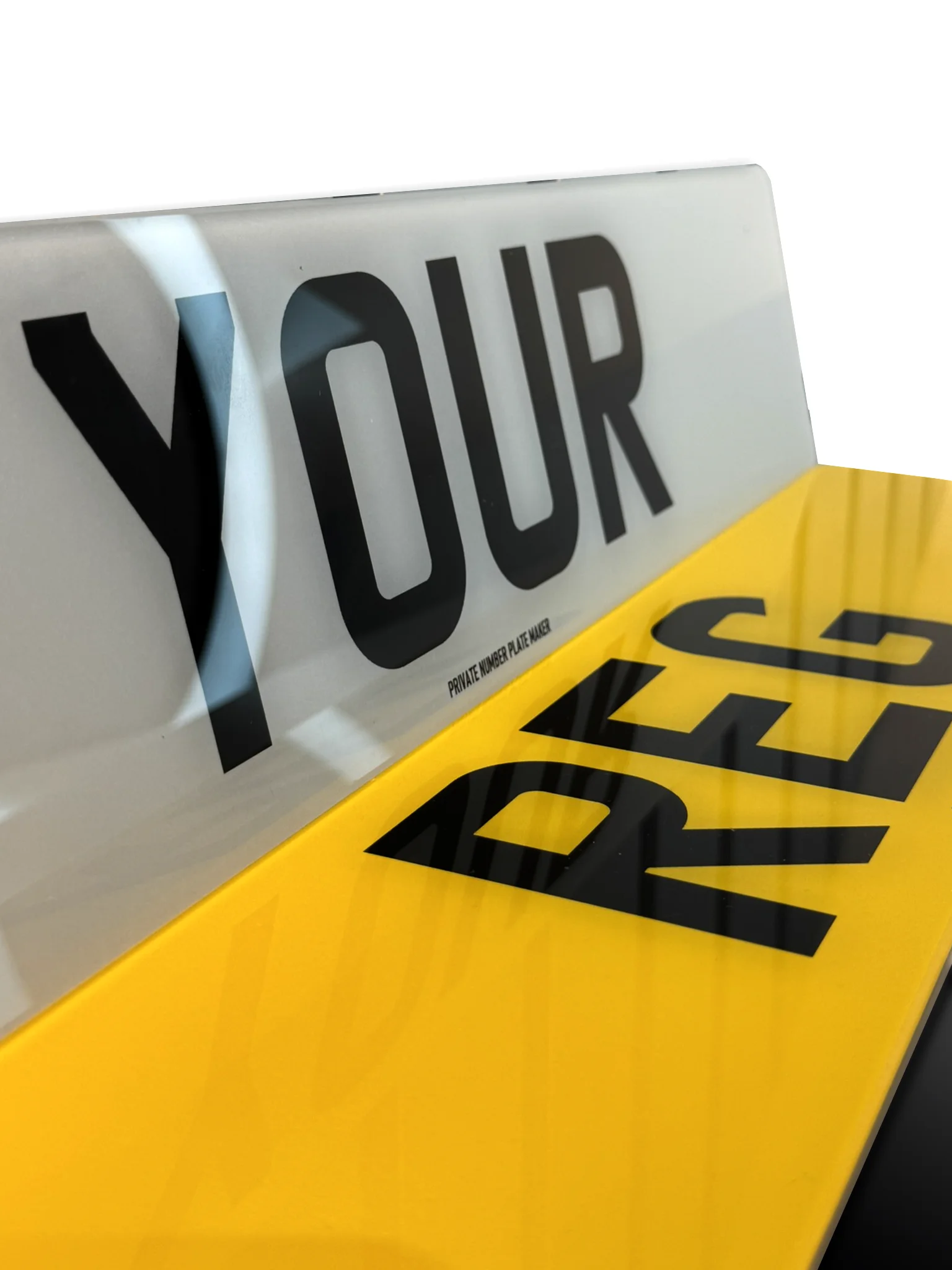
 Printed
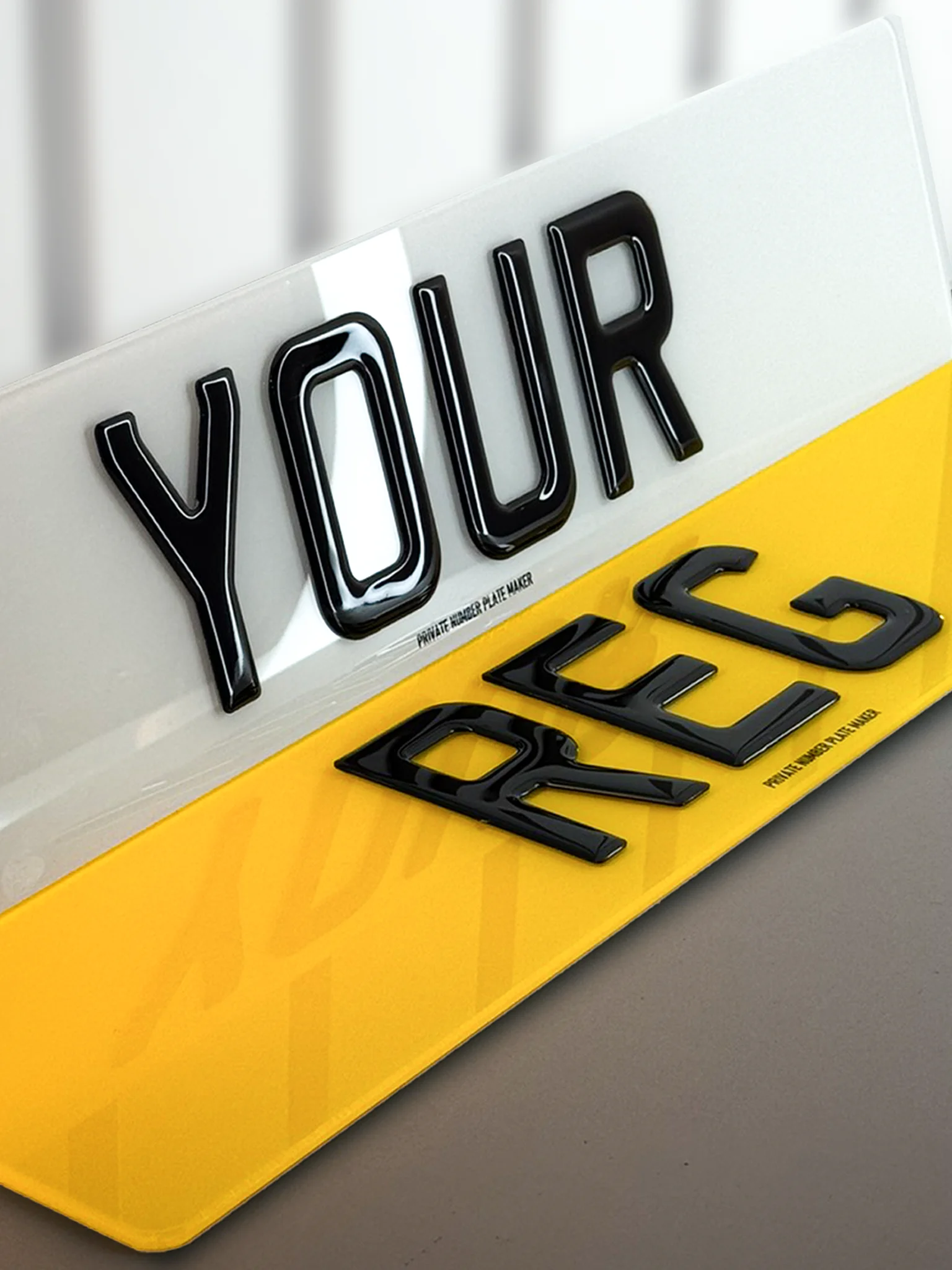 3D Plate
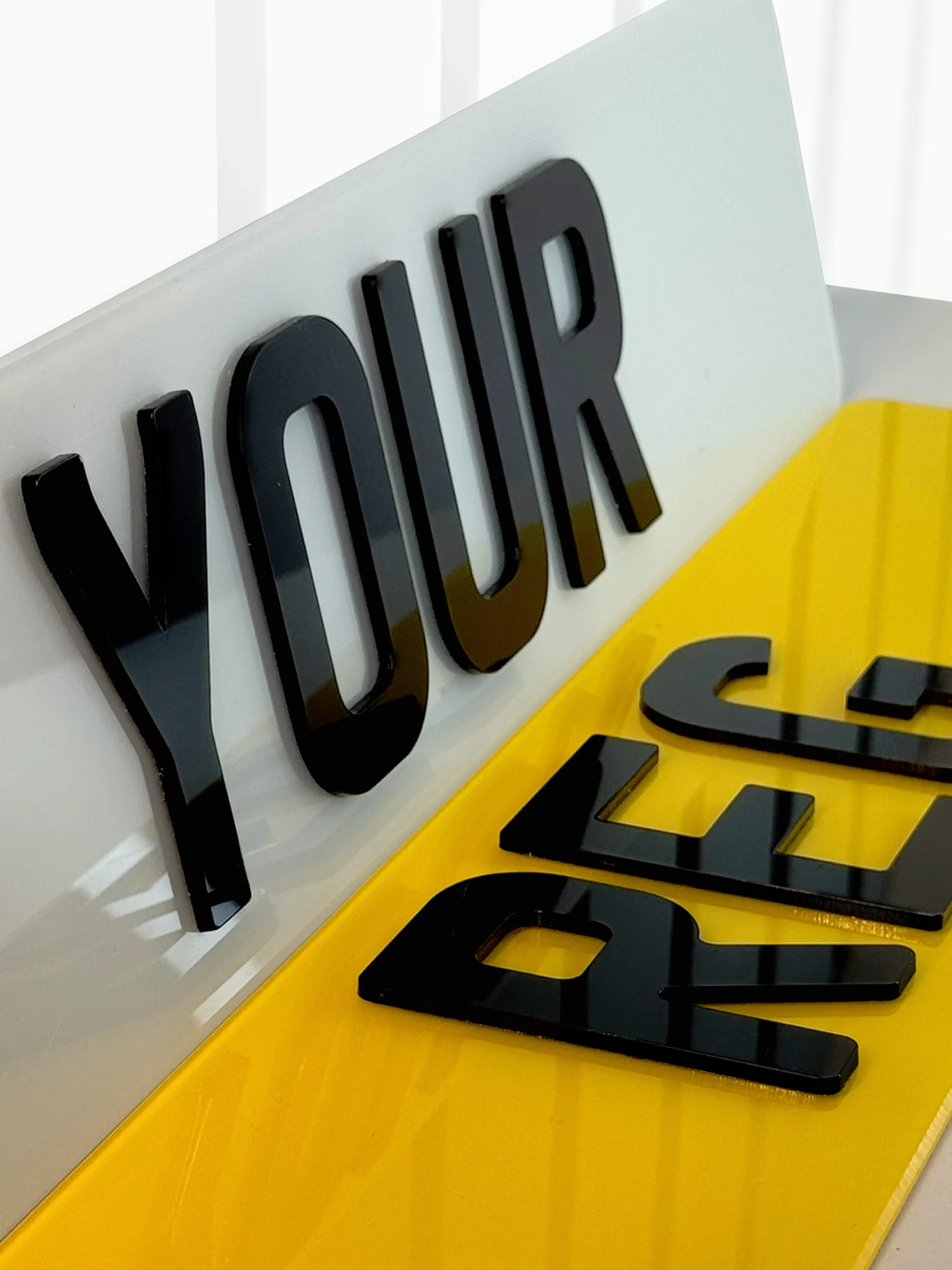 4D Plate
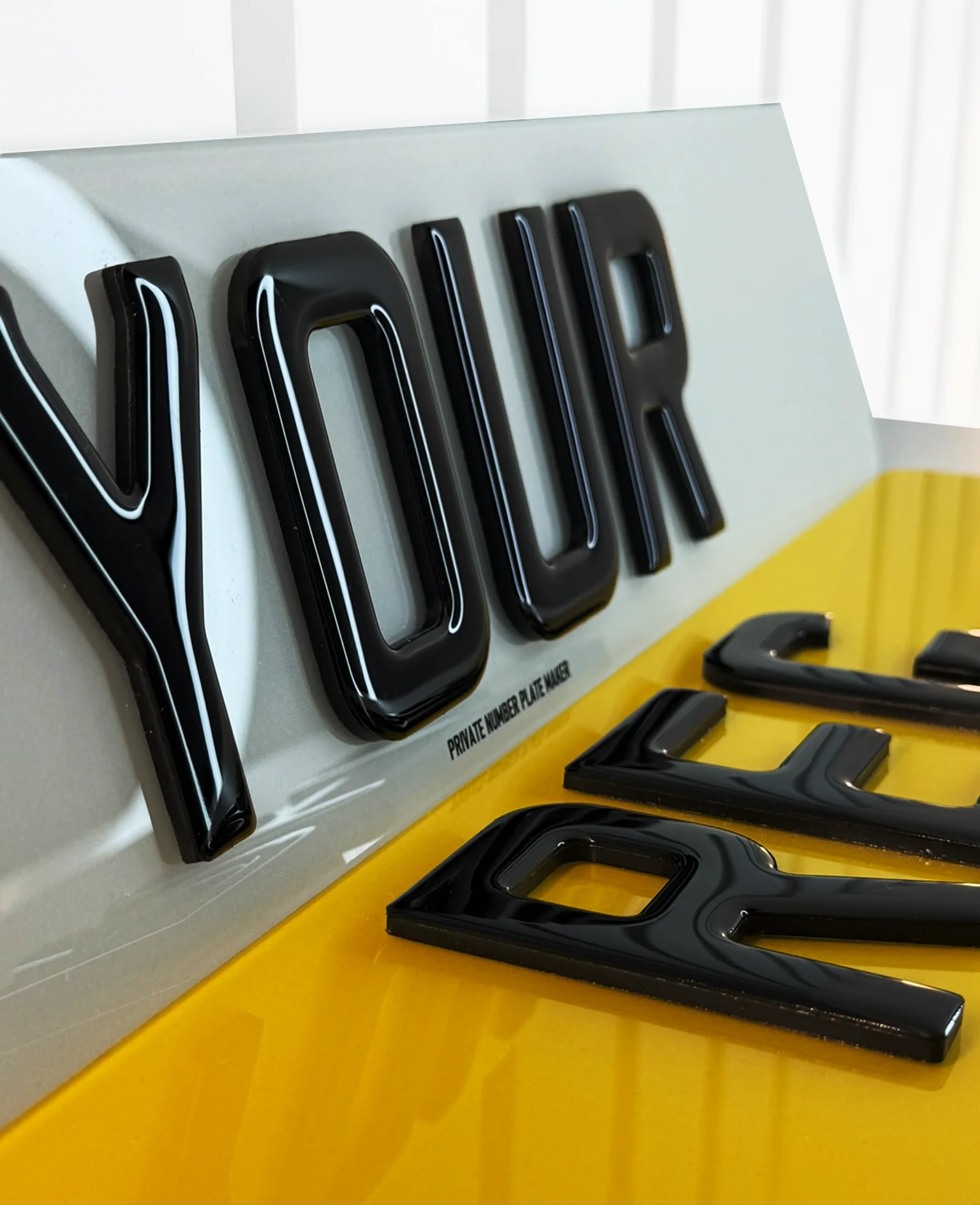 5D Plate
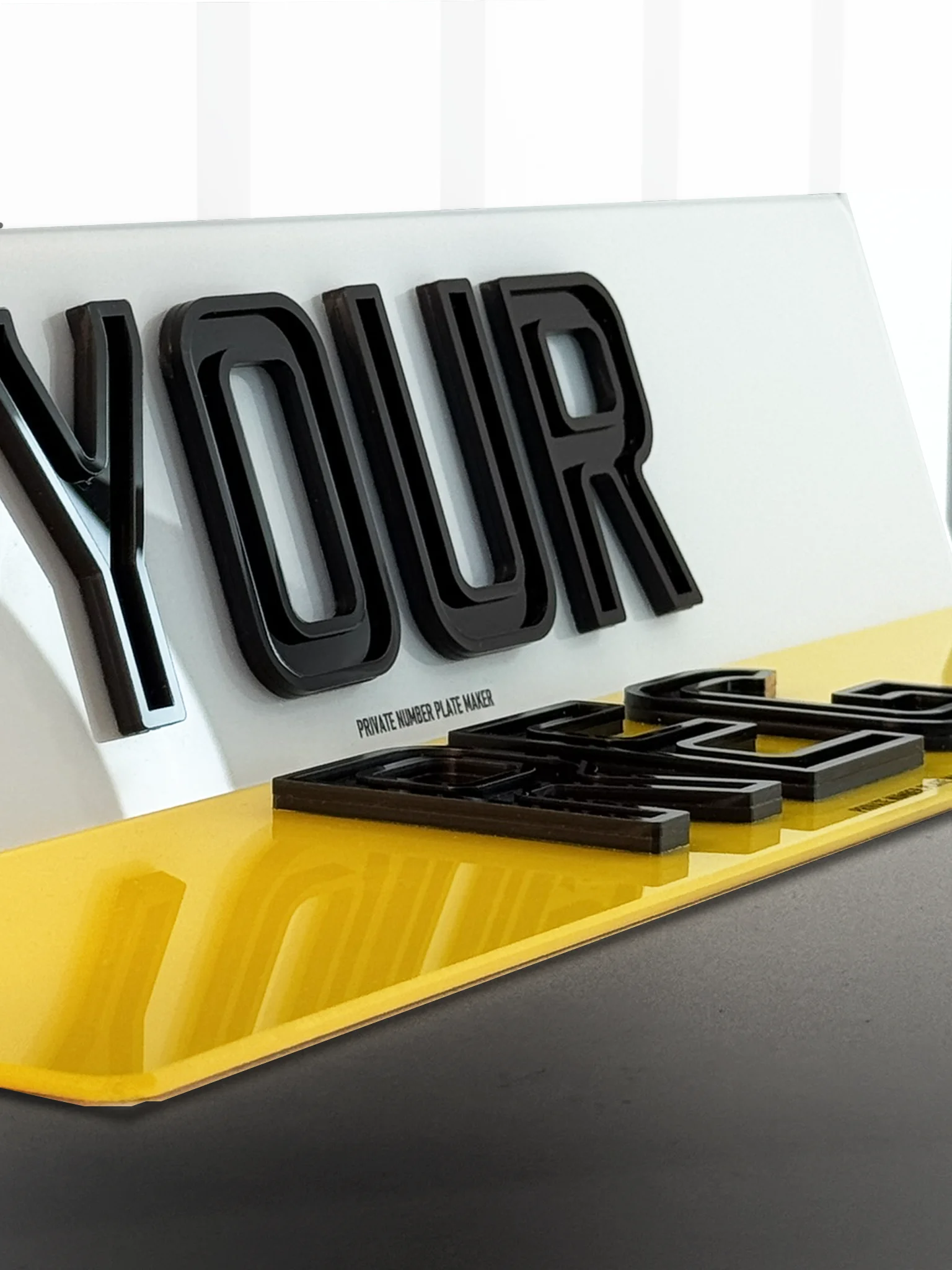 Ghost
Ghost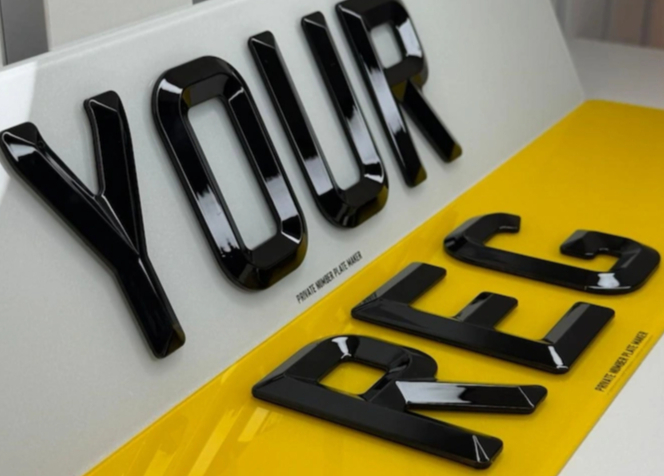 Bevel
BevelBevel vs 4D vs 5D vs 3D: The Ultimate Bevelled Plate Comparison Guide
Summary
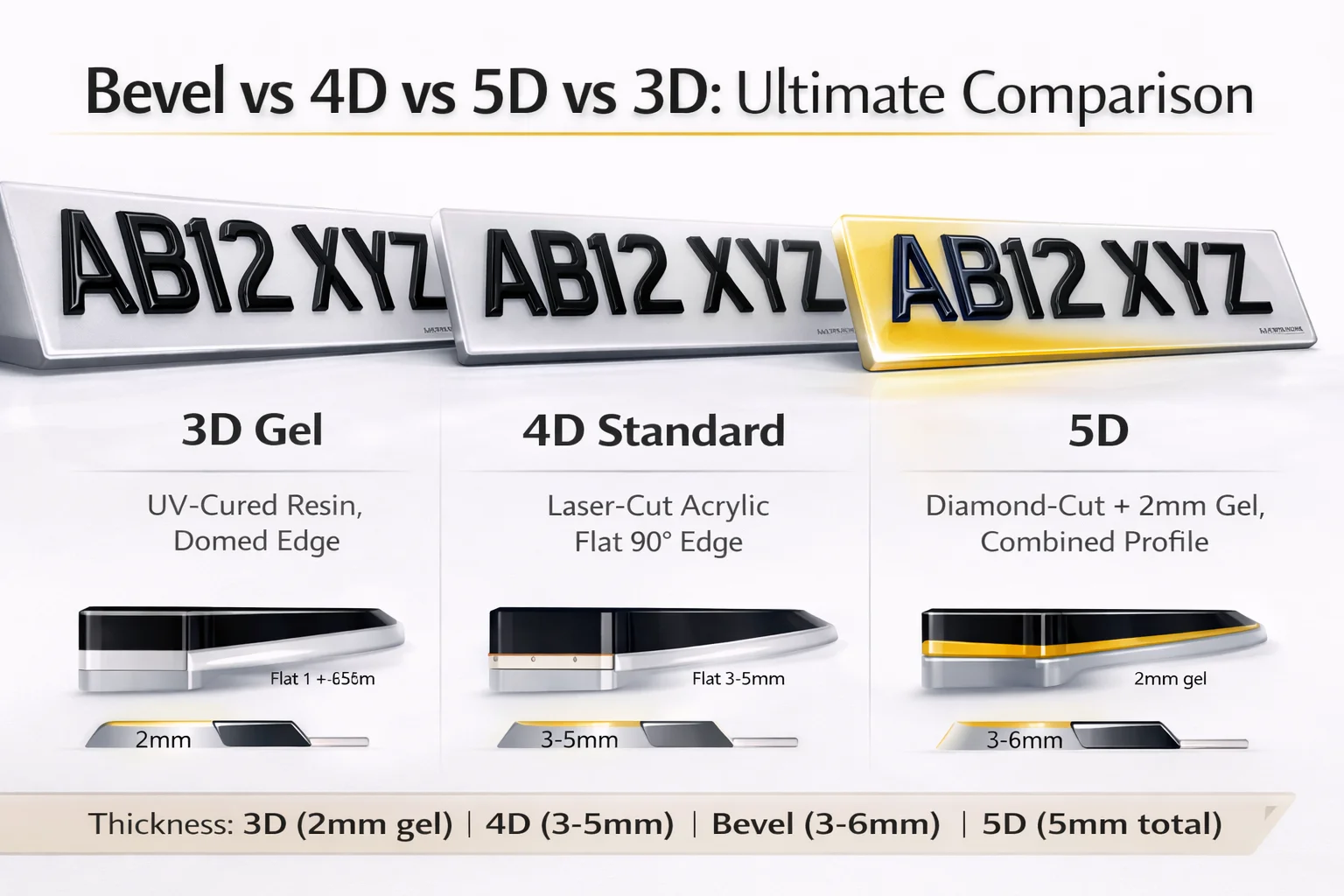
Bevel, 4D, 5D, and 3D number plates represent different premium construction methods, with the key distinction being edge profiles: 3D gel plates feature domed/rounded edges from UV-cured resin, standard 4D plates have flat 90-degree acrylic edges, bevel plates showcase diamond-cut faceted edges that catch light from multiple angles, and 5D plates combine 3mm acrylic base with 2mm gel overlay for dual-texture appearance.
All premium plate types must meet BS AU 145e:2018 standards including Charles Wright font, correct character dimensions (79mm height, 50mm width, 14mm stroke), and proper reflective materials to remain legal for UK road use. Thickness varies significantly: 3D gel typically 2mm, standard 4D ranges 3-5mm, bevel plates offer 3-6mm options, and 5D plates measure 5mm total (3mm acrylic + 2mm gel).
Related guide: 5D gel vs standard 4D comparison Guide | 4D number plates explained Guide
Understanding Premium Number Plate Types
Each premium plate type offers distinct visual characteristics, construction methods, and price points. Understanding these differences helps you make informed decisions.
Construction Method Comparison
| Plate Type | Character Construction | Edge Profile | Manufacturing Process |
|---|---|---|---|
| 3D Gel | UV-cured resin gel overlay on printed substrate | Domed/rounded edges | Gel applied, UV cured, polished |
| 4D Standard | Laser-cut acrylic characters bonded to substrate | Flat 90-degree edges | Laser cut, positioned, adhesive bonded |
| Bevel 4D | Laser-cut acrylic with diamond-cut faceted edges | 45-degree angled facets | Laser cut, CNC bevelled, polished, bonded |
| 5D | 3mm acrylic base + 2mm gel overlay combination | Flat acrylic + domed gel top | Acrylic cut, gel applied, dual-layer bonding |
Related guide: 3D gel number plates explained Guide | 5D number plates explained Guide
Edge Profile: The Key Differentiator
The edge profile is the most visible distinction between premium plate types:
3D Gel - Domed/Rounded:
- Smooth curved edge from surface tension of gel
- Soft, organic appearance
- Light reflects evenly across curved surface
- Resembles traditional badge finish
4D Standard - Flat 90-Degree:
- Clean straight edge cut perpendicular to face
- Modern, sharp appearance
- Single-plane light reflection
- Minimalist aesthetic
Bevel 4D - Diamond-Cut Faceted:
- Multiple angled facets cut into edge (typically 45 degrees)
- Premium, vintage badge appearance
- Multi-angle light reflection from facets
- Most distinctive edge profile
5D - Dual-Layer Profile:
- Flat acrylic edge at base
- Domed gel edge on top
- Combined reflection properties
- Maximum visual depth
Thickness Comparison
| Plate Type | Typical Thickness | Range Available | Visual Depth |
|---|---|---|---|
| 3D Gel | 2mm | 1-3mm | Subtle |
| 4D Standard | 3mm | 3-5mm | Moderate |
| Bevel 4D | 3mm | 3-6mm | Moderate to Maximum |
| 5D | 5mm total | 5mm standard | Maximum |
Detailed Comparison: 3D Gel Plates
3D gel plates were the first premium plate style to gain widespread popularity in the UK market.
Construction Details
Layer Structure:
- BS AU 145e reflective substrate base
- Printed black characters (Charles Wright font)
- UV-cured resin gel overlay (approximately 2mm)
- Protective top coating
Manufacturing Process:
- Characters printed on reflective substrate
- Gel resin applied over characters
- UV light cures and hardens gel
- Surface polished for clarity
Visual Characteristics
| Aspect | 3D Gel Characteristic |
|---|---|
| Edge Profile | Domed/rounded from gel surface tension |
| Light Reflection | Even, diffuse across curved surface |
| Texture | Smooth, glossy gel finish |
| Depth Perception | Subtle raised effect (2mm typical) |
| Colour Options | Black standard, some colour variants available |
Advantages of 3D Gel
- Most affordable premium option
- Smooth gel surface resists dirt accumulation
- Established style with proven durability
- Subtle premium enhancement
- Wide supplier availability
Limitations of 3D Gel
- Less depth than acrylic options
- Gel can yellow over time with UV exposure
- Edge profile less distinctive than bevel
- Can be damaged by harsh chemicals
- Limited thickness options
Best Suited For
| Vehicle Type | Suitability | Reason |
|---|---|---|
| Daily drivers | Excellent | Cost-effective premium |
| Fleet vehicles | Excellent | Budget-friendly consistency |
| Classic cars | Good | Traditional badge-like appearance |
| Enthusiast vehicles | Moderate | Less impact than acrylic |
| Luxury vehicles | Moderate | May want more substantial presence |
Related guide: 3D gel plates for motorcycles Guide | 3D gel plates FAQ Guide
Detailed Comparison: 4D Standard Plates
Standard 4D plates introduced laser-cut acrylic characters to the UK market, offering enhanced depth over 3D gel.
Construction Details
Layer Structure:
- BS AU 145e reflective substrate base
- Automotive-grade adhesive layer
- Laser-cut black acrylic characters (3-5mm)
- Protective coating on acrylic
Manufacturing Process:
- Acrylic sheet laser-cut to character shapes
- Charles Wright font precisely maintained
- Characters positioned on substrate
- Adhesive bonding under pressure
Visual Characteristics
| Aspect | 4D Standard Characteristic |
|---|---|
| Edge Profile | Flat 90-degree cut edge |
| Light Reflection | Single-plane from acrylic face |
| Texture | Smooth acrylic surface |
| Depth Perception | Moderate (3-5mm depending on thickness) |
| Colour Options | Black standard, coloured acrylic available |
Advantages of 4D Standard
- More substantial depth than 3D gel
- Acrylic more UV-resistant than gel
- Clean, modern appearance
- Multiple thickness options
- Good durability for daily use
Limitations of 4D Standard
- Flat edges less distinctive than bevel
- Single-plane reflection less dynamic
- Edge can show wear over time
- Adhesive bonds may weaken
- Mid-range pricing
Best Suited For
| Vehicle Type | Suitability | Reason |
|---|---|---|
| Daily drivers | Excellent | Good balance of cost and appearance |
| Executive cars | Excellent | Professional premium look |
| Enthusiast vehicles | Good | Noticeable upgrade from standard |
| Fleet vehicles | Good | Consistent appearance, reasonable cost |
| Show cars | Moderate | May want more distinctive style |
Related guide: Are 4D plates legal 2026 Guide | 4D number plate FAQ Guide
Detailed Comparison: Bevel 4D Plates
Bevel 4D plates represent the premium evolution of standard 4D plates, featuring diamond-cut faceted edges that create distinctive light reflection.
Construction Details
Layer Structure:
- BS AU 145e reflective substrate base
- Automotive-grade adhesive layer
- Laser-cut black acrylic characters (3-6mm)
- Diamond-cut bevelled edges (typically 45-degree facets)
- Edge polishing for clarity
- Protective coating on acrylic
Manufacturing Process:
- Acrylic sheet laser-cut to character shapes
- CNC machine cuts bevelled facets on edges
- Multiple passes for consistent angle
- Edge polishing for optical clarity
- Characters positioned and bonded to substrate
- Quality control for compliance
Visual Characteristics
| Aspect | Bevel 4D Characteristic |
|---|---|
| Edge Profile | Diamond-cut faceted edges (45-degree typical) |
| Light Reflection | Multi-angle from faceted edges |
| Texture | Smooth acrylic with precise edge facets |
| Depth Perception | Moderate to maximum (3-6mm options) |
| Colour Options | Black standard, premium appearance |
Advantages of Bevel 4D
- Most distinctive edge profile of all types
- Multi-angle light reflection creates dynamic appearance
- Vintage badge aesthetic highly sought after
- Premium perception and presence
- Thickness options for different preferences
- Acrylic durability with enhanced visual appeal
Limitations of Bevel 4D
- Higher cost than standard 4D
- Bevelled edges more vulnerable to impact damage
- Manufacturing requires specialised equipment
- Not all suppliers offer genuine bevel
- Edge facets require careful cleaning
Best Suited For
| Vehicle Type | Suitability | Reason |
|---|---|---|
| Enthusiast vehicles | Excellent | Maximum visual distinctiveness |
| Luxury vehicles | Excellent | Premium badge-like appearance |
| Show cars | Excellent | Stands out in display settings |
| Executive cars | Excellent | Professional with premium touch |
| Daily drivers | Good | Premium daily enjoyment |
| Classic cars | Excellent | Vintage badge aesthetic matches era |
Detailed Comparison: 5D Plates
5D plates combine the best characteristics of 3D gel and 4D acrylic, creating dual-layer construction with maximum visual depth.
Construction Details
Layer Structure:
- BS AU 145e reflective substrate base
- Automotive-grade adhesive layer
- Laser-cut black acrylic base (3mm)
- Second adhesive layer
- UV-cured gel overlay (2mm)
- Protective top coating
Manufacturing Process:
- Acrylic sheet laser-cut to character shapes
- Acrylic positioned and bonded to substrate
- Gel resin applied over acrylic
- UV light cures gel overlay
- Dual-layer quality inspection
- Compliance verification
Visual Characteristics
| Aspect | 5D Characteristic |
|---|---|
| Edge Profile | Flat acrylic base + domed gel top |
| Light Reflection | Combined acrylic + gel reflection |
| Texture | Dual-texture (smooth acrylic + glossy gel) |
| Depth Perception | Maximum (5mm total) |
| Colour Options | Black standard, gel colour variants possible |
Advantages of 5D
- Maximum visual depth of all premium types
- Combines acrylic durability with gel aesthetics
- Dual-layer creates unique appearance
- Excellent light reflection properties
- Premium perception
- Gel layer protects acrylic underneath
Limitations of 5D
- Highest cost of all premium types
- Thickest profile may not fit all holders
- More complex manufacturing
- Both layers must remain secure
- Heavier than other options
- Limited supplier availability
Best Suited For
| Vehicle Type | Suitability | Reason |
|---|---|---|
| Show cars | Excellent | Maximum visual impact |
| Enthusiast vehicles | Excellent | Premium statement piece |
| Luxury vehicles | Excellent | Matches premium vehicle status |
| Executive cars | Good | May be more than needed |
| Daily drivers | Moderate | Cost vs benefit consideration |
| Classic cars | Good | Substantial period-appropriate presence |
Related guide: 5D gel vs standard 4D comparison Guide | Premium 5D plates investment Guide
Head-to-Head Comparison Table
This comprehensive comparison helps you evaluate all premium plate types side by side.
Complete Feature Comparison
| Feature | 3D Gel | 4D Standard | Bevel 4D | 5D |
|---|---|---|---|---|
| Construction | UV-cured gel on printed substrate | Laser-cut acrylic | Laser-cut acrylic with bevelled edges | Acrylic + gel dual-layer |
| Edge Profile | Domed/rounded | Flat 90-degree | Diamond-cut faceted | Flat + domed combination |
| Thickness | 2mm typical | 3-5mm | 3-6mm | 5mm total |
| Light Reflection | Even, diffuse | Single-plane | Multi-angle faceted | Combined dual-layer |
| Visual Depth | Subtle | Moderate | Moderate to Maximum | Maximum |
| Durability | Good | Very Good | Very Good | Excellent |
| UV Resistance | Good (may yellow over time) | Excellent | Excellent | Excellent |
| Price Range | ? | ?? | ??? | ???? |
| Best Value | Budget premium | Balanced | Premium distinctive | Maximum impact |
Related guide: 3D vs 4D vs standard plates comparison Guide | 5D vs 4D vs 3D comparison Guide
Edge Profile Visual Comparison
| Plate Type | Edge Cross-Section | Light Interaction |
|---|---|---|
| 3D Gel | ”€”€- (curved dome) | Light spreads evenly across curve |
| 4D Standard | ”€”€”‚ (straight vertical) | Light reflects from single plane |
| Bevel 4D | ”€”€- (angled facets) | Light catches multiple facet angles |
| 5D | ”€”€ (flat base + dome top) | Light reflects from both surfaces |
Price Comparison (Typical UK Market)
| Plate Type | Single Plate | Pair (Front + Rear) | Value Rating |
|---|---|---|---|
| 3D Gel | £25-35 | £50-70 | ***** |
| 4D Standard | £35-45 | £70-90 | ***** |
| Bevel 4D | £45-65 | £90-130 | ***** |
| 5D | £55-75 | £110-150 | ***** |
Note: Prices vary by supplier, thickness, and order quantity. Fleet discounts may apply.
Light Reflection Properties Compared
Light reflection is a key differentiator between premium plate types, affecting visibility and aesthetic appeal.
Reflection Mechanism by Type
3D Gel Reflection:
- Curved gel surface creates diffuse reflection
- Light spreads evenly across dome
- Soft, consistent appearance from all angles
- Less dynamic but very readable
4D Standard Reflection:
- Flat acrylic face reflects from single plane
- Clean, sharp reflection
- Angle-dependent visibility
- Modern, minimalist appearance
Bevel 4D Reflection:
- Faceted edges catch light from multiple angles
- Each facet creates separate reflection point
- Dynamic appearance changes with viewing angle
- Most distinctive light play of all types
- Vintage badge sparkle effect
5D Reflection:
- Acrylic base provides structural reflection
- Gel overlay adds surface gloss
- Combined effect creates depth
- Maximum visual complexity
Performance in Different Lighting Conditions
| Condition | 3D Gel | 4D Standard | Bevel 4D | 5D |
|---|---|---|---|---|
| Direct Sunlight | Good even reflection | Sharp clear reflection | Dynamic multi-angle sparkle | Maximum depth visibility |
| Overcast | Moderate visibility | Good definition | Enhanced edge definition | Excellent depth |
| Night (Headlights) | Good retroreflection | Strong acrylic reflection | Faceted edge glow | Combined layer effect |
| Low Angle Light | Limited effect | Moderate edge highlight | Maximum facet activation | Strong dual-layer effect |
| Car Wash Lighting | Consistent appearance | Clean sharp look | Maximum visual impact | Premium presentation |
Legal Compliance Across All Premium Types
All premium plate types must meet identical legal requirements to remain road-legal in the UK.
Universal Compliance Requirements
Mandatory for All Types:
- Charles Wright font (no modifications)
- Character height: 79mm (cars), 64mm (motorcycles)
- Character width: 50mm (excluding 'I' and '1')
- Stroke thickness: 14mm
- Character spacing: 11mm between characters
- Age identifier gap: 33mm
- Margins: 11mm minimum
- BS AU 145e:2018 marking visible
- Supplier details on plate
- Solid black characters (no two-tone on face)
Compliance Considerations by Type
| Plate Type | Specific Compliance Points | Risk Areas |
|---|---|---|
| 3D Gel | Gel must not alter character shape | Gel thickness affecting dimensions |
| 4D Standard | Acrylic edges must not extend beyond character boundaries | Adhesive visibility around edges |
| Bevel 4D | Bevel must not alter character recognition | Edge facets creating confusion |
| 5D | Both layers must maintain character shape | Combined thickness within limits |
ANPR Compatibility
All premium types must work with ANPR systems:
- NIR contrast maintained on character surface
- Edge treatments must not interfere with reads
- Reflectivity requirements met
- Character boundaries clear and distinct
Related guide: 4D plates ANPR definitive Guide | BS AU 145e explained Guide
Durability and Longevity Comparison
Different construction methods affect how long each plate type maintains its appearance.
Expected Lifespan by Type
| Plate Type | Typical Lifespan | Factors Affecting Longevity |
|---|---|---|
| 3D Gel | 3-5 years | UV exposure, chemical cleaning, impact |
| 4D Standard | 5-7 years | Adhesive quality, UV resistance, impacts |
| Bevel 4D | 5-7 years | Edge care, impact vulnerability, adhesive |
| 5D | 6-8 years | Both layers must remain secure, UV resistance |
Vulnerability Comparison
| Damage Type | 3D Gel | 4D Standard | Bevel 4D | 5D |
|---|---|---|---|---|
| UV Fading | Moderate risk (gel may yellow) | Low risk (acrylic UV stable) | Low risk (acrylic UV stable) | Low risk (acrylic UV stable) |
| Impact Damage | Gel can chip | Acrylic can crack | Bevel edges most vulnerable | Both layers can be affected |
| Chemical Damage | Sensitive to solvents | Resistant to most chemicals | Resistant to most chemicals | Gel layer sensitive |
| Adhesive Failure | Substrate bond | Character bond | Character bond | Multiple bond points |
| Edge Wear | Minimal (domed) | Moderate (flat edges) | Higher (faceted edges) | Moderate (dual profile) |
Maintenance Requirements
| Plate Type | Cleaning Frequency | Special Care Needs |
|---|---|---|
| 3D Gel | Monthly | Avoid solvents, gentle on gel |
| 4D Standard | Monthly | Standard car cleaning |
| Bevel 4D | Monthly | Careful around bevel edges |
| 5D | Monthly | Careful on gel layer, standard on acrylic |
Choosing the Right Premium Plate for Your Vehicle
Selecting the best premium plate type depends on your vehicle, budget, and priorities.
Decision Framework
Step 1: Determine Your Priority
- Budget-conscious - 3D Gel
- Balanced value - 4D Standard
- Distinctive appearance - Bevel 4D
- Maximum impact - 5D
Step 2: Consider Your Vehicle Type
| Vehicle Category | Recommended Type | Reasoning |
|---|---|---|
| Daily Driver | 3D Gel or 4D Standard | Cost-effective, good durability |
| Executive Car | 4D Standard or Bevel 4D | Professional premium appearance |
| Enthusiast Vehicle | Bevel 4D or 5D | Maximum visual distinctiveness |
| Show Car | 5D or Bevel 4D | Maximum impact for display |
| Classic Car | Bevel 4D or 3D Gel | Vintage badge aesthetic complements era |
| Luxury Vehicle | Bevel 4D or 5D | Matches premium vehicle status |
| Fleet Vehicles | 3D Gel or 4D Standard | Consistent appearance, budget management |
| EV (with Green Flash) | Any type with integrated flash | Personal preference, all compliant |
Step 3: Evaluate Your Budget
| Budget Level | Recommended Type | Approximate Cost (Pair) |
|---|---|---|
| Entry Premium | 3D Gel | £50-70 |
| Mid Premium | 4D Standard | £70-90 |
| High Premium | Bevel 4D | £90-130 |
| Maximum Premium | 5D | £110-150 |
Step 4: Consider Thickness Preferences
| Thickness Preference | Recommended Type |
|---|---|
| Subtle (2mm) | 3D Gel |
| Moderate (3mm) | 4D Standard or Bevel 4D |
| Enhanced (5mm) | 4D Standard (5mm) or 5D |
| Maximum (6mm) | Bevel 4D (6mm option) |
Vehicle-Specific Recommendations
Sports Cars:
- Recommended: Bevel 4D or 5D
- Reasoning: Matches sporty aesthetic, maximum visual impact
Saloon/Sedan:
- Recommended: 4D Standard or Bevel 4D
- Reasoning: Professional appearance with premium touch
SUV/4x4:
- Recommended: 4D Standard or 5D
- Reasoning: Substantial presence matches vehicle size
Hatchback:
- Recommended: 3D Gel or 4D Standard
- Reasoning: Proportional to vehicle size, cost-effective
Classic/Vintage:
- Recommended: Bevel 4D or 3D Gel
- Reasoning: Vintage badge aesthetic complements era
Electric Vehicles:
- Recommended: Any type with green flash
- Reasoning: Modern technology matches any premium style
Related guide: 5D plates for car shows Guide | 5D plates for electric vehicles Guide
Common Misconceptions About Premium Plate Types
Several myths circulate about premium plates. Here are the facts.
Myth: "Bevel Plates Are Illegal"
Fact: Bevel plates are legal when manufactured to compliance standards:
- Charles Wright font must be maintained
- All dimension requirements apply
- BS AU 145e marking required
- Edge bevels must not alter character recognition
Myth: "5D Plates Are Just Marketing"
Fact: 5D plates have genuine dual-layer construction:
- 3mm acrylic base is measurable
- 2mm gel overlay is distinct layer
- Combined 5mm total thickness
- Different from single-layer 4D
Myth: "Thicker Plates Are Always Better"
Fact: Thickness should match your needs:
- Thicker plates more visible but cost more
- May not fit all plate holders
- Increased vulnerability to impact
- 3mm sufficient for most applications
Myth: "All 4D Plates Are the Same"
Fact: Significant variations exist:
- Standard 4D: flat edges
- Bevel 4D: diamond-cut faceted edges
- Quality varies by manufacturer
- Compliance not guaranteed across all suppliers
Myth: "Premium Plates Don't Last Longer"
Fact: Quality premium plates offer better longevity:
- Better materials resist UV degradation
- Superior adhesives maintain bonds
- Quality control ensures compliance
- Worth the investment for long-term use
Myth: "Edge Profile Doesn't Matter"
Fact: Edge profile significantly affects appearance:
- Most visible characteristic from side angles
- Affects light reflection properties
- Major differentiator between types
- Personal preference plays large role
Our Premium Plate Manufacturing at Private Number Plate Maker Ltd
As a DVLA-registered manufacturer (RNPS ID: 75449), we produce all premium plate types on-site at our Ilford workshop in Ilford.
Manufacturing Capabilities
All Premium Types Available:
- 3D Gel plates with UV curing
- 4D Standard laser-cut acrylic
- Bevel 4D with diamond-cut edges
- 5D dual-layer construction
Quality Control Process:
- BS AU 145e:2018 materials verified
- Charles Wright font templates confirmed
- Character dimensions measured
- Edge profile consistency checked
- ANPR readability tested
- Final inspection before dispatch
Thickness Options We Offer
| Plate Type | Available Thickness | Lead Time |
|---|---|---|
| 3D Gel | 2mm standard | Same-day collection |
| 4D Standard | 3mm, 5mm | Same-day to 1 day |
| Bevel 4D | 3mm, 5mm, 6mm | 1-2 days |
| 5D | 5mm total | 2-3 days |
Our Ilford Workshop Services
Same-Day Collection:
- Castleview Gardens, Ilford, East London
- Documents verified on arrival
- Plates manufactured while you wait
- Quality check before collection
UK Delivery:
- Next-day delivery available
- Secure packaging for premium plates
- Tracking provided
- Signature required
Local Coverage:
- Barking, Romford, Dagenham areas
- Greater London accessible
- UK-wide delivery service
Why Choose Our Premium Plates
On-Site Manufacturing:
- Unlike resellers, we manufacture on-site
- Full quality control over every plate
- Immediate correction of any issues
- No drop-shipping delays
Compliance Assurance:
- RNPS registration maintained
- DVLA requirements followed
- Document verification completed
- Records kept for audit
Expert Guidance:
- Staff knowledgeable about all premium types
- Help you choose right plate for your vehicle
- Compliance questions answered
- Installation advice provided
Related guide: Same-day number plates Ilford Guide | Delivery times Guide
Frequently Asked Questions
Which Premium Plate Type Is Most Popular?
4D Standard plates are currently most popular:
- Best balance of cost and appearance
- Good durability for daily use
- Wide supplier availability
- Recognised premium upgrade
Are Bevel Plates Worth the Extra Cost?
Depends on your priorities:
- Yes, if distinctive appearance is important
- Yes, for show or enthusiast vehicles
- Maybe not, for budget-conscious daily drivers
- Consider long-term satisfaction vs initial cost
Can I Mix Plate Types (Front 4D, Rear Bevel)?
Not recommended:
- Inconsistent appearance
- May look unintentional
- Both plates should match
- Order same type for front and rear
Do Premium Plates Affect Insurance?
Generally no impact:
- All types are road-legal when compliant
- Not considered vehicle modification
- No premium adjustment typical
- Declare if asked about modifications
Will Premium Plates Pass MOT?
Yes, when properly manufactured and maintained:
- Compliance markings must be visible
- Characters must be legible
- No damage affecting readability
- Securely attached to vehicle
How Do I Clean Premium Plates Without Damaging Them?
Follow type-specific guidelines:
- 3D/5D Gel: Avoid solvents, gentle on gel
- 4D/Bevel: Standard car cleaning, careful on edges
- All types: Mild car shampoo, microfiber cloth
- Never use abrasive cleaners or stiff brushes
Can Premium Plates Be Made with Green Flash for EV?
Yes, all premium types available with green flash:
- Only pure electric vehicles (BEV) eligible
- Not eligible for hybrids
- Integrated or sticker green flash options
- All other compliance requirements apply
Frequently Asked Questions
The key distinction lies in the edge profile: bevel plates feature diamond-cut faceted edges (typically 45-degree angles) that create dynamic multi-angle light reflection, while standard 4D plates have flat 90-degree acrylic edges with single-plane reflection. Both types must comply with BS AU 145e:2018 standards, including Charles Wright font and correct character dimensions (79mm height, 50mm width), to remain legal for UK road use under the Road Vehicles Regulations 2001. As a DVLA-registered manufacturer (RNPS ID: 75449), we produce both styles on-site at our Ilford workshop with full compliance verification.
Yes, bevel number plates are fully legal when manufactured to BS AU 145e:2018 standards and the Road Vehicles (Display of Registration Marks) Regulations 2001. Critical compliance requirements include maintaining the mandatory Charles Wright font, correct character dimensions (79mm height, 50mm width, 14mm stroke), visible BS AU 145e marking, and supplier details. The diamond-cut edge profile must not alter character recognition or interfere with ANPR readability. At our Ilford workshop (RNPS ID: 75449), we verify all compliance points before dispatch.
For maximum visual impact, Bevel 4D and 5D plates are ideal choices. Bevel plates offer distinctive diamond-cut faceted edges that create dynamic multi-angle light reflection, while 5D plates combine 3mm acrylic with 2mm gel overlay for maximum depth and dual-texture appearance. Both types must meet BS AU 145e:2018 compliance including Charles Wright font and correct character spacing. We manufacture these premium options on-site at our Ilford workshop with full document verification and same-day collection available.
Consider your budget, vehicle type, and aesthetic priorities: 3D gel offers affordable subtle enhancement (2mm thickness), 4D standard provides balanced depth (3-5mm), bevel delivers distinctive faceted edges (3-6mm), and 5D combines maximum depth with dual-layer construction (5mm total). All types must comply with BS AU 145e:2018 standards. Our Ilford workshop (RNPS ID: 75449) offers expert guidance to help you select the right premium style, with on-site manufacturing and same-day collection for local customers.
This guide references the following official and verified sources:
Road Vehicles (Display of Registration Marks) Regulations 2001 (SI 2001/561)
Statutory instrument governing registration mark display
legislation.gov.ukBritish Standards Institution - BS AU 145e:2018 Specification
Technical standard for retro-reflective registration plates
knowledge.bsigroup.comVehicle Excise and Registration Act 1994 - Section 42
Enforcement powers and penalty provisions
legislation.gov.ukGovernment announcements via gov.uk news section
gov.ukBritish Number Plate Manufacturers Association (BNMA) - Premium Plate Guidelines
www.bnma.org