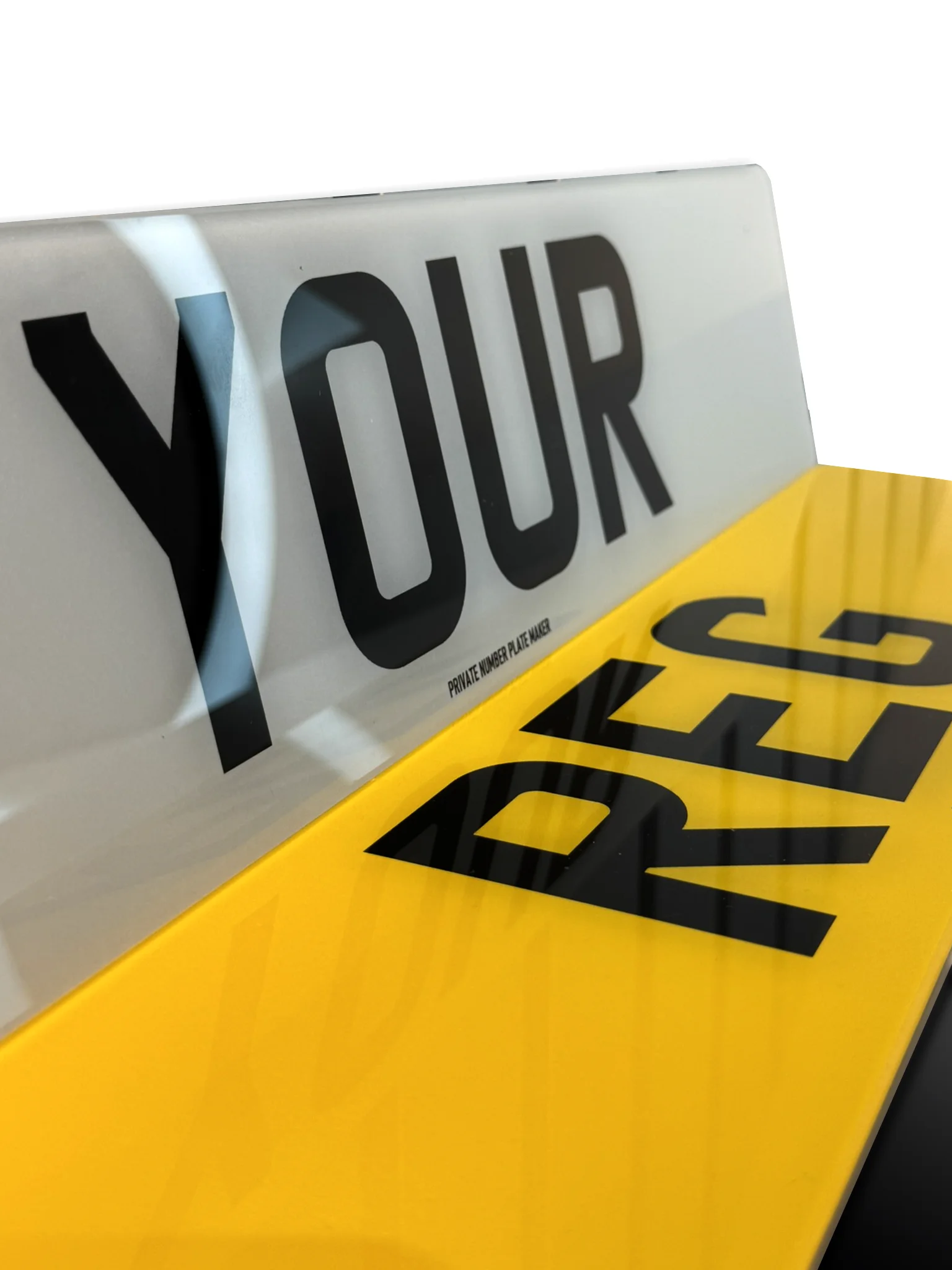
 Printed
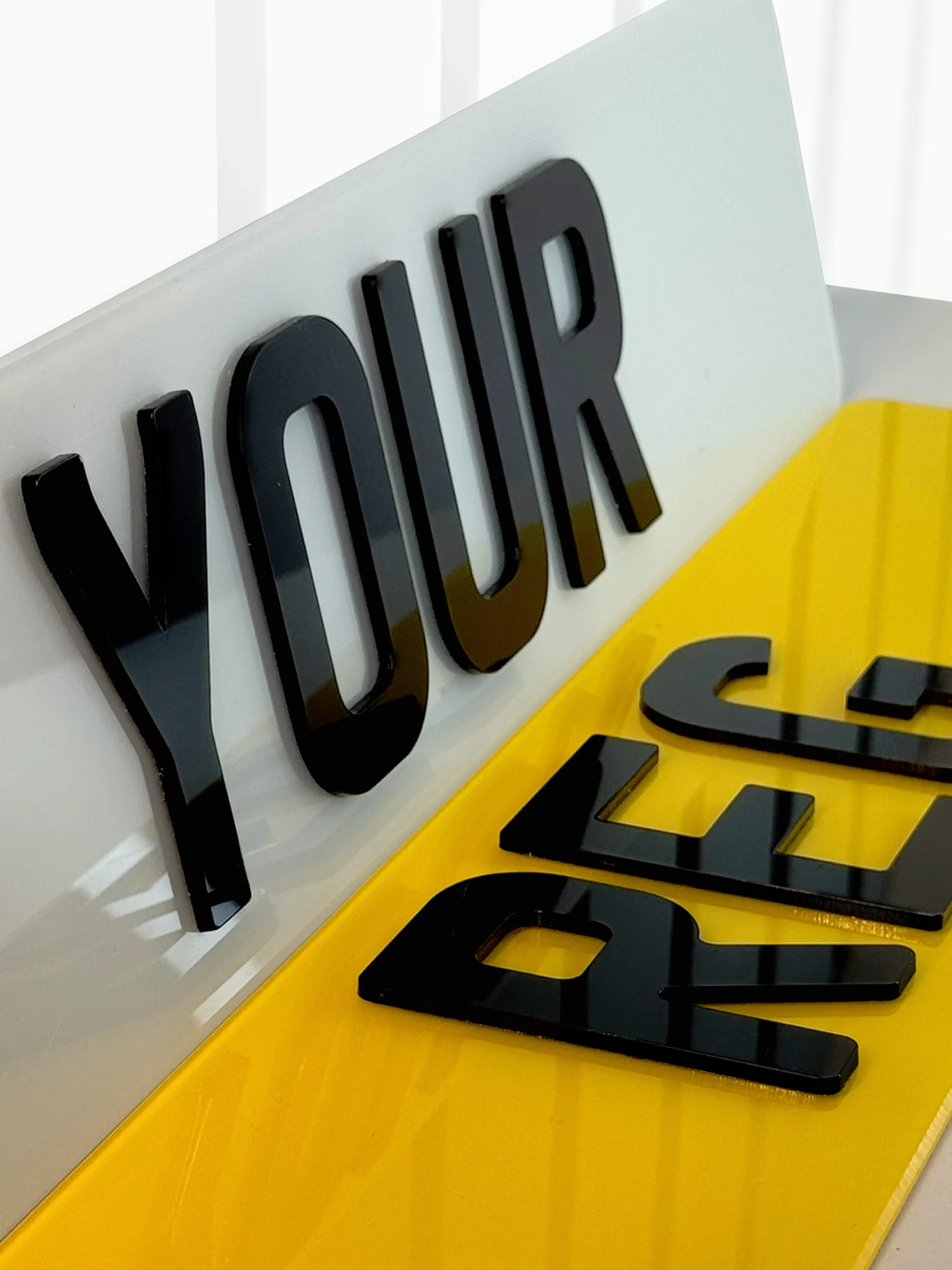
 3D Plate
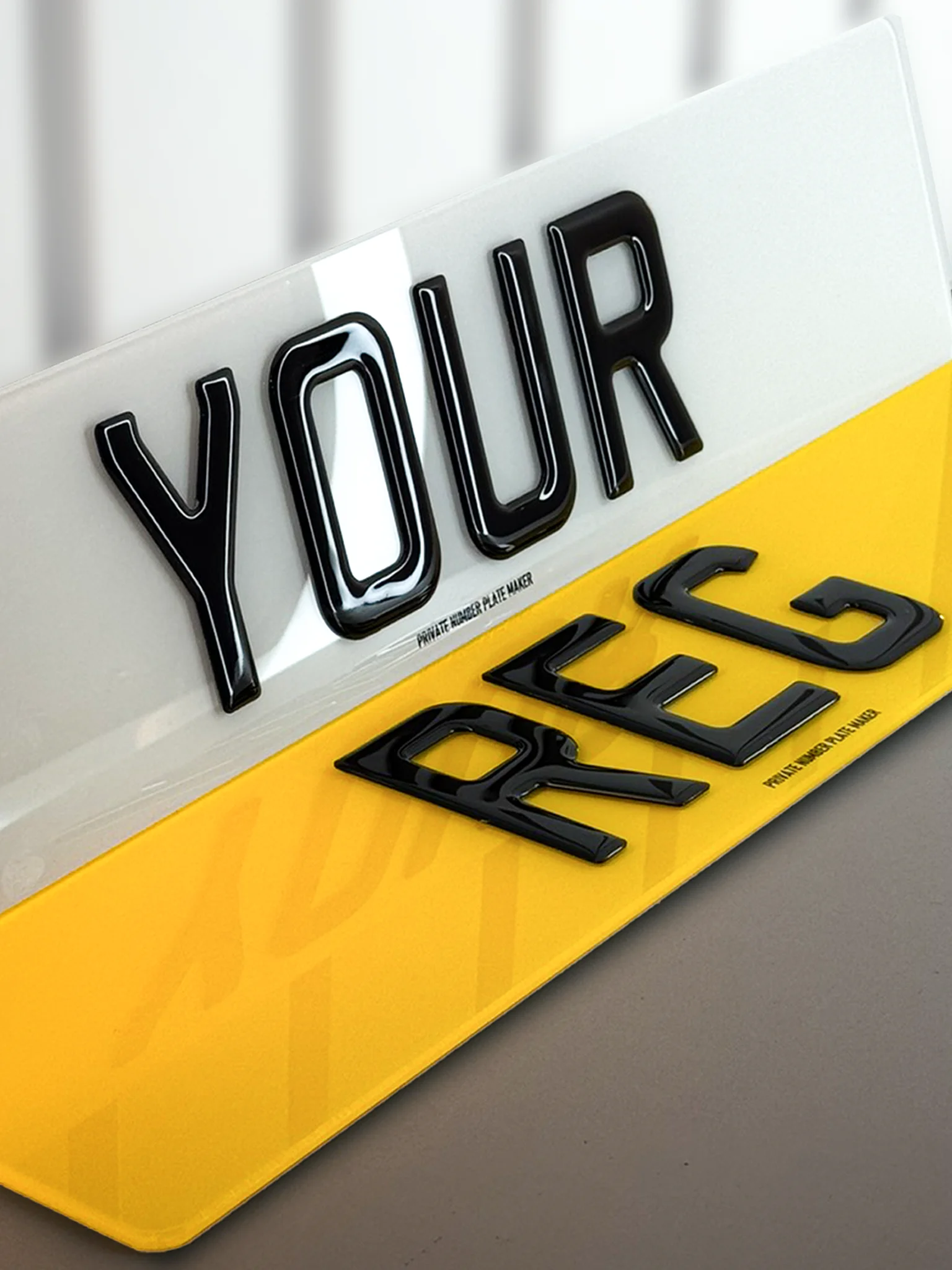
 4D Plate
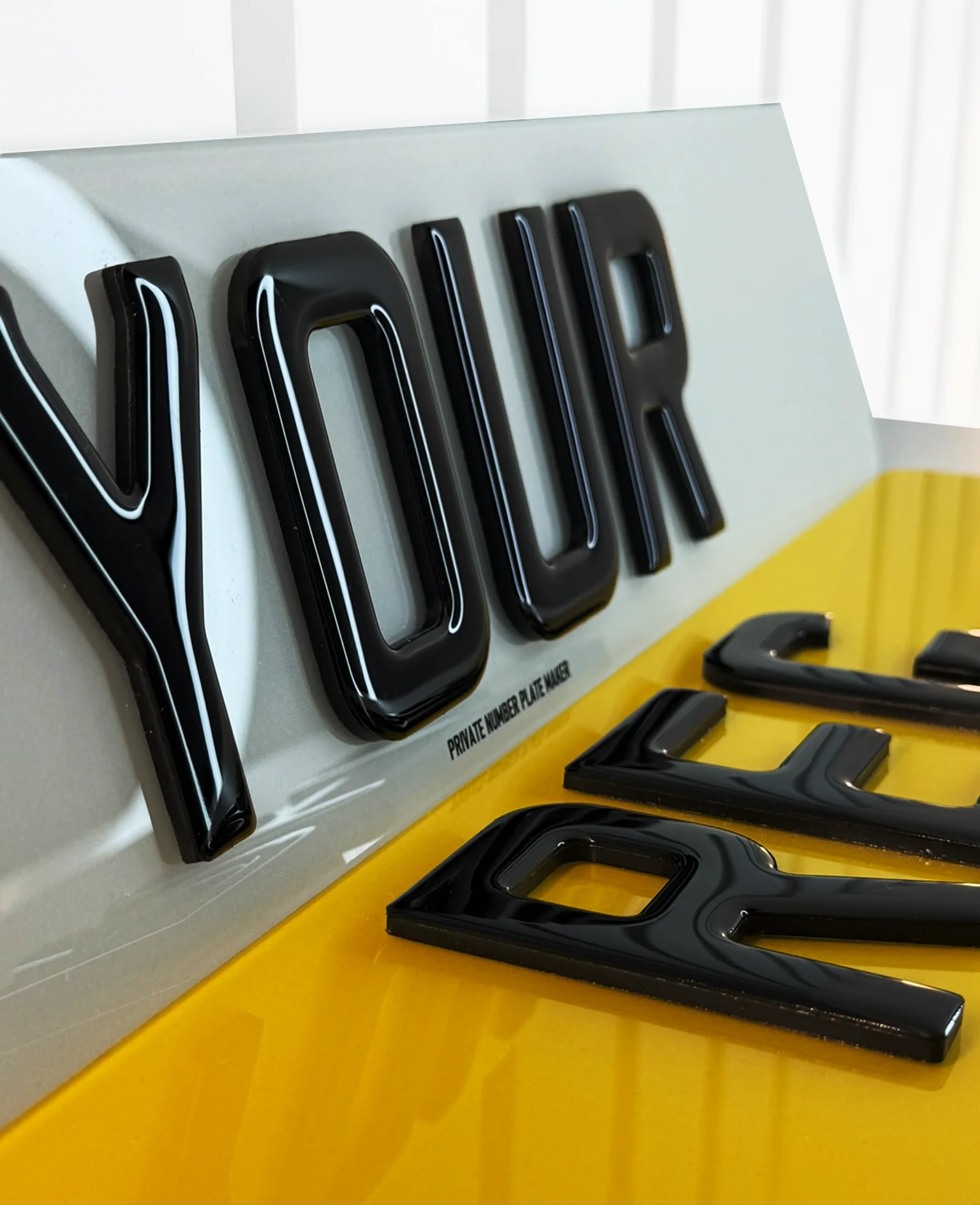 5D Plate
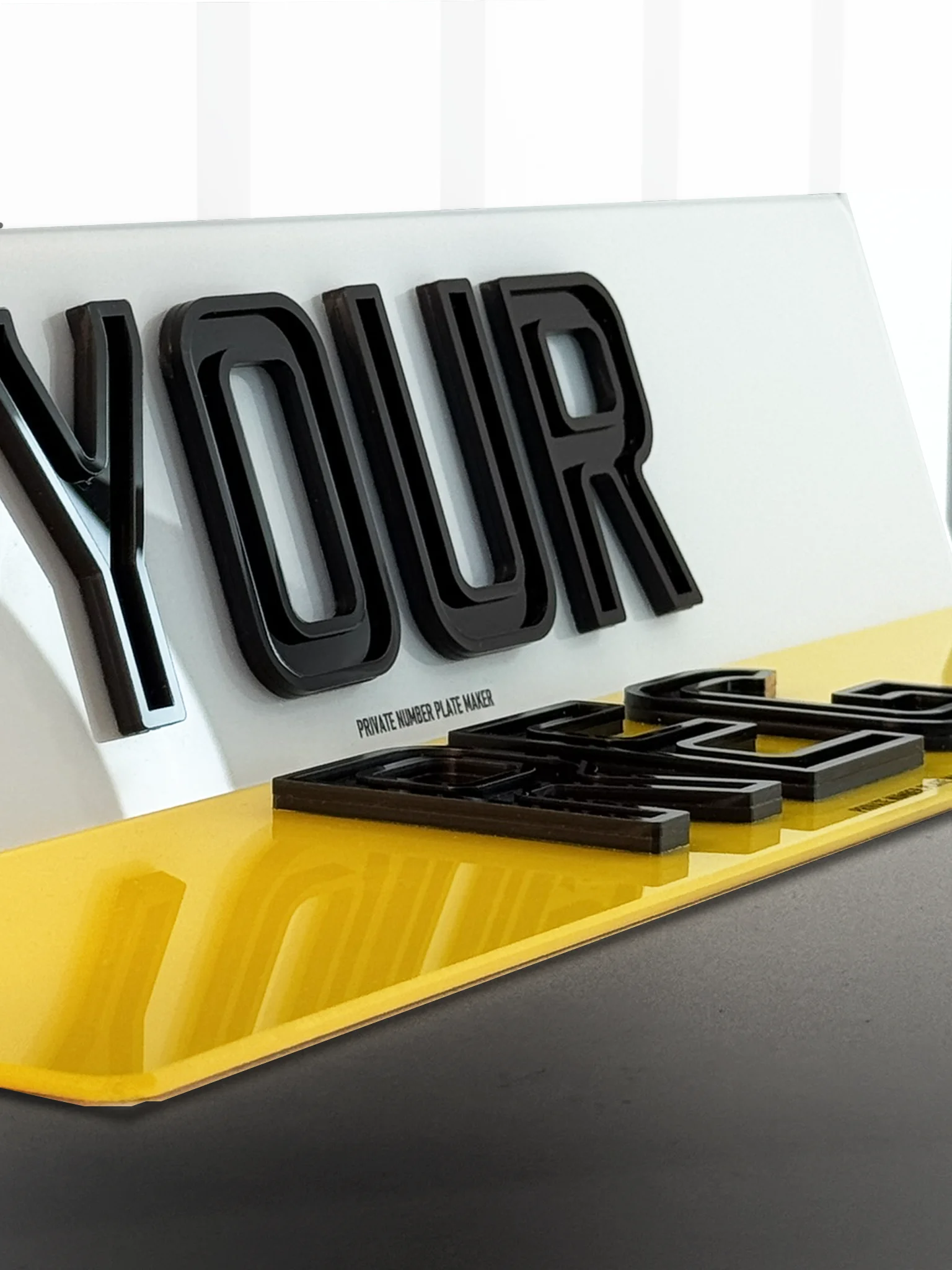 Ghost
Ghost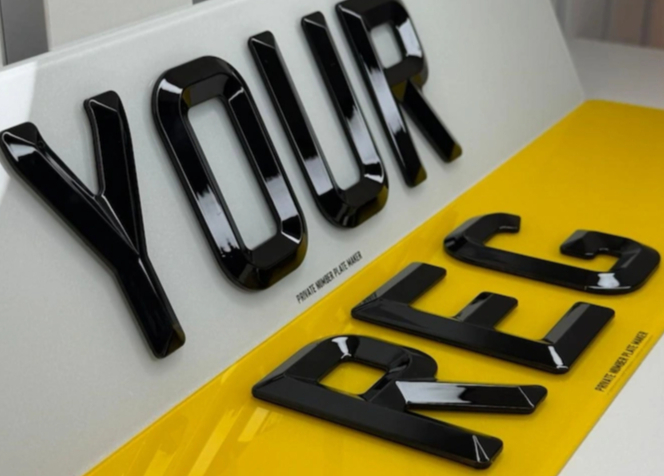 Bevel
Bevel5D Gel Number Plates vs Standard 4D: What's the Difference?
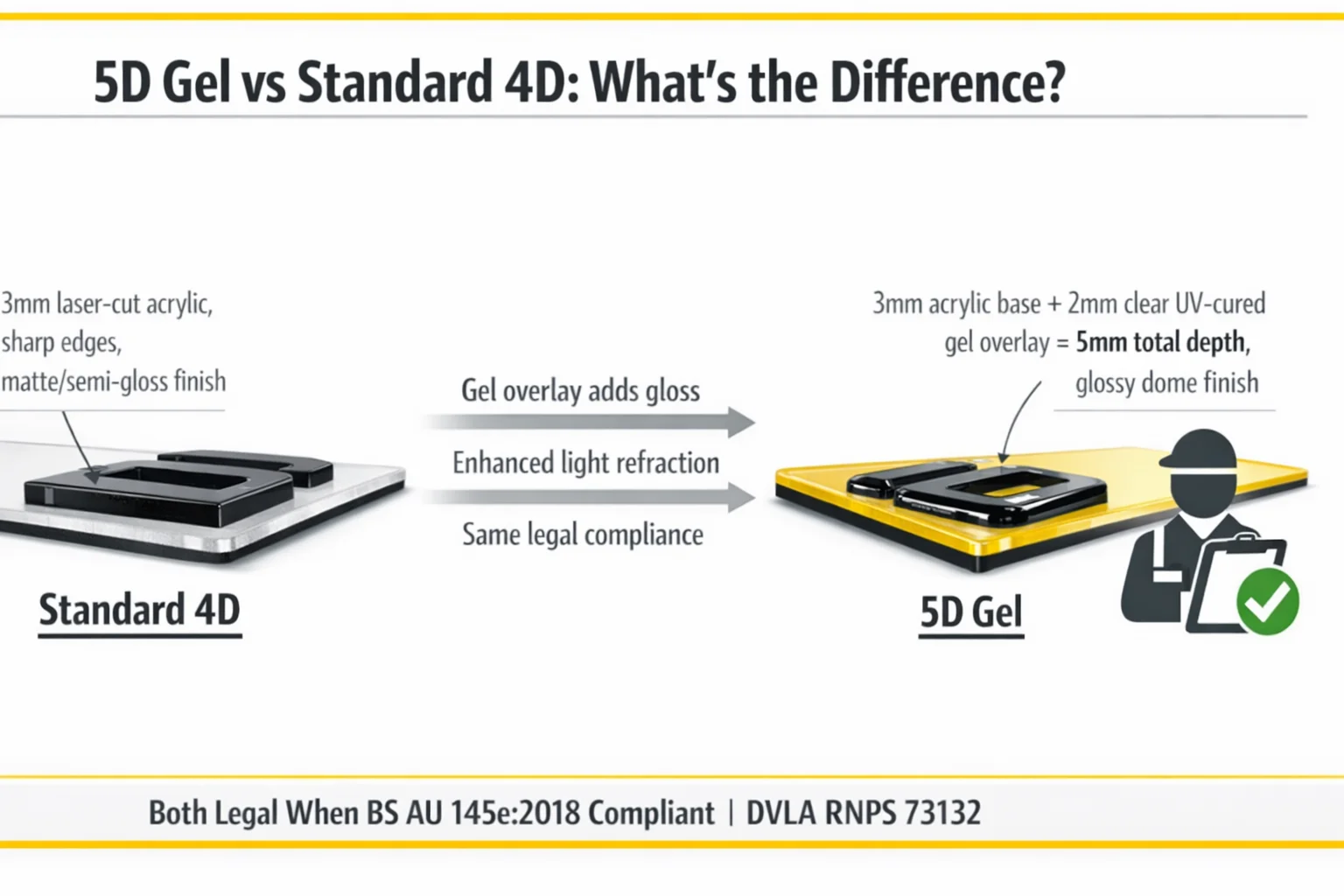
Summary
The key difference between 5D gel number plates and standard 4D plates is the addition of a 2mm clear UV-cured gel overlay applied over the 3mm laser-cut acrylic base. Standard 4D plates feature 3mm acrylic characters with a matte or semi-gloss finish. 5D plates combine the same acrylic foundation with a glossy gel dome, creating 5mm of total character depth that merges sharp edge definition with enhanced light refraction.
Both types can be fully legal for UK road use when manufactured to BS AU 145e:2018 standards, using the mandatory Charles Wright font, maintaining standard character dimensions (79mm height, 50mm width, 11mm spacing), and preserving full retroreflective performance. Importantly, many suppliers list the same dual-layer specification as "4D 5mm" or "4D with gel" - these terms generally refer to the same construction as "5D". As a DVLA-registered manufacturer (RNPS ID: 75449) based in Ilford, we produce both types on-site using certified materials and controlled processes.
Related guide: Learn more about 5D plate technology in our main guide | Full 3-way comparison
What Are Standard 4D Number Plates?
Understanding the baseline specification helps clarify what the gel overlay adds in 5D construction.
Construction and Materials
3mm Laser-Cut Acrylic Characters
Standard 4D plates feature characters cut from polymethyl methacrylate (PMMA) acrylic sheet using precision CNC laser equipment. This process delivers:
- Sharp, geometric edge definition
- Consistent character dimensions matching Charles Wright font specifications
- Structural rigidity resistant to minor impacts
- A modern, architectural aesthetic
Direct Bonding to Substrate
The acrylic characters are bonded directly to a BS AU 145e:2018 certified reflective substrate using automotive-grade adhesives. This ensures:
- Secure attachment without air pockets or delamination risk
- Preservation of the reflective substrate between characters
- Compliance with spacing and margin requirements
Finish Characteristics
Standard 4D plates typically feature a matte or semi-gloss acrylic surface with no additional coating, light interaction focused on edge definition rather than surface reflection, and a clean, minimalist appearance favoured by enthusiasts seeking understated premium styling.
Related guide: 4D number plates explained: complete guide to laser-cut plates | 4D plates FAQ
What Are 5D Gel Number Plates?
5D plates build upon the 4D foundation by adding a second manufacturing layer.
Dual-Layer Construction Explained
Base Layer: Identical to Standard 4D
- 3mm laser-cut acrylic characters using Charles Wright font
- Precision dimensions: 79mm height (cars), 50mm width, 14mm stroke
- Bonded to BS AU 145e:2018 certified reflective substrate
- Same structural foundation as standard 4D plates
Overlay Layer: 2mm UV-Cured Gel
Applied over the acrylic base is a transparent polyurethane resin gel that:
- Is dispensed using controlled equipment for consistent 2mm thickness
- Cures under UV light to form a durable, optically clear dome
- Creates a glossy finish that enhances light refraction
- Adds a protective coating resistant to minor surface abrasion
Combined Specification: 5mm Total Depth
- Characters stand 5mm proud of the plate substrate (3mm acrylic + 2mm gel)
- Merges 4D-style sharp edges with 3D-style glossy dome effect
- Delivers maximum visual prominence while maintaining compliance
Related guide: Learn about UV curing process for gel overlays
The Key Difference: Gel Overlay Explained
The gel overlay is the sole differentiator between standard 4D and 5D plates. Understanding its properties clarifies why it enhances appearance without affecting legality.
What the Gel Overlay Does
Visual Enhancement
- Creates a glossy, domed finish that catches and refracts light
- Adds perceived depth beyond the physical 5mm measurement
- Produces dynamic appearance that changes with viewing angle
- Enhances shadow definition for greater visual impact
Protective Function
- Shields the underlying acrylic from minor surface abrasion
- Resists environmental degradation (UV, moisture, temperature fluctuations)
- Maintains optical clarity over years of outdoor exposure when quality materials are used
Light Interaction
- Refracts ambient light through the curved gel surface
- Creates subtle highlights and colour shifts as light moves across characters
- Enhances visibility in low-light conditions without compromising ANPR readability
What the Gel Overlay Does Not Do
Does Not Affect Legal Compliance
- Applied only to character areas, preserving reflective substrate between characters
- Clear and transparent formulation allows NIR wavelengths to reach the certified substrate
- Does not alter character dimensions, font, or spacing requirements
- Maintains full BS AU 145e:2018 retroreflective performance when properly manufactured
Does Not Change Fundamental Construction
- The acrylic base remains identical to standard 4D plates
- Character formation, font, and planar dimensions are unchanged
- Manufacturing process for the acrylic layer is the same
Does Not Require Different Fitting or Maintenance
- Uses standard number plate fixings and positioning
- Cleaning methods are similar (mild soap, soft cloth, avoid abrasives)
- MOT inspection criteria are identical
Related guide: Complete number plate fitting guide | Maintenance tips
Understanding Market Terminology: "5D" vs "4D 5mm"
Confusion arises because different suppliers use varied terminology for essentially the same specification.
Common Terms and What They Mean
| Term Used | Typical Specification | What It Actually Means |
|---|---|---|
| 5D Number Plates | 3mm acrylic + 2mm gel = 5mm total | Dual-layer construction with glossy finish |
| 4D 5mm Number Plates | 3mm acrylic + 2mm gel = 5mm total | Same as "5D"; emphasises dimensional specification |
| 4D with Gel Overlay | 3mm acrylic + 2mm gel = 5mm total | Explicit description of dual-layer construction |
| Dual-Layer 4D Plates | 3mm acrylic + 2mm gel = 5mm total | Generic term for combined acrylic/gel construction |
| Standard 4D Plates | 3mm acrylic only = 3mm total | Single-layer acrylic without gel overlay |
What Matters Most: Specification Over Name
Regardless of terminology, confirm these key details before purchasing:
- Yes Total character depth: 5mm (3mm acrylic + 2mm gel) for dual-layer; 3mm for standard acrylic-only
- Yes Base material: Laser-cut acrylic, not printed or moulded plastic
- Yes Overlay material (if applicable): UV-cured resin gel, clear and untinted
- Yes Substrate: BS AU 145e:2018 certified reflective material
- Yes Font: Mandatory Charles Wright typeface
- Yes Dimensions: Standard character height (79mm), width (50mm), spacing (11mm)
Related guide: Charles Wright font requirements: complete guide | BS AU 145e explained
Visual and Aesthetic Comparison
The most noticeable distinction is appearance in different lighting conditions.
Daytime Appearance
Standard 4D Plates
- Sharp, defined edges create clear light/shadow contrast
- Matte or semi-gloss finish reduces glare
- Architectural, modern aesthetic with clean lines
- Characters appear precisely "cut out" with geometric profiles
5D Gel Plates
- Same sharp acrylic edges plus glossy gel dome
- Gel surface refracts light, creating highlights and subtle colour shifts
- Dynamic appearance that changes with viewing angle
- Maximum visual prominence with enhanced shadow definition
Nighttime and Low-Light Performance
Both types maintain full retroreflective performance between characters, ensuring ANPR cameras detect plates reliably, drivers can read plates in headlights, and legal compliance is preserved.
The raised elements interact with light differently: 4D sharp acrylic edges catch headlights creating defined highlights, while 5D combines acrylic edge definition with gel dome light refraction.
Vehicle Style Matching
Choose Standard 4D If:
- Your vehicle has modern, angular design lines
- You appreciate architectural precision without glossy finish
- You prefer matte or semi-gloss aesthetics
- Budget is a consideration within premium options
Choose 5D Gel If:
- You want maximum visual impact and character prominence
- You appreciate both sharp edges and glossy finish
- Your vehicle has bold or performance-oriented styling
- Budget allows for the highest premium option
Related guide: Are premium 5D number plates worth the investment? | 5D plates for car shows
Construction and Manufacturing Differences
Understanding the production process explains quality variations and pricing differences.
Standard 4D Manufacturing Steps
- Substrate Preparation: BS AU 145e:2018 certified reflective material verified and cut to size
- Acrylic Cutting: 3mm PMMA sheet laser-cut to Charles Wright font specifications
- Quality Inspection: Acrylic characters checked for edge quality and dimensional accuracy
- Bonding: Characters bonded to substrate using automotive-grade adhesive
- Final Inspection: Plate checked for font accuracy, spacing, reflectivity, and markings
5D Gel Manufacturing Steps (Includes All 4D Steps Plus)
- Gel Application: UV-cured polyurethane resin dispensed onto acrylic characters for consistent 2mm thickness
- UV Curing: Applied gel cured under UV light to form durable, optically clear dome
- Final Quality Check: Gel clarity, finish consistency, and overall compliance verified
Why 5D Costs More
| Cost Factor | Standard 4D | 5D Gel |
|---|---|---|
| Materials | Acrylic sheet + substrate | Acrylic + gel resin + substrate |
| Labour | Cutting + bonding | Cutting + bonding + gel application + curing |
| Equipment | Laser cutter + bonding station | Laser cutter + bonding + gel dispensing + UV curing |
| Quality Control | Dimensional + reflectivity checks | All 4D checks + gel clarity + finish consistency |
| Typical Price Range | £50-£85 | £70-£110 |
Prices indicative only; vary by supplier, vehicle type, and order volume
Legal Compliance: Both Can Be Legal When Made Correctly
Premium aesthetics must never compromise legal compliance. Understanding the regulatory requirements helps ensure your chosen option remains road-legal.
Mandatory Requirements for All Plate Types
Road Vehicles (Display of Registration Marks) Regulations 2001
Regulation 13: Character Requirements
- Font: Mandatory Charles Wright typeface (introduced 2001)
- Height: 79mm for cars, 64mm for motorcycles
- Width: 50mm (excluding 'I' and '1')
- Stroke thickness: 14mm
- Character spacing: 11mm between characters
- Margins: 11mm minimum around plate edges
Regulation 16: Material Requirements
- Plates must be made of reflective material
- Must meet performance standards for retroreflection
- Must not be treated with substances that reduce reflectivity
- Must comply with applicable British Standard specifications
BS AU 145e:2018 British Standard
All plates must use substrates certified to BS AU 145e:2018, mandating:
- Retroreflectivity for camera and driver visibility
- Impact resistance to withstand road debris
- Weathering durability for outdoor exposure
- NIR compatibility for ANPR detection
How Both Types Maintain Compliance
Character Dimensions & Reflectivity
Raised elements do not alter fundamental character dimensions. Charles Wright font is maintained in the acrylic base layer for both types. For 4D: acrylic applied only to character areas; reflective substrate between characters remains fully functional. For 5D: clear gel overlay allows light to reach and reflect from the certified substrate; no reduction in retroreflective performance.
ANPR Readability & Required Markings
Both types maintain NIR compatibility through certified materials and proper manufacturing. Character shapes remain clearly defined for pattern recognition. BS AU 145e:2018 marking remains visible and legible on both types, with supplier name, postcode, and RNPS ID displayed per regulations.
Related guide: Are 5D number plates legal? Complete UK guide | 4D plates ANPR definitive guide
Durability and Maintenance Comparison
Both types offer excellent longevity when manufactured correctly and maintained properly.
Impact Resistance
| Plate Type | Impact Resistance | Notes |
|---|---|---|
| Standard 4D | Very Good | Acrylic rigidity resists deformation; edges may chip if struck directly |
| 5D Gel | Excellent | Gel overlay shields acrylic edges; layered construction may absorb minor impacts better |
Weathering Performance
Both types use BS AU 145e:2018 certified substrates designed for UV resistance, moisture resistance, and temperature tolerance for UK climate conditions.
Additional Considerations:
- 4D Acrylic: Edges benefit from careful cleaning to avoid abrasion; matte finish may show minor scratches more readily
- 5D Gel: Glossy surface resists minor abrasion well; may require occasional polishing to maintain shine; UV-cured resin formulated for outdoor durability
Maintenance Requirements
Routine Cleaning (Both Types)
- Use mild car shampoo diluted in warm water
- Apply with soft microfiber cloth or sponge
- Rinse thoroughly and dry with clean microfiber towel
- Avoid abrasive cleaners, stiff brushes, or solvent-based products
Special Considerations
- 4D Acrylic: Take care not to catch edges on car wash brushes; avoid high-pressure washers at close range to edges
- 5D Gel: Avoid high-pressure washers at close range to gel surface; glossy finish may benefit from occasional gentle polishing
Which Should You Choose? Decision Guide
Use this framework to select the option that best matches your needs.
Quick Decision Checklist
Aesthetic Preference
- Prefer sharp edges without glossy finish - Standard 4D
- Want both sharp edges and glossy dome - 5D Gel
- Prefer subtle premium appearance - Standard 4D
- Want maximum visual impact - 5D Gel
Vehicle Styling
- Modern, angular design - Standard 4D complements well
- Bold or performance-oriented styling - 5D enhances presence
- Classic or understated vehicle - Either works; 4D may be more subtle
- Electric vehicle with green flash - Both types compatible
Budget Considerations
- Mid-premium budget - Standard 4D offers excellent value
- Highest premium budget - 5D delivers maximum impact
- Want premium appearance at lower cost - Standard 4D
Common Scenarios
"I like the look of 5D but worry about cost"
Standard 4D offers sharp edge definition and premium appearance at a lower price point. The aesthetic difference is subtle in many lighting conditions.
"I want the glossiest finish possible"
5D gel plates deliver the highest gloss finish available in premium number plates, combining acrylic sharpness with gel refraction.
"Will either type affect my MOT?"
Both types pass MOT inspection when manufactured correctly. Testers check reflectivity, character formation, spacing, and markings - all of which compliant 4D and 5D plates satisfy.
Related guide: 5D number plates MOT compliance guide | 5D plates for electric vehicles
Our Manufacturing Approach: Quality and Compliance at Our Ilford Workshop
At Private Number Plate Maker Ltd (RNPS ID: 75449), we manufacture both standard 4D and 5D gel number plates on-site at our Castleview Gardens, Ilford workshop, ensuring full control over quality and compliance.
On-Site Production Advantages
Material Verification
Every substrate is verified against BS AU 145e:2018 certification before production. We source acrylic and gel materials only from approved suppliers with batch documentation.
Precision Manufacturing
- Laser-cutting equipment calibrated for exact character dimensions and Charles Wright font accuracy
- Gel dispensing systems controlled for consistent 2mm overlay thickness on 5D plates
- UV curing parameters monitored for optimal optical clarity and adhesion strength
- Final inspection against dimensional, reflectivity, and finish quality standards
Document Verification
Under Schedule 2 of the Road Vehicles Regulations 2001, we verify your identity and entitlement before manufacturing:
- Accepted documents: V5C, V750, V778, V948, plus driving licence or passport
- Verification conducted in-person for collection or via secure encrypted upload for delivery
- Records retained as required by DVLA RNPS requirements
Same-Day Collection and Next-Day Delivery
Ilford Workshop Collection
Visit our Castleview Gardens, Ilford location for face-to-face document verification, view samples of standard 4D and 5D gel plates side by side, watch your plates being manufactured, and immediate collection once production is complete.
UK-Wide Delivery
For customers outside East London: secure encrypted document upload for remote verification, plates manufactured to order and quality-checked, dispatched via tracked next-day delivery service, and packaging designed to protect raised elements during transit.
Related guide: Same-day number plates in Ilford: what you need to know | Delivery times guide
Frequently Asked Questions
The key difference lies in construction: standard 4D plates use 3mm laser-cut acrylic characters with a matte or semi-gloss finish, while 5D plates add a 2mm clear UV-cured gel overlay to the same acrylic base, creating 5mm total character depth. This dual-layer design combines sharp edge definition with a glossy dome finish for enhanced light refraction. Both types must use the mandatory Charles Wright font and comply with BS AU 145e:2018 standards.
Yes, 5D gel number plates are fully legal when manufactured to meet the Road Vehicles (Display of Registration Marks) Regulations 2001 and BS AU 145e:2018 standards. Compliance requires the mandatory Charles Wright font, standard character dimensions (79mm height, 50mm width), and certified retroreflective substrate. The clear gel overlay must not compromise reflectivity or ANPR readability. Always purchase from a DVLA-registered supplier (RNPS ID: 75449) who verifies your documents before manufacture.
No, when manufactured correctly, the clear UV-cured gel overlay on 5D plates does not affect ANPR readability. The transparent formulation allows near-infrared wavelengths to reach the BS AU 145e:2018 certified reflective substrate, while the underlying acrylic characters maintain sharp definition for pattern recognition. Both 4D and 5D plates must preserve full retroreflective performance between characters to ensure reliable camera detection and legal compliance.
Both types offer excellent longevity when manufactured to BS AU 145e:2018 standards and maintained properly. The 2mm gel overlay on 5D plates may provide marginally enhanced protection against minor surface abrasion and environmental exposure, while standard 4D acrylic edges benefit from careful cleaning to avoid chipping. Regular maintenance with mild soap and a soft cloth preserves appearance for either type. For personalised advice, visit our Ilford workshop to view samples.
Related guide: Read real premium plate reviews from UK drivers
This guide references the following official and verified sources:
Road Vehicles (Display of Registration Marks) Regulations 2001
legislation.gov.ukBritish Standards Institution: BS AU 145e:2018
knowledge.bsigroup.comDVLA Registered Number Plate Supplier (RNPS) requirements
gov.ukMOT Inspection Manual
gov.ukManufacturer technical specifications for acrylic and UV-cured resin materials
Industry datasheets