 Printed
 3D Plate
 4D Plate
 5D Plate
 Ghost
Ghost Bevel
BevelAre Ghost Plates Legal in 2026? Latest Regulations Explained
Summary
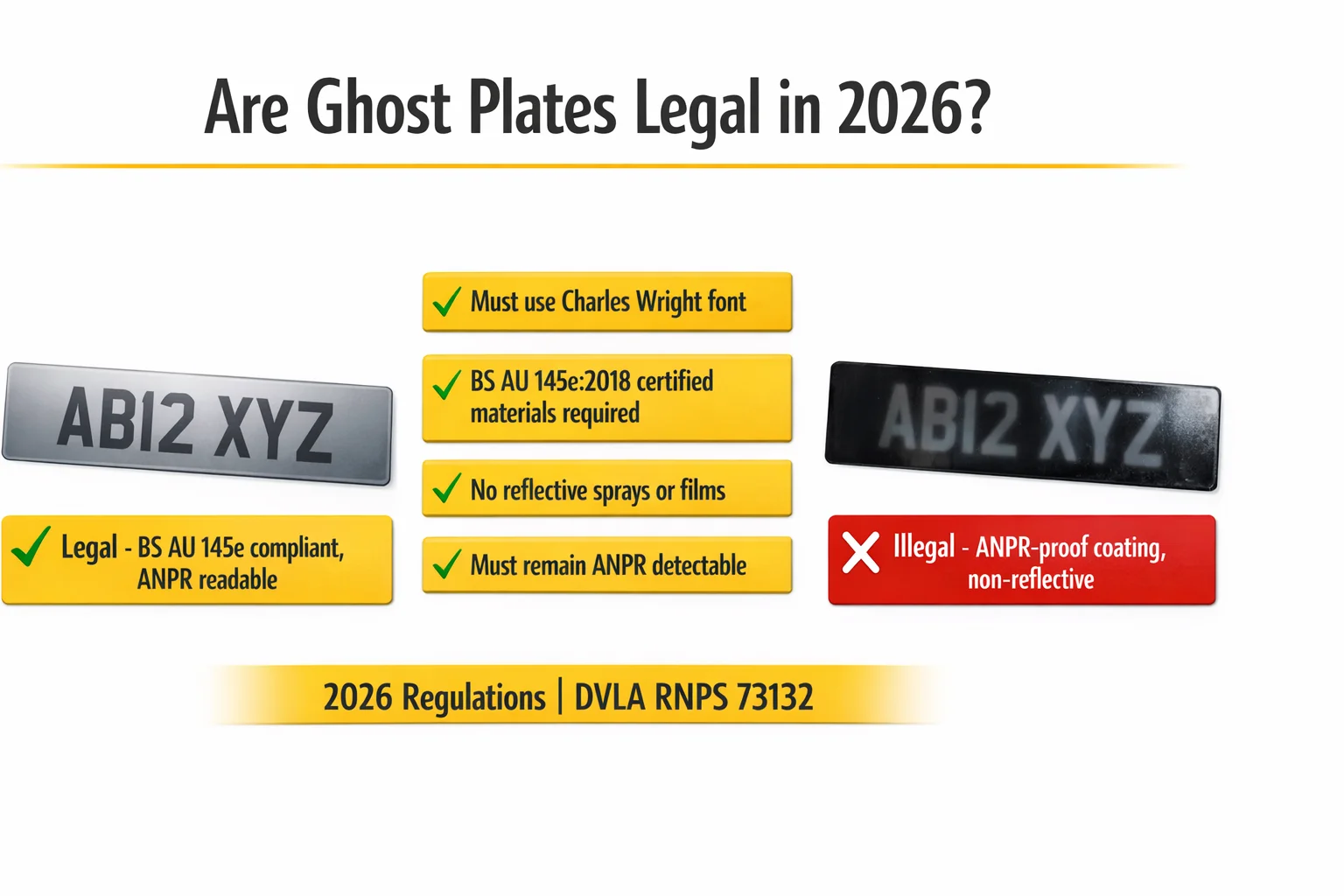
Ghost plates remain legal in 2026 when manufactured to meet specific UK regulations, but the government has significantly intensified enforcement against illegal variants. Legal ghost plates must use BS AU 145e:2018-certified reflective materials, display the mandatory Charles Wright font, maintain standard character dimensions, and remain fully readable by ANPR cameras. The critical distinction is that legal ghost plates achieve their subtle grey gradient aesthetic through approved printing techniques, while illegal plates use reflective sprays, films, or non-compliant materials specifically designed to evade detection.
The January 2026 Road Safety Strategy and recent statements from Transport Minister Lilian Greenwood have emphasised stricter enforcement of number plate compliance, with police and Trading Standards conducting coordinated crackdowns on suppliers and users of illegal plates. Under the Road Vehicles (Display of Registration Marks) Regulations 2001, drivers fitted with illegal ghost plates face fines up to £1,000, MOT failure, and potential vehicle seizure in serious cases.
As a DVLA-registered number plate manufacturer (RNPS ID: 75449) based in Ilford, we manufacture compliant ghost plates that meet all 2026 legal requirements. This guide explains the current regulations, what makes ghost plates legal or illegal, recent enforcement actions, and how to ensure your plates comply with UK law.
What Are Ghost Plates?
Ghost plates, also referred to as grey plates or tonal plates, feature registration characters with a subtle grey-on-grey or gradient effect that creates a sophisticated, understated appearance. The term "ghost" describes how the characters appear to blend with the plate background rather than standing out in traditional high-contrast black on white or yellow.
This aesthetic has gained popularity among car enthusiasts seeking a refined, minimalist look for their vehicles. However, the legality of ghost plates depends entirely on how they are manufactured, not the visual style itself. At our Ilford workshop, we manufacture legal ghost plates using specialised printing techniques that produce the gradient effect while maintaining full compliance with BS AU 145e:2018 standards and ensuring ANPR readability.
Are Ghost Plates Legal in 2026?
Yes, ghost plates are legal in 2026 provided they meet all requirements set out in the Road Vehicles (Display of Registration Marks) Regulations 2001 and use materials certified to BS AU 145e:2018. The regulations have not changed to prohibit ghost plates specifically, but enforcement of existing requirements has intensified significantly.
Current Legal Framework
The legality of all number plates in the UK, including ghost plates, is governed by:
Road Vehicles (Display of Registration Marks) Regulations 2001
This statutory instrument sets out the mandatory requirements for number plate display, including character fonts and dimensions, material specifications, reflectivity requirements, and spacing and formatting rules.
BS AU 145e:2018
The current British Standard for number plates, which mandates retroreflective performance, impact resistance, weathering durability, and NIR (Near-Infrared) compatibility for ANPR detection.
Vehicle Excise and Registration Act 1994
Section 42 provides enforcement powers and penalties for non-compliance.
2026 Enforcement Context
While the regulations themselves have not changed, 2026 has seen unprecedented enforcement action:
January 2026 Road Safety Strategy
The government's Road Safety Strategy emphasised number plate compliance as critical for effective ANPR enforcement, vehicle tax collection, insurance verification, and crime prevention.
Transport Minister Statements
Transport Minister Lilian Greenwood has publicly stated that illegal number plates undermine road safety and enforcement mechanisms, announcing coordinated action between police forces and Trading Standards.
Coordinated Crackdowns
Police and Trading Standards have conducted raids on suppliers selling illegal plates, particularly those marketed as "ANPR-proof" or designed to evade detection.
Legal Requirements for Ghost Plates in 2026
For ghost plates to be legal in 2026, they must meet all standard number plate requirements plus additional scrutiny due to increased enforcement focus.
| Requirement | Specification |
|---|---|
| BS AU 145e:2018 Materials | Certified retroreflective, impact-resistant, weather-resistant, NIR-compatible |
| Font | Mandatory Charles Wright typeface (no substitutions) |
| Character Height | 79mm (cars), 64mm (motorcycles) |
| Character Width | 50mm (except 'I' and '1') |
| Stroke Thickness | 14mm |
| Character Spacing | 11mm |
| Age Identifier Gap | 33mm |
| Margins | 11mm minimum |
| Front Plate Colour | Black characters on white background |
| Rear Plate Colour | Black characters on yellow background |
| ANPR Readability | Must remain fully detectable by ANPR cameras |
| Supplier Markings | BS AU 145e marking, supplier name, postcode, RNPS ID |
Document Verification
Under Schedule 2 of the Road Vehicles Regulations 2001, suppliers must verify your identity and entitlement before manufacturing plates. Accepted documents include V5C, V750, V778, V948, plus driving licence or passport.
What Makes Ghost Plates Illegal?
Illegal ghost plates are manufactured with the specific intent to evade ANPR detection or avoid compliance with regulations. Understanding what makes plates illegal is crucial for avoiding penalties.
Illegal Manufacturing Methods
Reflective Sprays
Applied to reduce or eliminate the plate's reflectivity, making it difficult or impossible for ANPR cameras to detect. These sprays are specifically designed to interfere with enforcement.
ANPR-Proof Films
Specialised coatings or films that block near-infrared wavelengths, preventing cameras from reading the plate while maintaining visible appearance to human observers.
Non-Reflective Substrates
Materials that fail to meet BS AU 145e:2018 reflectivity requirements, often cheaper alternatives that do not contain the necessary retroreflective properties.
Incorrect Fonts & Modified Dimensions
Use of fonts other than the mandatory Charles Wright typeface, or characters that are too narrow, too wide, incorrectly spaced, or otherwise deviate from standard specifications.
Legal vs Illegal Ghost Plates: Key Differences
Yes Legal Ghost Plates
- Manufactured by DVLA-registered suppliers (RNPS)
- Use BS AU 145e:2018 certified reflective materials
- Feature subtle tonal gradient via approved printing
- Remain fully readable by ANPR cameras
- Display correct Charles Wright font & dimensions
- Supplier verifies identity and entitlement documents
- Include BS AU 145e marking and supplier details
- Pass MOT inspection & legal for road use
No Illegal Ghost Plates
- Sold by unregistered resellers or online marketplaces
- Use non-reflective or modified materials
- Employ sprays, films, or coatings to reduce visibility
- Designed specifically to evade ANPR detection
- May use incorrect fonts or spacing
- No document verification required
- Missing required markings
- Fail MOT inspection & illegal for road use
The Critical Test
The fundamental question is: Can ANPR cameras read the plate? Legal ghost plates pass this test while achieving the aesthetic effect. Illegal plates fail this test by design. If a plate is manufactured to evade detection, it is illegal regardless of appearance.
Penalties for Illegal Ghost Plates
Using illegal number plates carries serious consequences under UK law. The 2026 enforcement crackdown means penalties are being applied more rigorously than ever.
Financial Penalties
Fixed Penalty Notice
£100 fine for non-compliant plates, issued on the spot by police or traffic officers.
Level 3 Fine (Magistrates' Court)
Up to £1,000 maximum fine for cases prosecuted under Section 42 of the Vehicle Excise and Registration Act 1994.
Unlimited Fines
For serious cases involving deliberate evasion or repeat offences, determined by court based on circumstances.
MOT Failure
Vehicles fitted with illegal number plates will fail their MOT test under the "Registration Plates" inspection item. Testers must refuse a certificate if plates are not made of reflective material, likely to be confused with other characters, incorrectly spaced or formatted, fitted with non-compliant fonts, or obscured/modified.
ANPR Enforcement & Vehicle Seizure
Police use ANPR cameras extensively for enforcement. When plates fail to register or appear non-compliant, police can stop and inspect the vehicle, issue immediate penalties, or seize the vehicle in serious cases under Section 165A of the Road Traffic Act 1988.
How to Check if Your Ghost Plates are Legal
Supplier Verification Checklist
-
Yes
DVLA RNPS Registration:
Ask for their Registered Number Plate Supplier ID and verify it exists. Our RNPS ID is 75449.
-
Yes
Physical Workshop:
Legitimate manufacturers have verifiable business addresses you can visit. We manufacture at our Castleview Gardens, Ilford workshop.
-
Yes
Document Verification:
They must request and check your entitlement documents before manufacturing. No legitimate supplier skips this step.
-
Yes
BS AU 145e Certification:
They should confirm materials meet the current 2018 standard and provide documentation if requested.
Plate Inspection Checklist
-
Yes
Reflectivity Test:
Hold the plate at an angle to light. It should reflect light clearly, even with the gradient effect.
-
Yes
Font & Dimension Check:
Characters must be Charles Wright typeface, 79mm height (cars), 50mm width, 11mm spacing.
-
Yes
Markings Present:
BS AU 145e marking, supplier name, postcode, and RNPS ID must be visible on the plate.
-
Yes
ANPR Test:
Drive through a known ANPR location. If the system reads your plate successfully, it passes this critical test.
Red Flags to Avoid
- No
"ANPR-proof" or "100% invisible" claims
- No
No document verification required
- No
Prices significantly below market rate
- No
Social media-only suppliers with no physical business
- No
Cannot or will not provide RNPS ID
Our Manufacturing Process: Ensuring 2026 Compliance
At Private Number Plate Maker Ltd, we manufacture legal ghost plates using a controlled process that ensures full regulatory compliance while achieving the desired aesthetic.
Step 1: Document Verification
We verify your identity and entitlement using DVLA-approved documents. This happens either in-person at our Ilford workshop or through our secure encrypted upload system. We never manufacture plates without proper verification.
Step 2: Material Selection
We use only BS AU 145e:2018 certified substrates from approved suppliers. Each batch comes with certification documentation that we retain for audit purposes. We never use non-reflective or modified materials.
Step 3: Digital Design
Your registration is formatted using approved software that ensures correct Charles Wright font, character spacing, and dimensions. The gradient effect is applied digitally while maintaining reflectivity requirements and NIR compatibility.
Step 4: Printing and Finishing
We use specialised printing equipment that creates the subtle tonal effect without applying reflective-reducing coatings. Our process maintains full ANPR readability while achieving the ghost aesthetic.
Step 5: Quality Control
Every plate undergoes rigorous inspection for correct font and dimensions, reflectivity levels meeting BS AU 145e:2018, print quality and gradient consistency, BS AU 145e marking placement, supplier identification marking, and ANPR readability testing.
Step 6: Collection or Dispatch
For same-day collection, you collect from our Castleview Gardens, Ilford workshop where we can answer any questions. For delivery orders, plates are securely packaged and dispatched via tracked next-day delivery UK-wide.
Ghost Plates and MOT Compliance in 2026
With increased enforcement focus, MOT testers are paying closer attention to number plate compliance. Understanding MOT requirements helps avoid failures.
MOT Inspection Points
- Presence: Front and rear plates must be fitted correctly
- Condition: No obscuring dirt, damage, cracking, or deterioration
- Characters: Correctly formed, spaced, and formatted per regulations
- Reflectivity: Must meet BS AU 145e:2018 (testers may use reflectivity meters)
- Colour: Front white background, rear yellow background
- Markings: BS AU 145e standard marking and supplier details must be present
- Font: Must be the mandatory Charles Wright typeface
Common Ghost Plate MOT Failures in 2026
Plates with reflective sprays applied, non-reflective substrates failing BS AU 145e, incorrect character spacing due to gradient effect bleeding, faded or deteriorated gradient coating, missing BS AU 145e marking, incorrect font used, or characters too narrow or wide.
What Happens After MOT Failure?
If your ghost plates fail the MOT, you cannot legally drive the vehicle except to pre-booked repair facilities. You must replace plates before the vehicle can pass retest, incurring new plate costs plus retest fees and time delays.
Frequently Asked Questions
Yes, ghost plates remain legal in 2026 when manufactured to BS AU 145e:2018 standards using reflective materials, the mandatory Charles Wright font, and standard character dimensions. Crucially, they must remain fully readable by ANPR cameras. Always purchase from a DVLA-registered supplier (RNPS) who verifies your documents.
Ghost plates become illegal when manufactured with reflective sprays, ANPR-blocking films, or non-reflective substrates designed to evade detection. Using incorrect fonts, modified character spacing, or missing BS AU 145e:2018 markings also breaches regulations. Plates marketed as "ANPR-proof" can result in fines up to £1,000, MOT failure, or vehicle seizure.
Absolutely. All number plates manufactured for road use in the UK must use materials certified to BS AU 145e:2018. This British Standard mandates retroreflective performance, impact resistance, weathering durability, and NIR compatibility for ANPR detection. Plates lacking the BS AU 145e:2018 marking will fail MOT inspection.
Legal ghost plates meeting BS AU 145e:2018 standards, displaying the Charles Wright font, correct dimensions, and adequate reflectivity will pass MOT inspection. However, testers are applying heightened scrutiny in 2026. As a DVLA-registered manufacturer (RNPS ID: 75449), we guarantee our ghost plates meet all MOT requirements.
This guide references the following official and verified sources:
Road Vehicles (Display of Registration Marks) Regulations 2001
Statutory instrument governing registration mark display
www.legislation.gov.ukBritish Standards Institution - BS AU 145e:2018
Specification for Retroreflecting Number Plates
knowledge.bsigroup.comVehicle Excise and Registration Act 1994 - Section 42
Enforcement powers and penalty provisions
www.legislation.gov.ukGovernment Road Safety Strategy January 2026
Official strategy document on number plate compliance
www.gov.uk
Related Internal Guides:
How ANPR Cameras Work Guide |
Legal Ghost Plates UK Guide |
Charles Wright Font Guide