 Printed
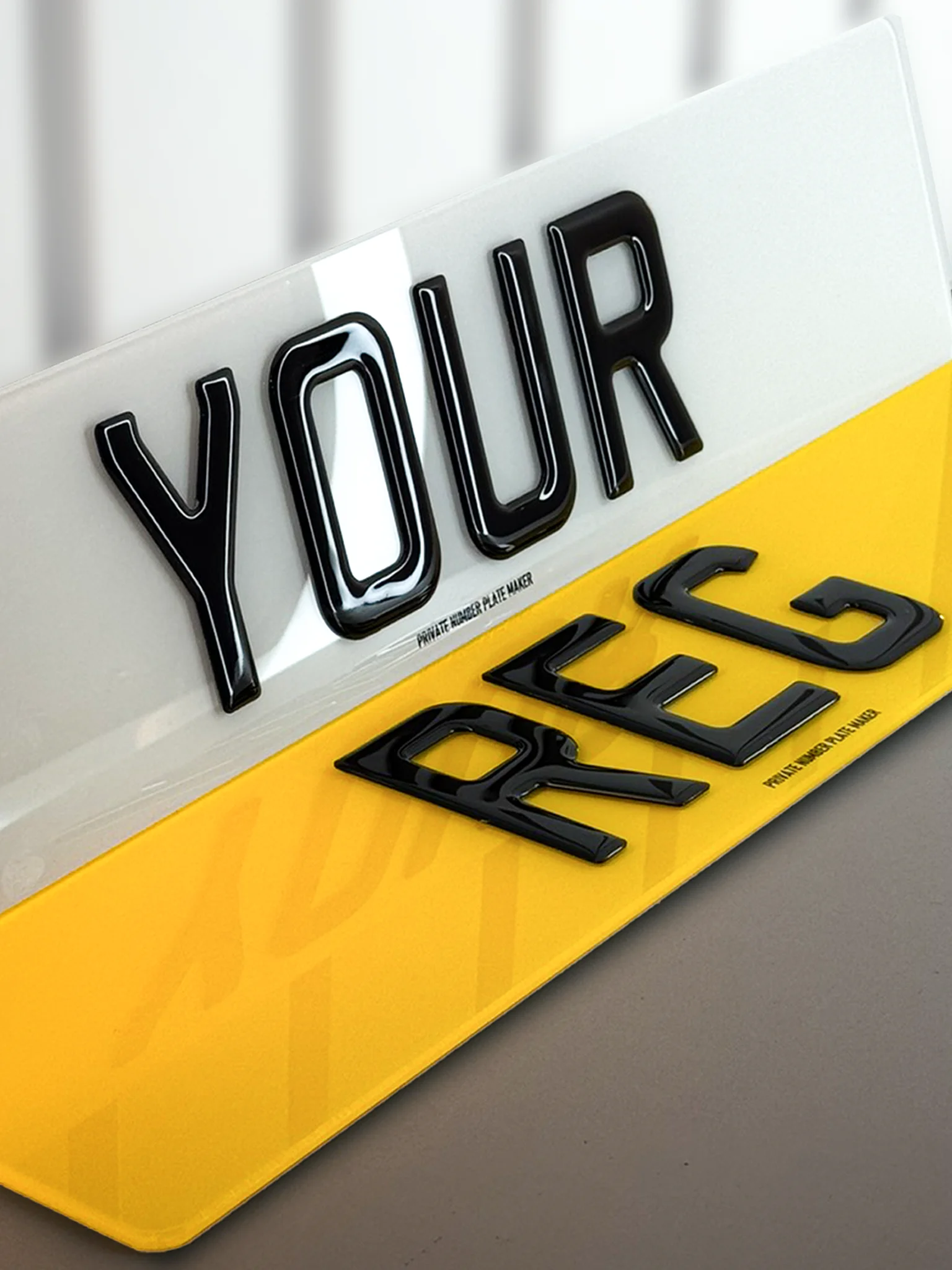 3D Plate
 4D Plate
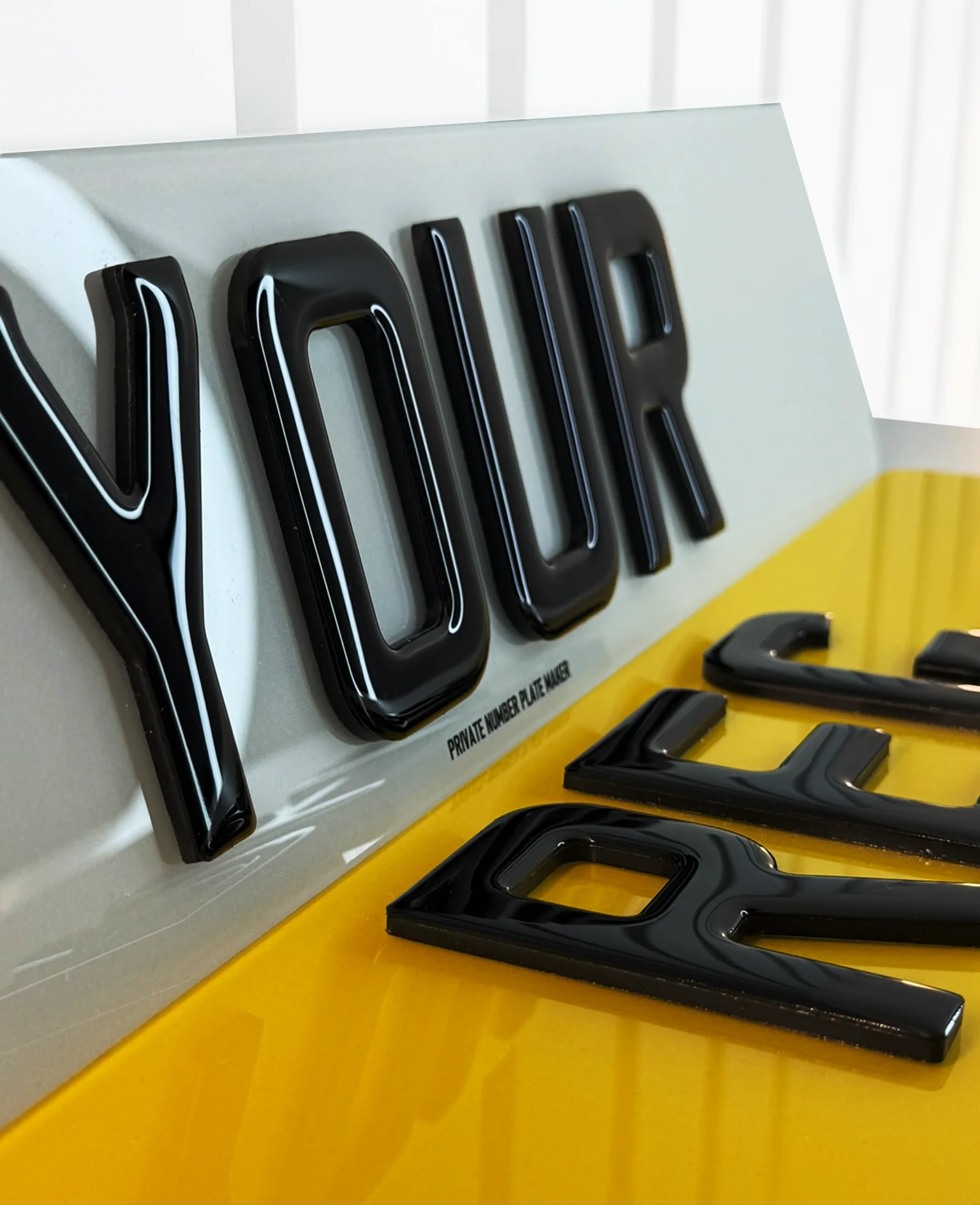 5D Plate
 Ghost
Ghost Bevel
BevelHow to Identify Legal Ghost Plates: 5 Essential Checks
Summary
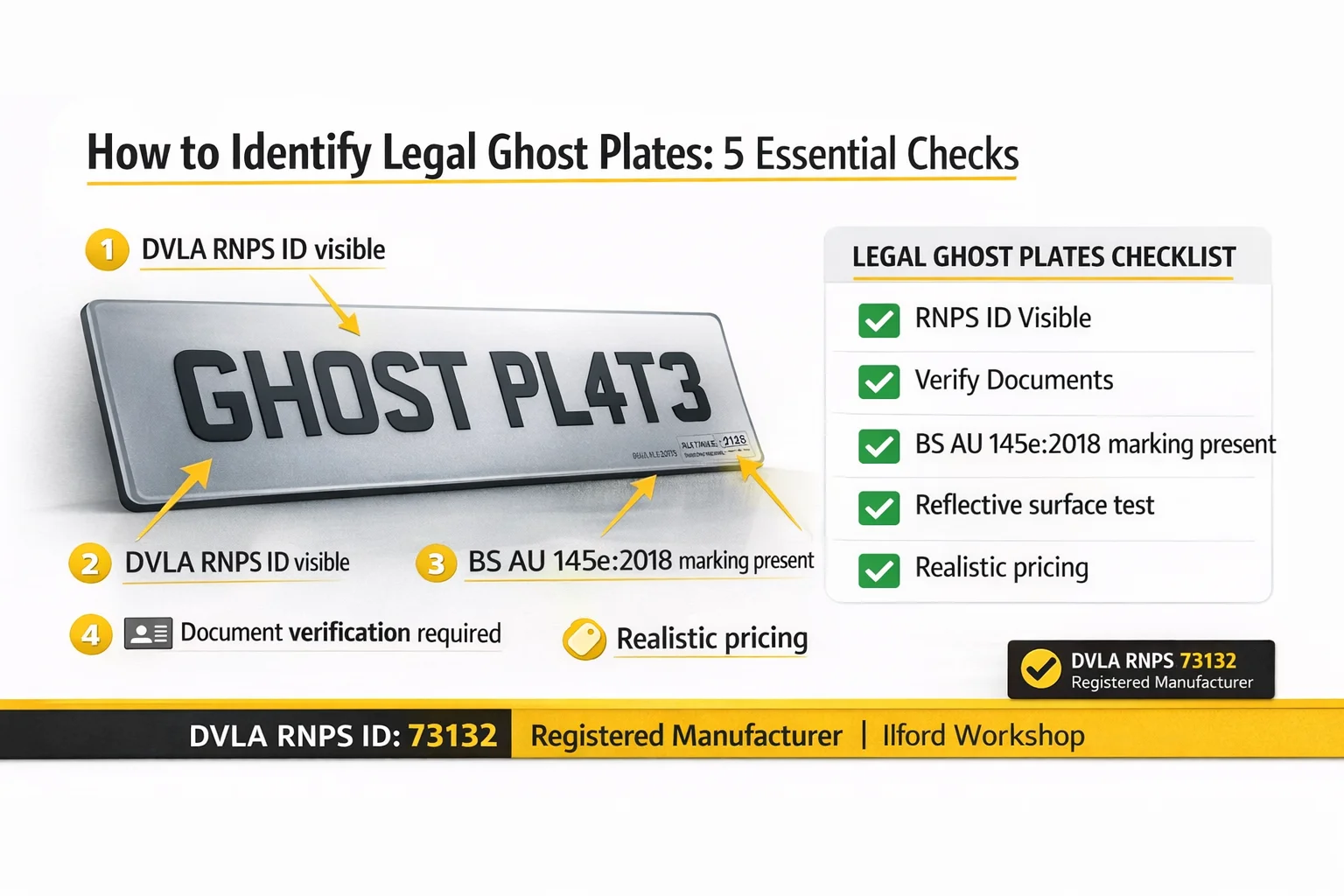
Legal ghost plates - those featuring a subtle grey gradient effect while remaining fully compliant with UK regulations - can be identified using five essential checks. First, verify the supplier is DVLA-registered with a valid RNPS ID. Second, ensure they require document verification before manufacturing. Third, confirm the plate displays BS AU 145e:2018 markings and supplier details. Fourth, test that the plate maintains proper reflectivity for ANPR readability. Fifth, be wary of prices significantly below market rate, which often indicate non-compliant materials or illegal manufacturing methods.
Legal Ghost Plates UK Guide | Are Ghost Plates Legal 2026 Guide
These checks protect you from purchasing illegal plates that carry penalties up to £1,000, cause MOT failure, or risk vehicle seizure. As a DVLA-registered manufacturer (RNPS ID: 75449) based in Ilford, we manufacture compliant ghost plates using BS AU 145e:2018 certified materials and verify all customer documents before production. This practical guide walks you through each verification step, helping you identify legal ghost plates with confidence and avoid costly mistakes.
Why Identifying Legal Ghost Plates Matters
Ghost plates have grown in popularity for their understated, sophisticated appearance. However, the market includes both compliant manufacturers and illegal suppliers selling plates designed to evade ANPR detection. Understanding how to distinguish legal from illegal ghost plates protects you from:
- Financial penalties up to £1,000 under Section 42 of the Vehicle Excise and Registration Act 1994
- MOT failure requiring immediate plate replacement
- Vehicle seizure if insurance or tax cannot be verified
- Potential prosecution for using plates designed to evade enforcement
Illegal Ghost Plates Penalties Guide
The five checks outlined in this guide provide a practical, verifiable framework for assessing plate legitimacy before purchase. Each check is anchored to specific regulatory requirements, not subjective opinion.
Check 1: Verify the Supplier is DVLA-Registered
The most fundamental indicator of legitimacy is whether the supplier holds valid registration with the DVLA as a Registered Number Plate Supplier (RNPS).
How to Verify RNPS Registration
Ask for the RNPS ID
Legitimate suppliers will readily provide their Registered Number Plate Supplier ID. Our RNPS ID is 75449. You can reference DVLA guidance on RNPS requirements to understand what registration entails.
Check for Physical Business Address
Registered suppliers operate from verifiable premises. We manufacture at our Castleview Gardens, Ilford workshop, open for same-day collection. Be cautious of suppliers operating only through social media or unverified websites.
Confirm DVLA Registration Status
While the DVLA does not publish a public searchable RNPS database, registered suppliers should be able to explain their registration status and compliance processes. Ask direct questions about their registration and document verification procedures.
Government Crackdown Ghost Plates 2026 Guide
Red Flags for Unregistered Suppliers
- Cannot or will not provide an RNPS ID
- No physical business address or workshop
- Operates exclusively through Instagram, Facebook, WhatsApp, or unverified marketplaces
- Claims exemption from document verification requirements
- Uses language suggesting plates are "ANPR-proof" or "invisible to cameras"
Check 2: Confirm Document Verification is Required
Under Schedule 2 of the Road Vehicles (Display of Registration Marks) Regulations 2001, all number plate suppliers must verify your identity and entitlement to the registration mark before manufacturing plates. This requirement applies equally to ghost plates and standard plates.
Accepted Documents for Verification
You should be asked to provide one of the following entitlement documents:
- V5C Registration Certificate (Log Book) - Shows you are the registered keeper
- V750 Certificate of Entitlement - For new registration purchases
- V778 Retention Document - For registrations held on retention
- V948 Authorisation Letter - From DVLA or auction house
- New Vehicle Registration Supplement - For brand new vehicles
Plus one form of identification:
- Valid UK Driving Licence (photocard)
- Valid Passport (UK or EEA)
DVLA Document Requirements Guide
How Verification Should Work
In-Person Collection
At our Ilford workshop, we verify documents face-to-face before manufacturing begins. You can watch your plates being produced while we retain copies of your documentation as required by law.
Secure Online Upload
For delivery orders, we use encrypted document upload systems that protect your personal data while enabling remote verification. We never accept screenshots, photographs of documents, or unverified digital copies.
Red Flags for Non-Compliant Verification
- No document requests at point of sale
- Acceptance of bank statements, utility bills, or unverified screenshots
- Willingness to manufacture plates without seeing entitlement documentation
- Claims that verification is "optional" or "not required for ghost plates"
If a supplier does not verify your documents, they are operating illegally and any plates they produce are non-compliant.
Check 3: Inspect Plate Markings and Supplier Details
Legal number plates must display specific markings that confirm compliance and traceability. These markings are required under the Road Vehicles (Display of Registration Marks) Regulations 2001 and BS AU 145e:2018.
Mandatory Markings on Legal Plates
BS AU 145e:2018 Standard Marking
The plate must display the British Standard reference, typically formatted as "BS AU 145e:2018". This confirms the substrate meets current requirements for reflectivity, impact resistance, weathering, and NIR compatibility.
Supplier Name and Postcode
The manufacturer's business name and postcode must be marked on the plate, usually along the bottom edge. This enables traceability and accountability.
RNPS ID Number
Registered suppliers must include their RNPS ID on plates they manufacture. Our plates display "RNPS 75449" as proof of DVLA registration.
Where to Find These Markings
Markings are typically positioned:
- Bottom left corner of the plate
- Bottom centre, beneath the registration characters
- Along the lower border, in small but legible text
Use a magnifying glass or phone camera zoom if markings are small. They should be permanently embedded in the plate material, not applied as stickers or temporary labels.
Red Flags for Missing or Incorrect Markings
- No BS AU 145e marking visible
- Markings that appear to be stickers or applied after manufacture
- Supplier details that cannot be verified (fake names, non-existent postcodes)
- RNPS ID that does not match the supplier's claimed registration
- Markings that rub off, fade, or appear poorly printed
Check 4: Test Reflectivity and ANPR Compatibility
Legal ghost plates must maintain the retroreflective performance required by BS AU 145e:2018 while achieving their subtle gradient aesthetic. This is the critical test that distinguishes legal from illegal plates.
Simple Reflectivity Test You Can Perform
The Torch Test
In a dimly lit area, hold a torch or phone light at the angle a camera would view the plate (approximately 15-30 degrees from perpendicular). A compliant plate will reflect light clearly back toward the source. The gradient effect should not eliminate this reflectivity.
What to Look For:
- Consistent reflection across the entire plate surface
- Characters remain visible and distinct under reflected light
- No areas that appear completely matte or non-reflective
- Gradient effect achieved through printing, not coating
ANPR Readability Check
Drive-Through Test
If possible, drive through a known ANPR location such as a car park entry, toll booth, or speed camera zone. Legal plates should be read consistently by the system. Inconsistent reads or repeated failures may indicate non-compliance.
Professional Verification
Some suppliers offer ANPR readability testing as part of their quality control. Ask whether your plates have been tested against ANPR systems before dispatch.
Why Reflectivity Matters
BS AU 145e:2018 mandates four key requirements:
- Retroreflectivity - Plates must reflect light back to its source for camera and driver visibility
- Impact Resistance - Materials must withstand stone chips and minor impacts
- Weathering - Plates must resist fading, cracking, or deterioration from environmental exposure
- NIR Compatibility - Materials must be detectable by near-infrared wavelengths used by ANPR cameras
ANPR-Proof Plates Illegal Guide
Illegal ghost plates often fail the NIR compatibility requirement because manufacturers apply coatings that block near-infrared detection. This makes them illegal regardless of visible appearance.
Check 5: Assess Pricing as a Compliance Indicator
While price alone does not determine legality, significantly below-market pricing often indicates corner-cutting on materials, manufacturing standards, or regulatory compliance.
Understanding Legal Plate Costs
Legal ghost plates require:
- BS AU 145e:2018 certified substrates (more expensive than non-certified alternatives)
- Specialised printing equipment to achieve gradient effects without compromising reflectivity
- Document verification systems and staff training
- RNPS registration fees and compliance audits
- Quality control processes and testing
These requirements create a baseline cost structure that legitimate suppliers cannot significantly undercut without compromising compliance.
Price Red Flags
Extremely Low Prices
Be cautious of ghost plates priced significantly below standard plates. Legal ghost plates typically cost 10-30% more than standard 2D plates due to specialised printing processes.
Bulk Discount Pressure
Suppliers pushing large bulk orders at deep discounts may be offloading non-compliant stock or using inferior materials.
No Price Transparency
Legitimate suppliers provide clear pricing breakdowns. Vague quotes or pressure to pay before seeing specifications warrant caution.
What Reasonable Pricing Looks Like
While exact prices vary by supplier and plate specifications, legal ghost plates from registered manufacturers typically fall within predictable ranges. Contact us for current pricing on compliant ghost plates manufactured at our Ilford workshop.
Bonus: Quick Pre-Purchase Checklist
Use this condensed checklist before finalising any ghost plate purchase:
Yes Supplier Verification
- RNPS ID provided and verifiable
- Physical business address confirmed
- Clear compliance guarantees offered
Yes Document Process
- Entitlement documents requested before manufacture
- Secure verification method (in-person or encrypted upload)
- No acceptance of unverified screenshots or informal ID
Yes Plate Markings
- BS AU 145e:2018 marking present and permanent
- Supplier name, postcode, and RNPS ID visible
- Markings embedded in material, not applied as stickers
Yes Reflectivity Test
- Plate reflects light consistently under torch test
- Gradient effect does not eliminate retroreflectivity
- ANPR readability confirmed where possible
Yes Pricing Assessment
- Price aligns with market rates for compliant plates
- No pressure for bulk purchases at deep discounts
- Clear breakdown of what is included
If any check fails, reconsider the purchase. The risks of illegal plates far outweigh any short-term savings.
What to Do If You Suspect Illegal Plates
If you have already purchased plates and suspect they may be non-compliant:
Stop Using Them Immediately
Do not fit suspected illegal plates to your vehicle. Driving with non-compliant plates carries enforcement risks.
Contact the Supplier
Request documentation proving BS AU 145e:2018 certification and RNPS registration. Legitimate suppliers will provide this promptly.
Seek Replacement from Registered Manufacturer
Replace suspected plates with compliant ones from a DVLA-registered supplier. Keep records of the replacement to demonstrate good faith if questioned.
Replacement Number Plates UK Complete Buying Guide
Report Suspicious Suppliers
You can report suspected illegal plate suppliers to:
- DVLA via their official contact channels
- Trading Standards via the Citizens Advice consumer service
- Local police if plates are marketed as "ANPR-proof"
Document Everything
Keep receipts, order confirmations, and correspondence. These provide evidence if enforcement action arises or if you need to dispute charges.
Frequently Asked Questions
To verify a supplier's DVLA registration, ask for their Registered Number Plate Supplier (RNPS) ID - legitimate suppliers provide this readily. Our RNPS ID is 75449. Confirm they operate from a physical business address, not just social media. While the DVLA doesn't publish a public RNPS database, registered suppliers should transparently explain their compliance processes. Always request proof of registration before purchase to ensure your plates meet Road Vehicles Regulations 2001 requirements.
Legal ghost plates must permanently display three key markings: the BS AU 145e:2018 standard reference, the manufacturer's business name and postcode, and their RNPS ID number. These should be embedded in the plate material along the bottom edge, not applied as stickers. At our Ilford workshop, we mark "RNPS 75449" on every plate for traceability. Missing, incorrect, or removable markings indicate non-compliance and risk MOT failure.
Yes. Under Schedule 2 of the Road Vehicles (Display of Registration Marks) Regulations 2001, all number plate suppliers must verify your identity and entitlement before manufacturing any plates, including ghost styles. You'll need to provide a V5C, V750, V778, or V948 plus valid photo ID. We verify documents face-to-face at our Ilford workshop or via secure encrypted upload for delivery orders. Any supplier skipping this step is operating illegally.
Absolutely. Legal ghost plates maintain full retroreflectivity and near-infrared (NIR) compatibility required by BS AU 145e:2018, ensuring reliable ANPR readability. The subtle grey gradient is achieved through approved printing techniques that don't compromise camera detection. You can perform a simple torch test: in dim light, a compliant plate reflects light consistently across its surface. If a supplier claims plates are "ANPR-proof" or "invisible to cameras", they are selling illegal products.
Conclusion
Identifying legal ghost plates requires attention to five essential checks: supplier registration, document verification, plate markings, reflectivity testing, and pricing assessment. These checks are not subjective opinions but verifiable indicators anchored to UK regulations and British Standards.
By applying this framework before purchase, you protect yourself from the financial, legal, and practical risks of illegal plates. You also support legitimate manufacturers who invest in compliance, quality, and customer protection.
At Private Number Plate Maker Ltd (RNPS ID: 75449), we manufacture compliant ghost plates at our Ilford workshop, verifying all documents and guaranteeing legal road use. Every plate we produce passes the five checks outlined in this guide - because compliance is not optional, it is essential.
Choose verified suppliers. Choose compliant plates. Choose peace of mind.
This guide references the following official and verified sources:
Road Vehicles (Display of Registration Marks) Regulations 2001
Statutory instrument governing registration mark display
www.legislation.gov.ukVehicle Excise and Registration Act 1994 - Section 42
Enforcement powers and penalty provisions
www.legislation.gov.ukBritish Standards Institution - BS AU 145e:2018
Specification for Retroreflecting Number Plates
knowledge.bsigroup.comTrading Standards Consumer Guidance
Consumer protection guidance on number plate compliance
www.bnma.org