
 Printed
 3D Plate
 4D Plate
 5D Plate
 Ghost
Ghost Bevel
BevelWho Can Get Green Number Plates? Eligibility Guide 2026
Summary
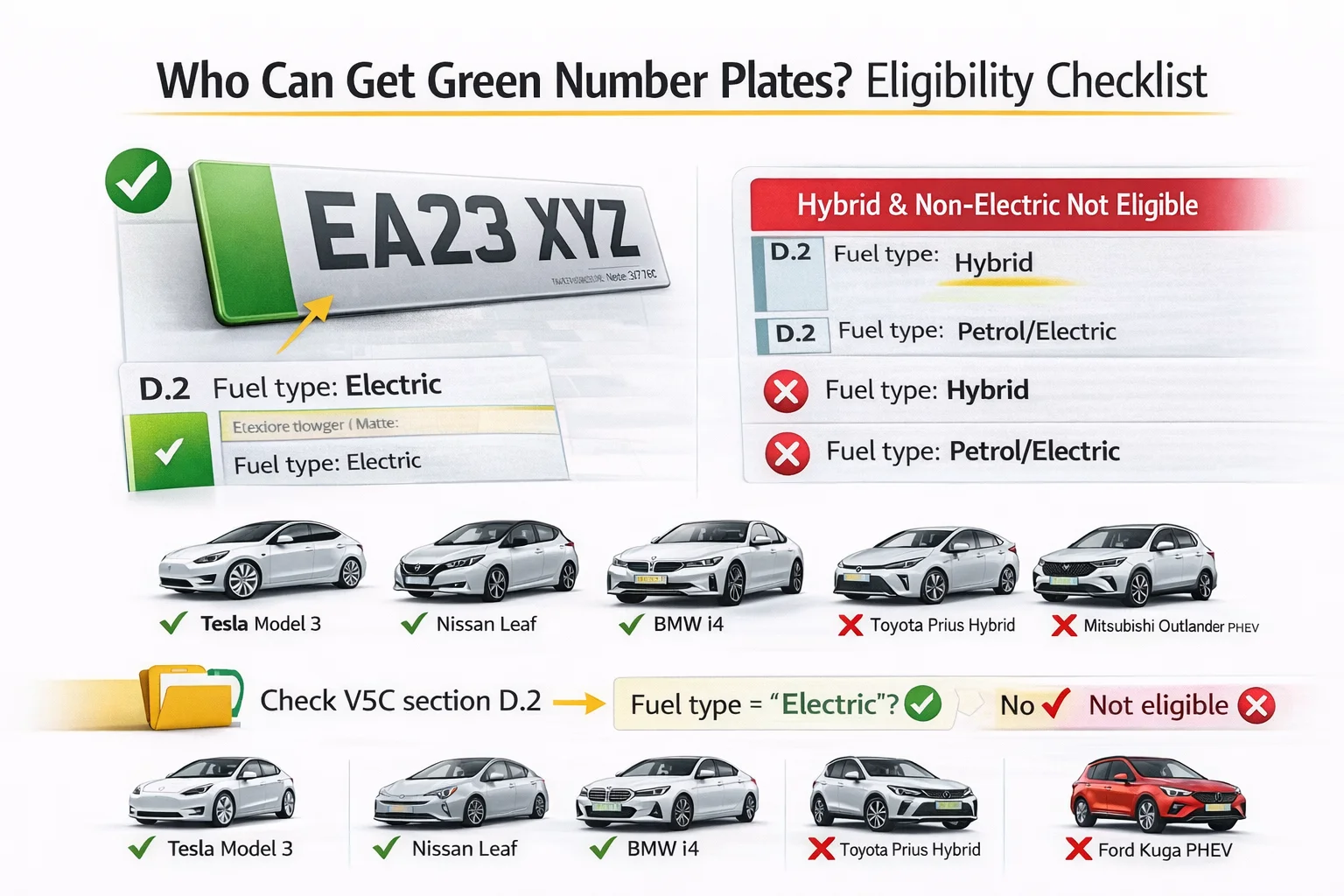
Only pure battery electric vehicles (BEVs) with zero tailpipe CO2 emissions are eligible for green number plates in the UK. This excludes all hybrid electric vehicles (HEVs), plug-in hybrid electric vehicles (PHEVs), and range-extended electric vehicles, regardless of their electric-only range or low emissions rating. Eligibility is determined solely by the fuel type recorded on your V5C registration certificate - it must state "Electric" in section D.2. For full details, see our green number plates UK Guide.
As a DVLA-registered number plate manufacturer (RNPS ID 75449) based in Ilford, we verify every green plate order against your V5C documentation before manufacturing. We only produce green flash plates for vehicles with confirmed "Electric" fuel type status. Displaying green plates on an ineligible vehicle can result in MOT failure, fines up to £1,000 under Section 42 of the Vehicle Excise and Registration Act 1994, and potential invalidation of insurance claims. Learn more in our number plate fines UK Guide.
Quick Answer: The Eligibility Rule in One Sentence
Only vehicles with "Electric" recorded as the fuel type in section D.2 of the V5C registration certificate qualify for green number plates.
This single rule determines eligibility. It does not matter:
- How low your vehicle's CO2 emissions are
- Whether your vehicle can drive on electric power alone for short distances
- Whether your vehicle is classified as "Ultra Low Emission" or "Zero Emission Capable"
- Whether you believe your vehicle should qualify based on environmental credentials
If the V5C does not say "Electric", the vehicle is not eligible for green number plates. Check our DVLA document requirements Guide for verification details.
The Legal Framework: Why Only Pure BEVs Qualify
Green number plates were introduced on 8 December 2020 following a UK government consultation on measures to support electric vehicle adoption. The policy specification, published via gov.uk, explicitly limits eligibility to vehicles with zero tailpipe emissions - meaning pure battery electric vehicles (BEVs) only.
The legal basis for this restriction is found in:
- The Road Vehicles (Display of Registration Marks) Regulations 2001, which govern all number plate specifications - see our 4D plates legal 2026 Guide
- DVLA guidance for Registered Number Plate Suppliers (RNPS), which requires suppliers to verify vehicle eligibility before manufacturing green flash plates
- The Vehicle Excise and Registration Act 1994, which provides enforcement powers for incorrect registration mark display - details in our number plate fines UK Guide
The policy intent is clear: green plates serve as a visual identifier for vehicles that produce zero tailpipe emissions at all times. Hybrid and plug-in hybrid vehicles, while lower-emission than conventional petrol or diesel cars, still produce tailpipe emissions when their combustion engine is operating. Including them would undermine the clarity and enforcement value of the green flash system.
Eligible Vehicles: Pure Battery Electric Vehicles (BEVs)
What Defines a BEV?
A Battery Electric Vehicle (BEV) is powered exclusively by electricity stored in an onboard battery pack. It has:
- No internal combustion engine of any kind
- No fuel tank for petrol, diesel, or other liquid fuels
- Zero tailpipe CO2 emissions under all driving conditions
- A V5C registration certificate that records fuel type as "Electric"
Common Eligible Vehicle Models
The following popular models are eligible for green number plates when registered as pure electric variants:
Tesla:
- Model 3 (all variants)
- Model Y (all variants)
- Model S
- Model X
Nissan:
- Leaf (all generations)
- Ariya
Hyundai:
- Ioniq Electric (not Ioniq Hybrid or Ioniq Plug-in Hybrid)
- Ioniq 5
- Ioniq 6
- Kona Electric
Kia:
- e-Niro
- EV6
- Soul EV
Volkswagen Group:
- Volkswagen ID.3, ID.4, ID.5, ID.7
- Volkswagen e-up!
- Audi Q4 e-tron, e-tron GT
- Å koda Enyaq iV
- Cupra Born
BMW:
- i3 (pure electric variant, not REx)
- i4
- iX
- iX1, iX3
MG:
- MG4 Electric
- MG ZS EV
- MG5 EV
Other Eligible Models:
- Polestar 2
- Fiat 500e
- Renault Zoe
- Mini Cooper SE
- Peugeot e-208, e-2008
- Vauxhall Corsa-e, Mokka-e
- Ford Mustang Mach-E
This list is not exhaustive. The definitive test is always your V5C registration certificate, not the model name alone. Some model ranges include both electric and hybrid variants - only the pure electric versions qualify. See our green number plates UK Guide for complete eligibility details.
Ineligible Vehicles: Hybrids, PHEVs, and Other Exclusions
Hybrid Electric Vehicles (HEVs) - Not Eligible
Hybrid vehicles that cannot be plugged in to charge their battery are not eligible, even if they have very low CO2 emissions.
Common ineligible HEV models:
- Toyota Prius (hybrid variant)
- Toyota Yaris Hybrid
- Honda Jazz Hybrid
- Hyundai Ioniq Hybrid (not the Electric variant)
- Kia Niro Hybrid
These vehicles generate electricity through regenerative braking and their combustion engine. They cannot be charged from an external power source and always have a petrol or diesel engine that produces tailpipe emissions.
Plug-in Hybrid Electric Vehicles (PHEVs) - Not Eligible
Plug-in hybrids can be charged from an external power source and may drive significant distances on electric power alone. However, they still contain a combustion engine and produce tailpipe emissions when that engine is operating.
Common ineligible PHEV models:
- Mitsubishi Outlander PHEV
- Ford Kuga PHEV
- Volvo XC60 T8 Recharge, XC90 Recharge
- BMW 330e, 530e, X5 xDrive45e
- Mercedes-Benz GLC 300e, GLE 350de
- Hyundai Tucson PHEV, Santa Fe PHEV
- Kia Sportage PHEV, Sorento PHEV
- Toyota RAV4 Plug-in Hybrid
- Cupra Formentor e-Hybrid
Even if a PHEV has an official electric-only range of 30, 40, or 50 miles, it is not eligible for green number plates. The presence of any combustion engine that can produce tailpipe emissions disqualifies the vehicle. Learn more in our tinted vs ghost plates legal Guide.
Range-Extended Electric Vehicles (REEVs) - Not Eligible
Some vehicles, such as the BMW i3 with Range Extender (REx), use a small petrol engine solely to generate electricity for the battery. While the combustion engine does not directly drive the wheels, these vehicles are still not eligible because:
- They contain a petrol fuel tank and combustion engine
- They produce tailpipe emissions when the range extender is operating
- Their V5C will not record fuel type as "Electric"
Hydrogen Fuel Cell Vehicles - Current Status
Hydrogen fuel cell electric vehicles (FCEVs), such as the Toyota Mirai or Hyundai Nexo, produce only water vapour at the tailpipe. However, under current DVLA guidance, these vehicles are not automatically eligible for green number plates unless their V5C explicitly records fuel type as "Electric" or an equivalent zero-emission classification.
If you own a hydrogen fuel cell vehicle and wish to obtain green plates, contact DVLA directly to confirm your vehicle's classification before ordering.
Converted or Kit-Electric Vehicles
Vehicles that have been converted from petrol or diesel to electric power after original registration are not automatically eligible. The conversion must be officially recognised by DVLA, and the V5C must be updated to reflect the new fuel type as "Electric" before green plates can be issued.
How to Check Your V5C for Eligibility
Step-by-Step Verification
- Locate your V5C registration certificate (log book). If you have recently purchased the vehicle and are waiting for the full V5C, you may use the V5C/2 new keeper supplement temporarily, but the full V5C must confirm eligibility before green plates can be manufactured.
- Find section D.2 on the V5C. This section is labelled "Fuel type" or "Fuel" and appears in the vehicle details section, typically on the first or second page.
- Read the fuel type entry exactly as printed. Eligibility requires the entry to state "Electric" (case-insensitive, but the word must be present).
- Confirm the vehicle identification number (VIN) in section E matches the vehicle you are ordering plates for, to prevent errors or fraud.
What the V5C Fuel Type Field Might Show
| V5C Fuel Type Entry | Eligible for Green Plates? |
|---|---|
| Electric | Yes Yes |
| Battery Electric | Yes Yes (if DVLA system records as eligible) |
| Petrol | No No |
| Diesel | No No |
| Petrol/Electric | No No (indicates hybrid or PHEV) |
| Diesel/Electric | No No (indicates hybrid or PHEV) |
| Hybrid | No No |
| Plug-in Hybrid | No No |
| Other | No No (contact DVLA for clarification) |
| Blank or missing | No No (contact DVLA to update record) |
If Your V5C Is Not Yet Updated
If you have recently purchased an electric vehicle and your V5C still shows the previous owner's details or an outdated fuel type:
- Use the V5C/2 new keeper supplement temporarily for standard plates only
- Wait for the updated V5C to arrive from DVLA before ordering green plates
- If the updated V5C does not show "Electric" as fuel type despite the vehicle being pure electric, contact DVLA immediately to correct the record
What If My V5C Doesn't Say "Electric"?
Common Scenarios and Solutions
Scenario 1: You bought a new electric vehicle, but the V5C shows "Petrol/Electric"
This indicates the DVLA system has not yet been updated with the correct fuel classification
- Contact DVLA via their online enquiry form or phone line with your vehicle details and proof of purchase
- Request that they update the fuel type to "Electric" on your registration record
- Do not order green plates until the V5C is corrected
Scenario 2: You imported an electric vehicle from overseas
- Imported vehicles require DVLA type approval and registration before a UK V5C is issued
- Work with your importer or DVLA directly to ensure the fuel type is recorded correctly at first registration
- Green plates can only be ordered once the UK V5C shows "Electric"
Scenario 3: You converted a vehicle to electric power
- Post-registration conversions require DVLA inspection and reclassification
- Submit evidence of the conversion (receipts, engineer's report, photos) to DVLA
- Once DVLA updates your V5C to show "Electric", you become eligible for green plates
Scenario 4: Your V5C is lost or damaged
- Apply for a replacement number plate Guide from DVLA before ordering green plates
- Standard replacement process applies; green plates cannot be issued based on alternative documentation alone
Contacting DVLA for Eligibility Queries
For questions about your vehicle's classification:
- Visit: www.gov.uk/contact-the-dvla
- Phone: 0300 790 6802 (Monday to Friday, 8am to 7pm; Saturday, 8am to 2pm)
- Have your vehicle registration number and VIN ready when you call
DVLA can confirm your vehicle's official fuel classification and advise on steps to update your record if needed.
Company Cars, Leased Vehicles, and Fleet EVs
Leased Electric Vehicles
If you lease an electric vehicle through a contract hire or personal lease agreement:
- The V5C will typically be held by the finance company or leasing provider
- You can still order green plates if you can provide:
- A copy of the V5C (the leasing company can supply this)
- Your driving licence as proof of identity
- The lease agreement showing you are the registered keeper or primary driver
Contact your leasing provider to request the documentation needed for number plate orders. Most major leasing companies are familiar with this process for electric vehicles. See our fleet number plates Guide for business ordering details.
Company Fleet EVs
For vehicles registered to a business:
- The company must provide authorisation for the individual ordering the plates
- Acceptable documentation includes:
- V5C showing the company as registered keeper
- Letter of authorisation on company letterhead naming the individual authorised to order plates
- The authorised individual's driving licence for identity verification
We verify all business orders with the same rigour as private orders to ensure compliance with RNPS requirements.
Salary Sacrifice and Novated Lease Schemes
Vehicles obtained through salary sacrifice or novated lease arrangements follow the same eligibility rules. The key factor remains the fuel type recorded on the V5C, not the method of acquisition.
Why the Strict Eligibility Rules Matter
Preventing Misuse of EV Incentives
Local authorities and parking operators use green number plates as a quick visual identifier for vehicles eligible for benefits such as:
- Free or discounted parking in EV bays
- Exemption from clean air zone charges (where EVs are exempt)
- Access to bus lanes or priority lanes in some areas
If non-eligible vehicles displayed green plates, it would:
- Undermine the fairness of these incentive schemes
- Create enforcement challenges for parking attendants and ANPR systems
- Reduce public trust in the green plate system
Protecting You From Enforcement Action
Displaying green plates on an ineligible vehicle is not a minor technicality. It can lead to:
- MOT failure if the plate is deemed non-compliant
- Fixed Penalty Notices up to £1,000 under Section 42 of the Vehicle Excise and Registration Act 1994
- Penalty Charge Notices if you use EV-only parking or lanes without eligibility
- Potential insurance complications if a claim arises while displaying incorrect plates
By verifying eligibility before manufacturing, we protect both you and the integrity of the green plate scheme. Review our number plate fines UK Guide for penalty details.
Ordering Green Plates: Document Requirements
What We Need to See
Before we can manufacture green number plates, we must verify:
Your identity:
- Valid UK photocard driving licence, OR
- Valid passport (UK or EEA), OR
- Biometric Residence Permit
Your entitlement to the registration mark AND EV status:
- V5C registration certificate showing "Electric" in section D.2 (primary document)
- V5C/2 new keeper supplement (temporary, pending full V5C)
- V750 Certificate of Entitlement for a personalised registration assigned to an EV
- V778 Retention Document for a registration held on retention for an EV
- Official DVLA letter confirming electric status (for converted or imported vehicles)
Why We Cannot Accept Alternative Documents
We cannot accept:
- Screenshots or photos of documents (unless official electronic DVLA emails)
- Bank statements or utility bills (not proof of vehicle status)
- V5C showing any fuel type other than "Electric"
- Self-declaration forms or emails stating "my car is electric"
These restrictions are not arbitrary - they are required by DVLA guidance for Registered Number Plate Suppliers to prevent fraud and ensure only eligible vehicles receive green flash plates. See our DVLA document requirements Guide.
Our Verification Process in Ilford
At our Ilford workshop:
- We examine your original documents in person or verify encrypted uploads remotely
- We confirm the registration number on your documents matches the plates you are ordering
- We check that section D.2 of your V5C states "Electric"
- We record the verification as required by RNPS regulations
- Only after successful verification do we manufacture your green plates
This process takes minutes for in-person collection and 2-4 hours for online orders during business hours.
Common Misconceptions About Eligibility
Myth: "My plug-in hybrid has a 40-mile electric range, so it should qualify"
Fact: Electric-only range is irrelevant to eligibility. The presence of any combustion engine that can produce tailpipe emissions disqualifies the vehicle. Only pure BEVs with zero tailpipe emissions qualify.
Myth: "My car is classified as Zero Emission Capable, so I can get green plates"
Fact: Marketing terms like "Zero Emission Capable" or "Ultra Low Emission" are not legal classifications for number plate purposes. Only the V5C fuel type entry determines eligibility.
Myth: "I can order green plates online without showing my V5C"
Fact: All DVLA-registered suppliers must verify your V5C and identity before manufacturing any number plate, especially green flash plates. Any supplier offering plates without document checks is operating illegally.
Myth: "If I put green plates on my hybrid, no one will notice"
Fact: ANPR cameras, parking enforcement systems, and MOT testers are trained to spot non-compliant plates. Displaying incorrect plates risks fines, MOT failure, and insurance complications.
Myth: "The rules will change soon to include hybrids"
Fact: While policy can evolve, there are no announced plans to extend green plate eligibility to hybrid or plug-in hybrid vehicles. Always base decisions on current, verified guidance, not speculation.
What Happens If You Display Green Plates Ineligibly?
MOT Consequences
During MOT testing, examiners check that number plates comply with legal requirements. A green flash plate on an ineligible vehicle may fail the MOT because:
- The plate does not match the vehicle's official registration details
- The green flash implies a vehicle classification that is not recorded on the V5C
- The tester may deem the plate "incorrectly displayed" under the Road Vehicles Regulations
Without a valid MOT certificate, you cannot legally drive your vehicle on public roads (except when driving to a pre-booked MOT test).
Enforcement and Penalties
Police officers, DVSA enforcement officers, and local authority parking attendants can take action against vehicles displaying incorrect number plates:
- Fixed Penalty Notice: Up to £1,000 (Level 3 on the standard scale) under Section 42 of the Vehicle Excise and Registration Act 1994
- Penalty Charge Notice: If green plates are used to claim EV-only parking or lane access without eligibility
- Vehicle seizure: In serious cases involving deliberate fraud or repeated offences
Insurance Implications
Displaying non-compliant number plates can invalidate your motor insurance. If you are involved in an accident while displaying green plates on an ineligible vehicle, your insurer may:
- Refuse to cover damage to your vehicle
- Decline third-party liability claims
- Deny personal injury claims
This leaves you personally liable for all costs, which can be substantial in serious accidents.
This guide references the following official and verified sources:
Road Vehicles (Display of Registration Marks) Regulations 2001
Statutory instrument governing registration mark display
legislation.gov.ukVehicle Excise and Registration Act 1994 - Section 42
Enforcement powers and penalty provisions
legislation.gov.ukUK Government Announcement: "Green flash number plates for electric vehicles" (gov.uk, July 2020)
gov.ukDVLA Registered Number Plate Supplier (RNPS) Requirements
gov.ukFrequently Asked Questions
Only pure battery electric vehicles (BEVs) with zero tailpipe emissions qualify for green number plates in the UK. Eligibility is determined solely by your V5C registration certificate - section D.2 must explicitly state "Electric" as the fuel type. This excludes all hybrid electric vehicles (HEVs), plug-in hybrids (PHEVs), and range-extended electric vehicles, regardless of their electric-only range. As a DVLA-registered manufacturer (RNPS ID: 75449), we verify every green plate order against your V5C before production at our Ilford workshop.
No. Under current DVLA guidance, hybrid electric vehicles (HEVs) and plug-in hybrid electric vehicles (PHEVs) are not eligible for green number plates, even if they have low CO2 emissions or significant electric-only range. The presence of any combustion engine that can produce tailpipe emissions disqualifies the vehicle. Only vehicles with "Electric" recorded in section D.2 of the V5C qualify. Displaying green plates on an ineligible vehicle may result in fines up to £1,000 under the Vehicle Excise and Registration Act 1994.
Locate section D.2 on your V5C registration certificate, labelled "Fuel type" or "Fuel". If this field states "Electric" (case-insensitive), your vehicle qualifies for green number plates. Confirm the VIN in section E matches your vehicle. If your V5C shows "Petrol/Electric", "Hybrid", or any other entry, your vehicle is not eligible. If you believe your V5C is incorrect, contact DVLA at 0300 790 6802 or via www.gov.uk/contact-the-dvla before ordering plates.
Displaying green flash plates on a non-eligible vehicle can lead to MOT failure, Fixed Penalty Notices up to £1,000 under Section 42 of the Vehicle Excise and Registration Act 1994, Penalty Charge Notices for misusing EV-only parking or lanes, and potential insurance complications. At our Ilford workshop, we verify all documentation before manufacturing to protect customers from enforcement action. Always confirm your V5C states "Electric" in section D.2 before ordering green plates.