
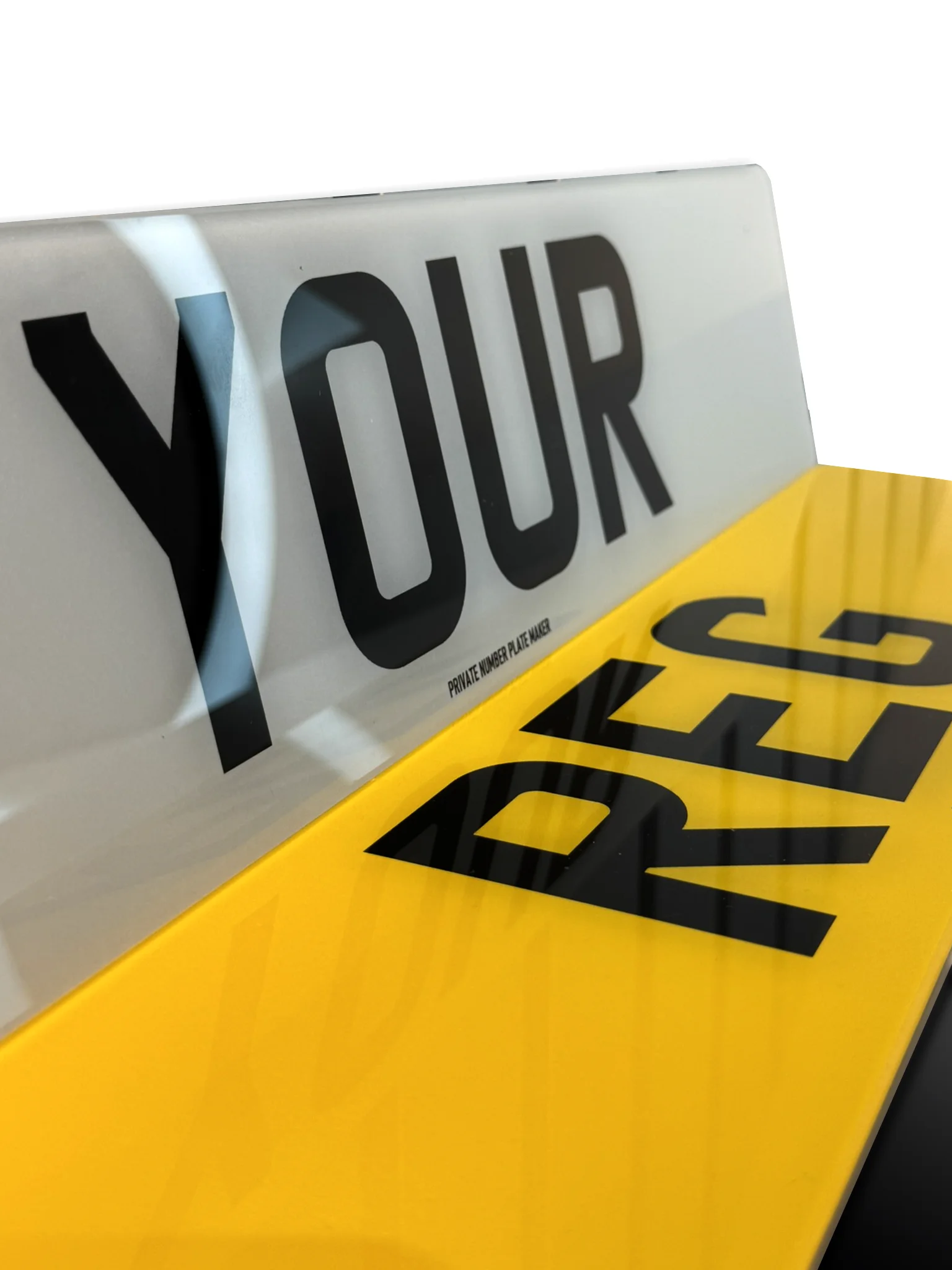
 Printed
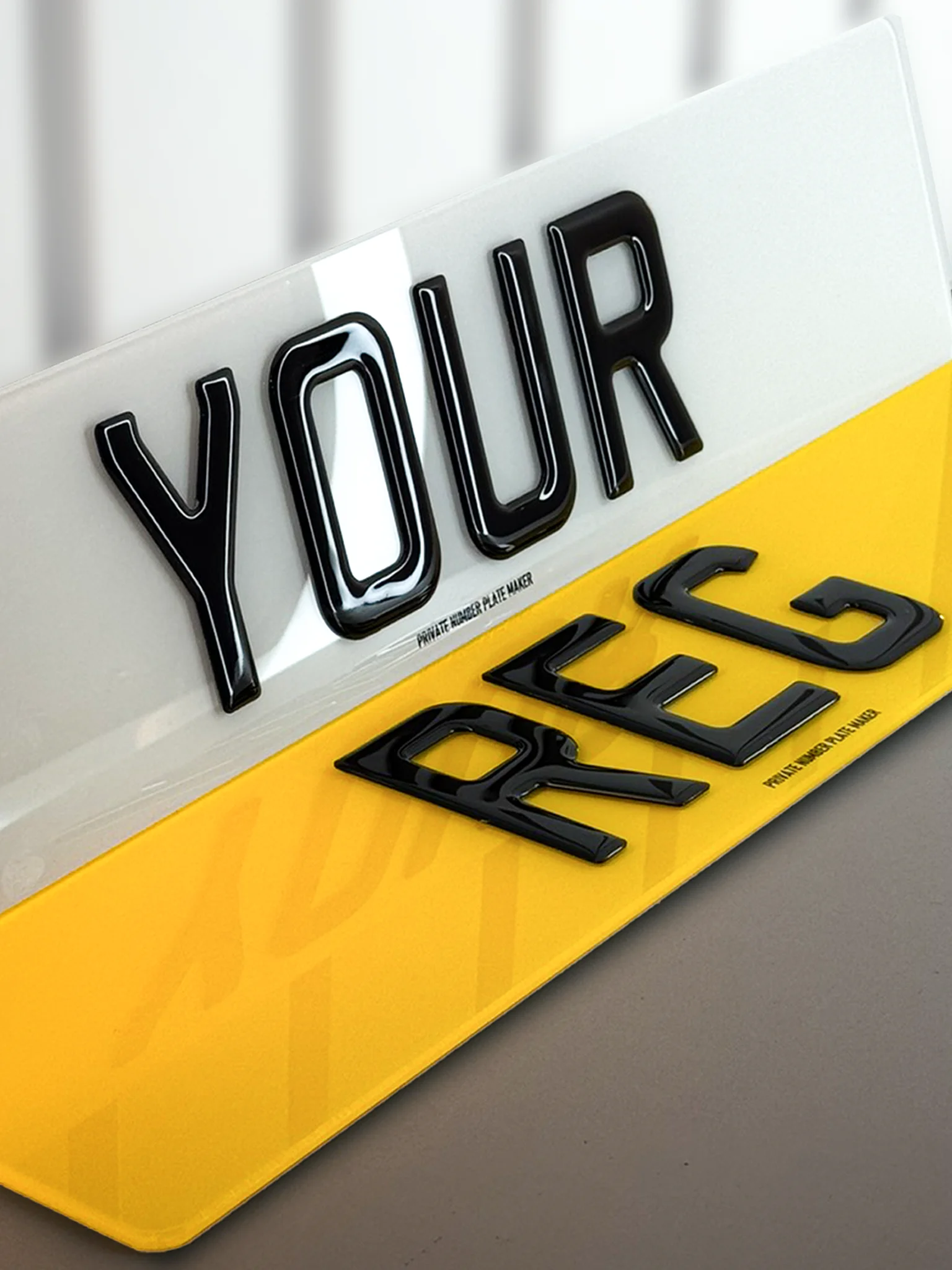 3D Plate
 4D Plate
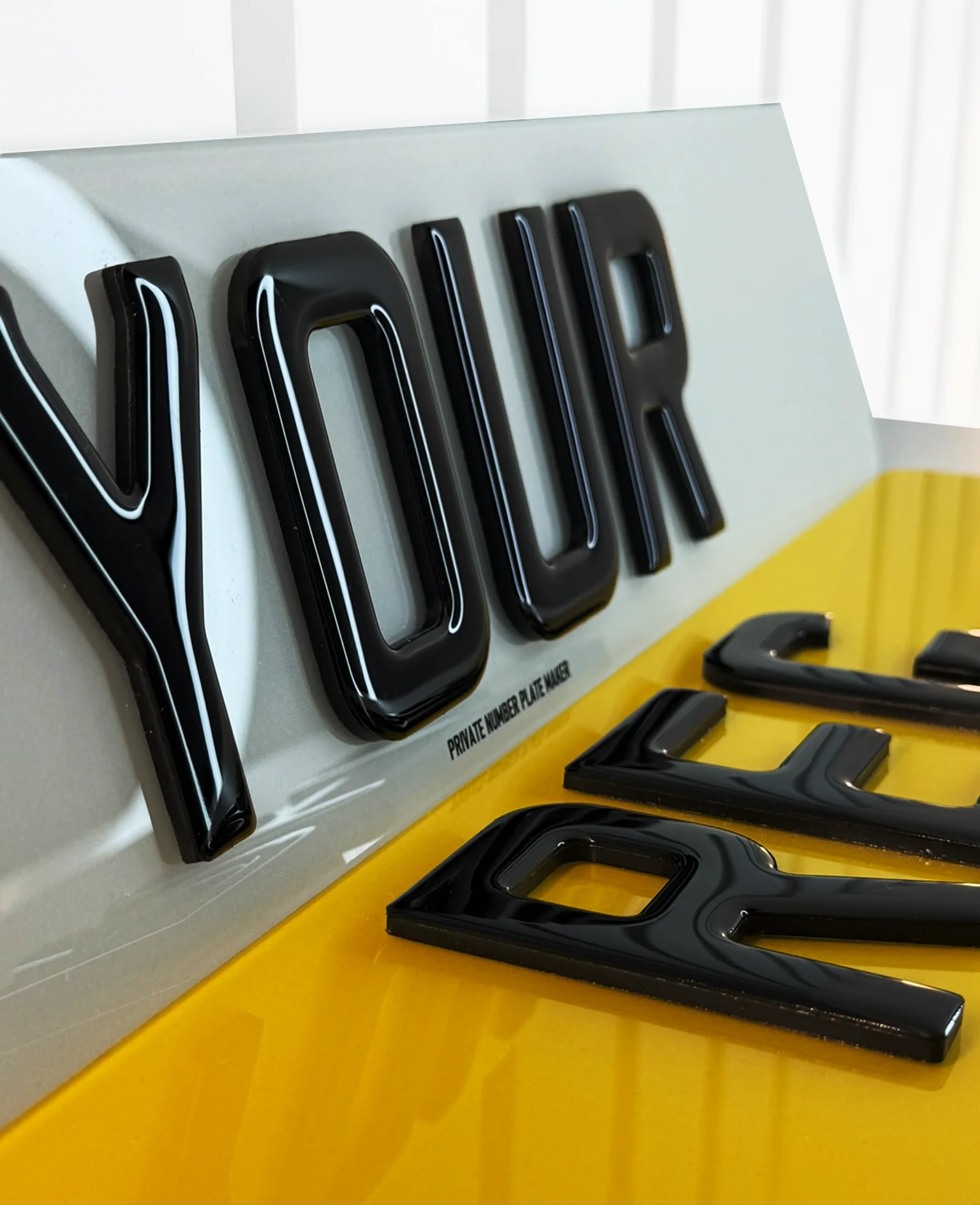 5D Plate
 Ghost
Ghost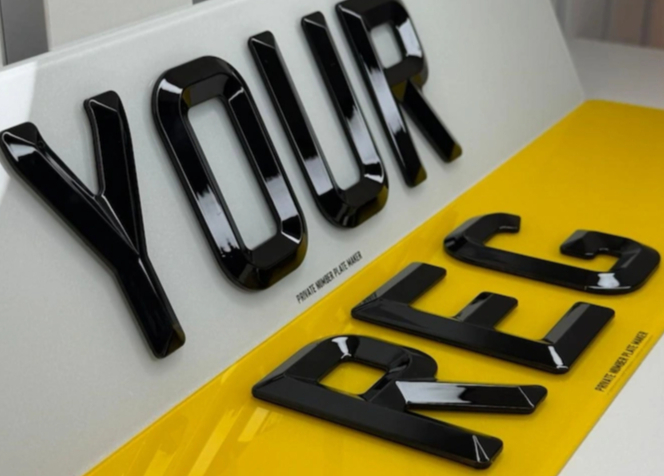 Bevel
BevelBevel Number Plates: Diamond-Cut Edges Explained
Summary
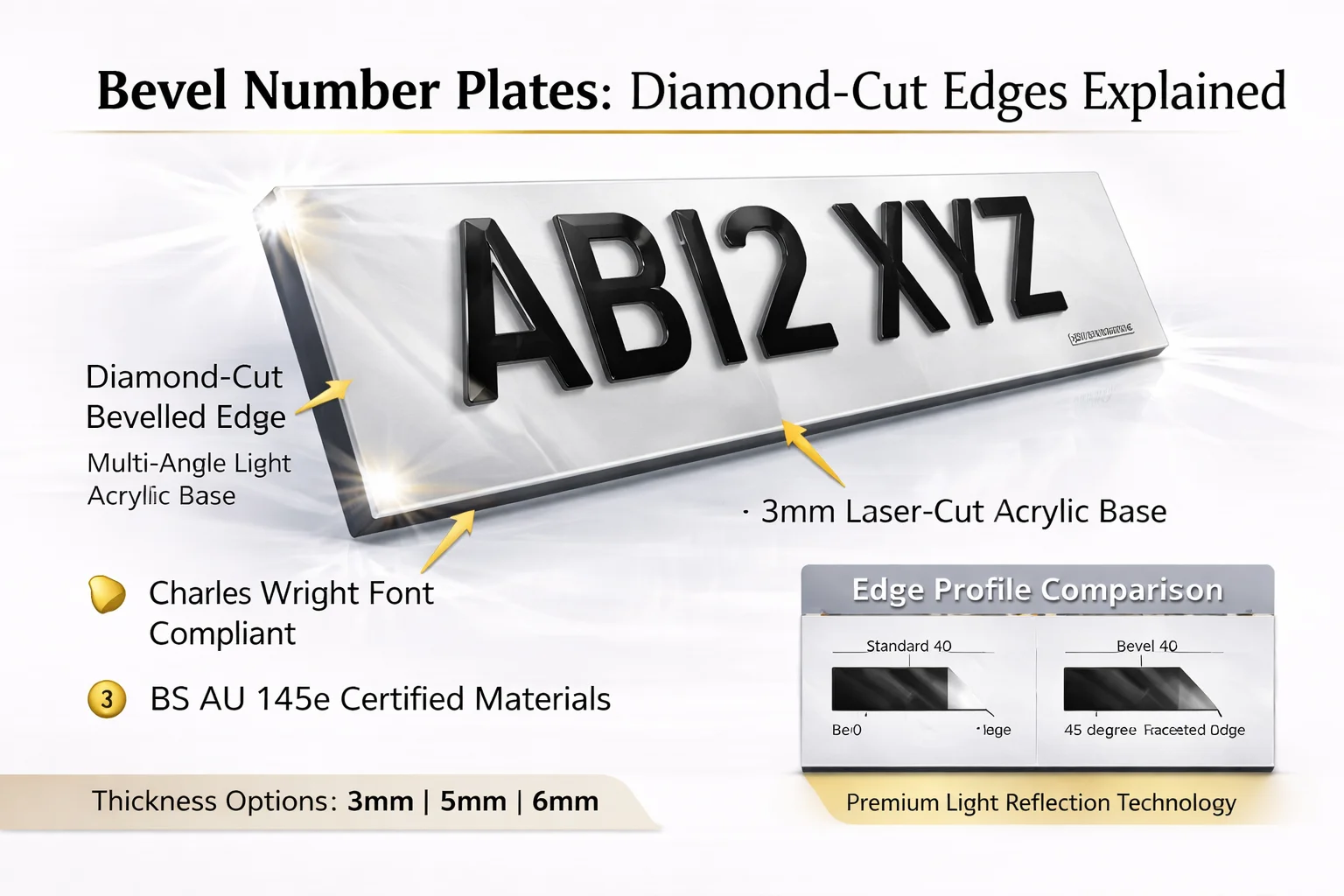
Bevel number plates are premium 4D laser-cut acrylic plates featuring diamond-cut faceted edges that catch and reflect light from multiple angles, creating a distinctive premium appearance compared to standard 4D plates with flat edges. The bevelled edge is created through precision CNC machining that cuts the acrylic at angled facets (typically 45 degrees), producing enhanced light reflection and visual depth.
Bevel Number Plates Explained Guide
All bevel number plates must meet BS AU 145e:2018 standards including the mandatory Charles Wright font, correct character dimensions (79mm height, 50mm width, 14mm stroke), and proper reflective materials to remain legal for UK road use. Thickness options typically include 3mm (standard bevel), 5mm (premium bevel), and 6mm (maximum depth), with thicker options providing more pronounced light reflection effects.
What Are Bevel Number Plates?
Bevel number plates represent a premium evolution of 4D laser-cut acrylic plates, distinguished by their diamond-cut edged characters that create enhanced light reflection.
Defining Characteristics of Bevel Plates
| Feature | Description | Visual Effect |
|---|---|---|
| Bevelled Edges | Diamond-cut facets at character edges (typically 45-degree angle) | Multi-angle light reflection |
| Acrylic Base | Laser-cut acrylic characters (3mm, 5mm, or 6mm thickness) | Substantial depth and presence |
| Light Reflection | Faceted edges catch light from multiple directions | Enhanced visibility and premium appearance |
| Dual-Layer Construction | Acrylic characters bonded to reflective substrate | Durability plus compliance |
How Bevel Plates Differ from Other Premium Types
| Plate Type | Character Construction | Edge Profile | Light Reflection |
|---|---|---|---|
| Standard 2D | Printed on substrate | Flat (no depth) | Standard reflectivity |
| 3D Gel | UV-cured resin gel overlay | Domed/rounded | Gel surface reflection |
| Standard 4D | Laser-cut acrylic | Flat 90-degree edge | Acrylic surface only |
| Bevel 4D | Laser-cut acrylic with diamond-cut edges | Faceted angled edges | Multi-angle edge reflection |
| 5D | 3mm acrylic + 2mm gel combination | Flat acrylic + domed gel | Combined reflection types |
The Bevel Manufacturing Process
Step 1: Acrylic Sheet Preparation
- Premium grade acrylic selected (3mm, 5mm, or 6mm)
- Black acrylic for character layer
- Quality inspection before cutting
Step 2: Laser Cutting
- Charles Wright font characters cut to specification
- Precision laser ensures clean edges
- Character dimensions verified (79mm height, 50mm width, 14mm stroke)
Step 3: Diamond-Cut Beveling
- CNC machine cuts facets at character edges
- Typical 45-degree angle for optimal light reflection
- Multiple facets possible for enhanced effect
- Edge polishing for clarity
Step 4: Bonding to Substrate
- Characters positioned on BS AU 145e reflective backing
- Automotive-grade adhesive applied
- Pressure bonding ensures secure attachment
- Curing time for full bond strength
Step 5: Quality Control
- BS AU 145e marking applied
- Supplier details added
- Final inspection for compliance
- ANPR readability verified
Technical Specifications and Construction Details
Understanding the technical construction of bevel plates helps you make informed purchasing decisions.
Thickness Options Explained
| Thickness | Construction | Best For | Light Reflection |
|---|---|---|---|
| 3mm Bevel | Single 3mm acrylic with bevelled edges | Standard premium look | Good edge reflection |
| 5mm Bevel | 5mm acrylic or 3mm + 2mm base | Enhanced depth | Strong edge reflection |
| 6mm Bevel | Maximum thickness acrylic | Maximum premium effect | Maximum light capture |
Character Dimension Requirements
All bevel plates must comply with Road Vehicles (Display of Registration Marks) Regulations 2001:
| Specification | Requirement | Applies to Bevel Plates |
|---|---|---|
| Character height | 79mm (cars) | Yes - mandatory |
| Character width | 50mm (excluding 'I' and '1') | Yes - mandatory |
| Stroke thickness | 14mm | Yes - mandatory |
| Character spacing | 11mm between characters | Yes - mandatory |
| Age identifier gap | 33mm | Yes - mandatory |
| Margins | 11mm minimum | Yes - mandatory |
Bevel Edge Specifications
| Aspect | Specification | Purpose |
|---|---|---|
| Bevel Angle | Typically 45 degrees | Optimal light reflection |
| Facet Count | 1-3 facets per edge | Enhanced light capture |
| Edge Polish | High-gloss finish | Maximum clarity |
| Edge Consistency | Uniform across all characters | Professional appearance |
Material Requirements
Acrylic Quality:
- Automotive-grade acrylic
- UV-resistant formulation
- Impact-resistant properties
- Colour-stable black (no fading)
Adhesive Specifications:
- Automotive-grade bonding adhesive
- Temperature-resistant (-40?C to +80?C)
- Moisture-resistant
- Long-term durability
Substrate Requirements:
- BS AU 145e:2018 certified reflective material
- Retroreflective properties maintained
- NIR compatibility for ANPR
- Weathering resistance tested
Legal Compliance: Are Bevel Plates Legal in the UK?
Bevel number plates are legal in the UK provided they meet all regulatory requirements under the Road Vehicles (Display of Registration Marks) Regulations 2001.
Compliance Requirements for Bevel Plates
Mandatory Requirements:
- Charles Wright font must be used (no modifications)
- Character dimensions must match regulations exactly
- BS AU 145e:2018 marking must be visible
- Supplier details must appear on plate
- Solid black characters (no two-tone effects on bevel)
- Reflective substrate must meet standards
Bevel-Specific Considerations:
- Bevelled edges must not alter character shape recognition
- Light reflection must not interfere with ANPR readability
- Character boundaries must remain clear and distinct
- No reflective coatings on bevel edges
Are 4D Plates Legal 2026 Guide | Are 5D Number Plates Legal Guide
What Makes Bevel Plates Non-Compliant
| Non-Compliant Feature | Why It's Illegal | Consequence |
|---|---|---|
| Modified font shape | Charles Wright must be maintained | MOT failure |
| Incorrect character dimensions | Regulations specify exact measurements | Fine up to £1,000 |
| Missing BS AU 145e marking | Standard compliance not verifiable | Enforcement action |
| Reflective bevel coating | Interferes with ANPR | Potential seizure |
| Obscured character boundaries | Reduces legibility | MOT failure |
ANPR Compatibility
Why Bevel Plates Must Work with ANPR:
- Police use ANPR for enforcement
- Cameras read in Near Infrared spectrum
- Character contrast must be maintained
- Bevel edges must not create confusion
Testing Requirements:
- NIR contrast verified during manufacturing
- Character recognition tested
- Edge reflection must not interfere
- Multiple angle reads confirmed
4D Plates ANPR Definitive Guide
MOT Inspection for Bevel Plates
MOT Testers Check:
- Character legibility from reasonable distance
- No damage affecting readability
- Secure attachment to vehicle
- BS AU 145e marking visible (post-2021 plates)
Common MOT Failures:
- Bevel edges damaged or cracked
- Characters loose or detaching
- Excessive reflection obscuring characters
- Missing compliance markings
Bevel Plate Thickness: 3mm vs 5mm vs 6mm Compared
Thickness affects both appearance and durability of bevel plates.
3mm Bevel Plates
Characteristics:
- Standard premium thickness
- Subtle bevel effect
- Lighter weight
- Most cost-effective bevel option
Best For:
- Daily driver vehicles
- Subtle premium enhancement
- Budget-conscious buyers
- Fleet vehicles wanting premium look
Considerations:
- Less pronounced light reflection
- Standard durability
- Easier to fit (lower profile)
5mm Bevel Plates
Characteristics:
- Enhanced depth and presence
- Stronger light reflection
- More substantial feel
- Mid-range pricing
Best For:
- Enthusiast vehicles
- Noticeable premium upgrade
- Show cars (non-competitive)
- Executive company cars
Considerations:
- More pronounced bevel effect
- Better durability than 3mm
- May require careful fitting
6mm Bevel Plates
Characteristics:
- Maximum thickness available
- Most dramatic light reflection
- Heaviest option
- Premium pricing
Best For:
- Maximum visual impact
- Show and display vehicles
- Luxury vehicle enhancement
- Enthusiast collections
Considerations:
- Most pronounced bevel effect
- Maximum durability
- Requires secure mounting
- Check fitment clearance
Thickness Comparison Table
| Feature | 3mm Bevel | 5mm Bevel | 6mm Bevel |
|---|---|---|---|
| Depth | Standard | Enhanced | Maximum |
| Light Reflection | Good | Strong | Maximum |
| Weight | Lightest | Medium | Heaviest |
| Durability | Standard | Enhanced | Maximum |
| Price | Most affordable | Mid-range | Premium |
| Fitment | Easiest | Standard | Check clearance |
Light Reflection and Visual Effects
The bevelled edge design creates distinctive light reflection characteristics that differentiate bevel plates from standard 4D plates.
How Bevel Edges Create Light Reflection
Physics of Bevel Reflection:
- Light hits faceted edge at multiple angles
- Each facet reflects light differently
- Multiple reflections create depth effect
- Movement changes reflection pattern
Comparison to Standard 4D:
- Standard 4D: Single flat edge reflection
- Bevel 4D: Multiple facet reflections
- Enhanced visibility in varying light
- More dynamic appearance
Lighting Condition Performance
| Condition | Standard 4D | Bevel 4D | Advantage |
|---|---|---|---|
| Direct Sunlight | Single reflection | Multiple reflections | Bevel more dynamic |
| Overcast | Moderate visibility | Enhanced edge definition | Bevel more visible |
| Night (Headlights) | Standard reflection | Enhanced edge glow | Bevel more distinctive |
| Low Angle Light | Limited effect | Maximum facet activation | Bevel significantly better |
Visual Impact Factors
Factors Affecting Bevel Appearance:
- Acrylic quality (clarity affects reflection)
- Bevel angle precision (consistent angles = consistent reflection)
- Edge polish quality (smoother = clearer reflection)
- Character spacing (affects overall pattern)
Maintenance of Reflection Quality:
- Regular cleaning preserves edge clarity
- Avoid abrasive cleaners (scratch edges)
- Check for edge damage periodically
- Replace if bevel becomes cloudy
Common Misconceptions About Bevel Plates
Several myths circulate about bevel number plates. Here are the facts.
Myth: "Bevel Plates Are Automatically Illegal"
Fact: Bevel plates are legal when manufactured to compliance standards:
- Charles Wright font must be maintained
- All dimension requirements apply
- BS AU 145e marking required
- ANPR readability must not be compromised
Myth: "Bevel Edges Interfere with ANPR Cameras"
Fact: Properly manufactured bevel plates work with ANPR:
- Bevel is on character edges, not face
- NIR contrast maintained on character surface
- Edge reflection does not affect camera read
- Testing confirms compatibility
Myth: "All 4D Plates Are the Same"
Fact: Significant differences exist between 4D variants:
- Standard 4D: Flat edges
- Bevel 4D: Diamond-cut faceted edges
- Quality varies by manufacturer
- Compliance not guaranteed across all suppliers
Myth: "Thicker Bevel Plates Are Always Better"
Fact: Thickness should match your needs:
- 3mm sufficient for most vehicles
- 5mm for enhanced presence
- 6mm for maximum impact
- Consider fitment and clearance
Myth: "Bevel Plates Cost Significantly More"
Fact: Price premium is modest for quality bevel plates:
- Manufacturing process adds cost
- Premium materials justify price
- Longevity offsets initial cost
- Compare value not just price
Our Bevel Plate Manufacturing at Private Number Plate Maker Ltd
As a DVLA-registered manufacturer (RNPS ID: 75449), we produce bevel plates on-site at our Ilford workshop in Ilford.
Our Manufacturing Standards
Quality Control Process:
- BS AU 145e:2018 materials verified
- Charles Wright font templates confirmed
- Bevel angle consistency checked
- Character dimensions measured
- ANPR readability tested
- Final inspection before dispatch
Material Sourcing:
- Premium automotive-grade acrylic
- Certified reflective substrates
- UV-resistant formulations
- Batch documentation maintained
Compliance Assurance:
- RNPS registration maintained
- DVLA requirements followed
- Document verification completed
- Records kept for audit
Thickness Options We Offer
| Thickness | Availability | Lead Time |
|---|---|---|
| 3mm Bevel | Standard stock | Same-day collection |
| 5mm Bevel | Standard stock | 1-2 days |
| 6mm Bevel | Made to order | 2-3 days |
Our Ilford Workshop Services
Same-Day Collection:
- Castleview Gardens, Ilford, East London
- Documents verified on arrival
- Plates manufactured while you wait
- Quality check before collection
UK Delivery:
- Next-day delivery available
- Secure packaging for bevel plates
- Tracking provided
- Signature required
Local Coverage:
- Barking, Romford, Dagenham areas
- Greater London accessible
- UK-wide delivery service
Choosing the Right Bevel Plate for Your Vehicle
Selecting appropriate bevel plates depends on your vehicle type, usage, and preferences.
Vehicle Type Recommendations
| Vehicle Type | Recommended Thickness | Rationale |
|---|---|---|
| Daily Driver | 3mm Bevel | Subtle premium, cost-effective |
| Executive Car | 5mm Bevel | Enhanced presence, professional |
| Enthusiast Vehicle | 5mm or 6mm Bevel | Maximum visual impact |
| Classic Car | 3mm Bevel | Period-appropriate premium |
| EV (with Green Flash) | 3mm or 5mm Bevel | Modern look matches EV identity |
| Fleet Vehicles | 3mm Bevel | Consistent appearance, budget-conscious |
Budget Considerations
Value Factors:
- Initial cost vs longevity
- Quality affects plate life
- Compliance prevents fines
- Premium appearance adds vehicle value
Cost-Saving Tips:
- Order front and rear together
- Consider 3mm for fleet orders
- Same-day collection saves delivery
- Bulk orders may qualify for discount
Fitment Considerations
Before Ordering:
- Check existing plate holder depth
- Verify clearance with vehicle bodywork
- Consider mounting method (screws vs adhesive)
- Account for any plate surrounds
Installation Tips:
- Handle bevel edges carefully
- Use appropriate fixings for thickness
- Avoid overtightening (can crack acrylic)
- Check security regularly
Maintenance and Care for Bevel Plates
Proper maintenance preserves the bevelled edge appearance and compliance.
Cleaning Guidelines
Safe Cleaning Methods:
- Mild car shampoo and water
- Soft microfiber cloth
- Gentle wiping motion (not circular on edges)
- Rinse thoroughly
What to Avoid:
- Abrasive cleaners (scratch bevel edges)
- Stiff brushes (damage edge facets)
- Solvent-based products (may cloud acrylic)
- High-pressure washers at close range
Regular Inspection Checklist
Monthly Checks:
- Bevel edges clear and undamaged
- Characters securely bonded
- No clouding or discolouration
- BS AU 145e marking visible
Seasonal Checks:
- After winter (salt damage check)
- Before MOT test
- After long journeys
- Following any impact
Number Plate Maintenance Guide
When to Replace Bevel Plates
Replace When:
- Bevel edges cracked or chipped
- Characters becoming loose
- Acrylic clouding affects appearance
- BS AU 145e marking no longer visible
- Before MOT if condition borderline
Frequently Asked Questions
Yes, bevel number plates are legal in the UK when manufactured to comply with the Road Vehicles (Display of Registration Marks) Regulations 2001 and BS AU 145e:2018 standards. Key requirements include using the mandatory Charles Wright font, maintaining correct character dimensions (79mm height, 50mm width, 14mm stroke), and displaying the BS AU 145e marking. At Private Number Plate Maker Ltd (RNPS ID: 75449), all our bevel plates are manufactured on-site in Ilford using certified materials with full document verification.
The ideal thickness depends on your vehicle and preferences. 3mm bevel plates offer a subtle premium look and are cost-effective for daily drivers. 5mm provides enhanced depth and stronger light reflection, ideal for executive or enthusiast vehicles. 6mm delivers maximum visual impact for show cars but requires checking fitment clearance. All thickness options must maintain BS AU 145e compliance and Charles Wright font specifications. Our Ilford workshop can advise on the best option for your vehicle during document verification.
Yes, properly manufactured bevel plates will pass MOT tests when they meet BS AU 145e:2018 requirements. MOT testers check character legibility, secure attachment, visible compliance markings, and that no damage affects readability. Bevelled edges must not obscure character boundaries or interfere with ANPR camera readability. Regular maintenance, including checking for edge damage and keeping plates clean, helps ensure ongoing compliance. As a DVLA-registered manufacturer (RNPS ID: 75449), we test all plates for ANPR compatibility before dispatch.
Bevel plates feature diamond-cut faceted edges (typically 45-degree angles) on laser-cut acrylic characters, creating multi-angle light reflection and enhanced visual depth. Standard 4D plates have flat 90-degree edges with single-surface reflection. Both must use Charles Wright font and meet BS AU 145e:2018 standards for UK legality. The bevelled edge process requires precision CNC machining, resulting in a more premium appearance while maintaining full compliance with the Road Vehicles Regulations 2001.
Yes, bevel plates can be manufactured with the green flash for eligible pure battery electric vehicles (BEVs), as permitted under DVLA guidance. Hybrids are not eligible. The green flash can be integrated or applied as a sticker, but all other compliance requirements remain: Charles Wright font, correct dimensions, BS AU 145e:2018 marking, and reflective substrate. We verify vehicle eligibility during document checks at our Ilford workshop before manufacturing EV-compliant bevel plates.
This guide references the following official and verified sources:
Road Vehicles (Display of Registration Marks) Regulations 2001
Statutory instrument governing registration mark display
legislation.gov.ukBritish Standards Institution - BS AU 145e:2018
Specification for Retroreflecting Number Plates
knowledge.bsigroup.comVehicle Excise and Registration Act 1994 - Section 42
Enforcement powers and penalty provisions
legislation.gov.uk