
 Printed
 3D Plate
 4D Plate
 5D Plate
 Ghost
Ghost Bevel
Bevel
 Printed
 3D
3D 4D
4D 5D
5D Ghost
Ghost Bevel
BevelData Sharing Revolution: How DVLA, DVSA, and Home Office Are Tackling Plate Crime

Executive Summary
In January 2026, the UK Government confirmed a major intensification of inter-agency collaboration to combat number plate fraud, with the DVLA, Home Office, and National Police Chiefs’ Council working together on enhanced enforcement and data sharing initiatives. The Department for Transport published its new Road Safety Strategy on 7 January 2026, which includes proposals for penalty points and vehicle seizure for drivers using incorrect, altered, or false number plates. This represents a significant escalation from the current £100 fixed penalty notice, reflecting growing concern about the link between illegal plates and serious criminal activity including uninsured driving, petrol theft, and county lines drug dealing.
For UK drivers, this means stricter enforcement ahead and tougher penalties on the horizon. The DVLA is strengthening application and audit processes for registered number plate suppliers, while the British Standards Institution has proposed updates to BS AU 145e that would require all finished plates to be flat, effectively banning raised-character “ghost plates“. As a DVLA-registered manufacturer (RNPS ID: 73132), Private Number Plate Maker Ltd has always maintained rigorous document verification and compliance with British Standards, ensuring our customers avoid these enforcement risks entirely.
This article explains what the January 2026 parliamentary answers reveal about the government’s crackdown, what it means for vehicle owners, and how to ensure your plates remain fully compliant.
What Happened: January 2026 Parliamentary Answers
The Written Questions
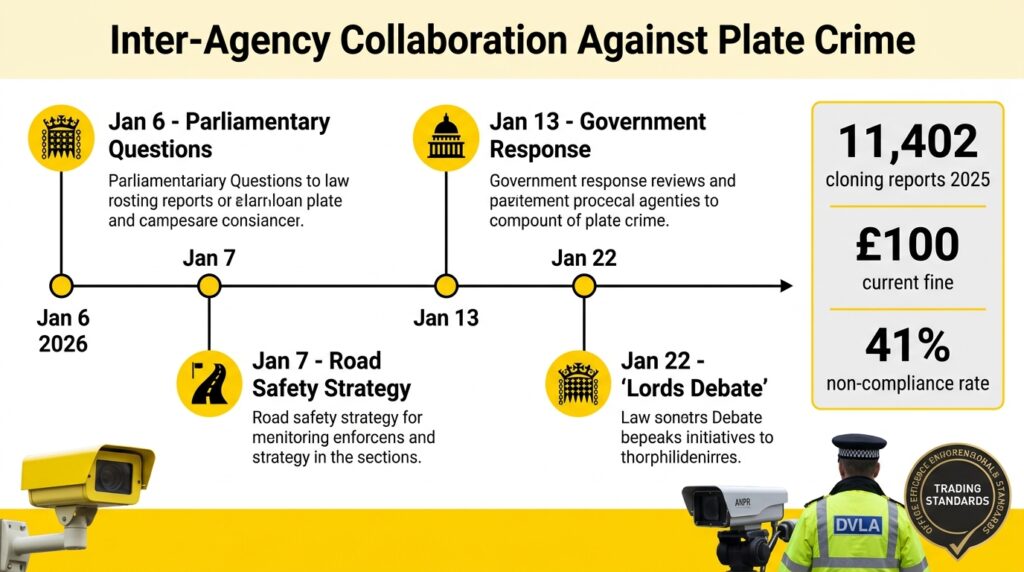
On 6 January 2026, Dr Al Pinkerton, Liberal Democrat MP for Surrey Heath, tabled a series of written questions to the Secretary of State for Transport regarding number plate fraud and inter-agency cooperation. The questions specifically asked about:
- Discussions between the Department for Transport and the Home Office on penalties and enforcement for illegal number plate offences
- Steps to improve data sharing between the DVLA, DVSA, and Home Office on vehicle registration marks
- Assessment of enforcement capacity for illegal and non-compliant plates
- Economic impact of number plate fraud on motorists, insurers, and the public purse
The Government Response
Lilian Greenwood, Minister of State for Transport, answered on 13 January 2026 with a comprehensive statement of the government’s position: “The Government recognises the impact of number plate fraud and is committed to addressing this issue. The Driver and Vehicle Licensing Agency (DVLA) collaborates with the National Police Chiefs’ Council, the Home Office, and other departments to enhance the identification and enforcement of number plate offences.”
The response confirmed several critical developments:
- New Road Safety Strategy published 7 January 2026 – Setting out the vision for safer roads with specific focus on number plate compliance.
- Consultation on enhanced penalties – Seeking views on introducing penalty points and vehicle seizure for incorrect/altered/false number plates.
- BS AU 145e updates proposed – British Standards Institution committee (of which DVLA is a member) has proposed requiring all finished plates to be flat, preventing production of raised-character “ghost plates“.
- Strengthened supplier oversight – Enhanced application and audit processes for registered number plate suppliers.
- Enhanced data sharing – Police have established access to DVLA records for crime prevention and detection.
- Joint enforcement operations – DVLA enforcement officers working with police and Trading Standards on compliance visits.
House of Lords Debate: 22 January 2026
The issue gained further prominence when it was debated in the House of Lords on 22 January 2026. Lord Snape raised concerns about the ease of becoming a registered number plate supplier, noting that anyone can apply by paying a £40 fee to the DVLA, and that 36,000 people or companies have already registered.
The Minister responded: “The DVLA is already on the case to strengthen the application process to become a registered number plate supplier and to make it more robust. Options being considered include, as my noble friend remarked, the fee level, the structure, eligibility criteria, and much greater enforcement.”
The Scale of the Problem
During the Lords debate, the Minister revealed striking data from a joint Metropolitan Police and Transport for London operation: “In 1,000 vehicle checks carried out by the Metropolitan Police with Transport for London in March 2023 using cameras which are able to detect ghost number plates, 41% of licensed taxis and private hire vehicles were found to have non-compliant plates.”
This single statistic demonstrates the widespread nature of non-compliance, even among professional drivers who should know better.
What This Means for UK Drivers
Current Penalties vs Proposed Changes
Current penalties (2026):
- £100 fixed penalty notice for incorrect or non-compliant number plates.
- Up to two years in prison, unlimited fine, or both for cloned number plates.
- MOT failure if plates do not meet legal requirements.
Proposed penalties under consultation (2026):
- Penalty points on driving licence (specific number under consultation).
- Vehicle seizure powers for police.
- Potentially higher fines.
The consultation document is available at www.gov.uk/government/consultations/proposed-changes-to-penalties-for-motoring-offences.
Why the Crackdown?
Number plate fraud is not a victimless crime. During the Lords debate, multiple peers highlighted the connection to serious criminal activity: Lord Holmes of Richmond stated: “My noble friend is absolutely right, and the Government are considering precisely those two things [increased penalties and vehicle confiscation], among others. This is linked to lots of other crime. It is linked to petrol theft, which is an enormous problem for retailers, to county lines drug dealing, and to robbery and car boot sales.”
The government’s concern centres on several key issues:
- Uninsured driving: Lords debate highlighted that 70% of uninsured drivers are criminals, and they are five times more likely to have collisions, which are nine times more likely to be serious.
- ANPR evasion: Illegal plates designed to defeat Automatic Number Plate Recognition cameras undermine the entire enforcement infrastructure.
- Vehicle cloning: Criminals copy registration numbers from legitimate vehicles onto similar vehicles. The DVLA received 11,402 such reports in 2025 alone, up from 7,430 in 2021.
The Technology Challenge
The parliamentary answers revealed growing sophistication in both illegal plate production and detection methods:
- Ghost plates: These use raised characters with reflective coatings that appear normal to the human eye but are unreadable to cameras. You can read more about whether ghost plates are legal here.
- Gradient/reflective sprays: Illegal coatings applied to legal plates to reduce reflectivity.
- AI detection: The Road Safety Strategy mentions “the potential use of AI to help stamp out illegal plates,” suggesting advanced camera systems that can detect subtle non-compliance.
Data Sharing and Enforcement
The confirmation of enhanced data sharing between DVLA, Home Office, and police has significant implications:
- Real-time checks: Police ANPR cameras now have direct access to DVLA records, enabling instant verification of registration details and insurance status.
- Cross-agency intelligence: The National Vehicle Crime Intelligence Service (NaVCIS) coordinates information sharing between regional police forces, DVLA, DVSA, and insurance companies.
- Targeted operations: Joint DVLA-police-Trading Standards compliance visits are increasing to ensure suppliers follow RNPS regulations.
How Plate-Maker Ensures Compliance
As a DVLA-registered number plate manufacturer (RNPS ID: 73132) based in Ilford, East London, Private Number Plate Maker Ltd operates at the forefront of compliance and quality assurance. Here’s how we protect our customers:
Document Verification Process
Under Schedule 2 of the Road Vehicles (Display of Registration Marks) Regulations 2001, we must verify both identity and entitlement before manufacturing. Our process includes:
- Identity verification: We accept driving licences, passports, utility bills, and council tax bills.
- Entitlement verification: We require one of the following: V5C, V750, or V778 retention documents.
BS AU 145e:2018 Compliance
All our number plates meet or exceed the current British Standard, which mandates:
- Reflectivity: Background must be visible to ANPR cameras in all weather conditions.
- Impact resistance: Plates must withstand stone chips without delamination.
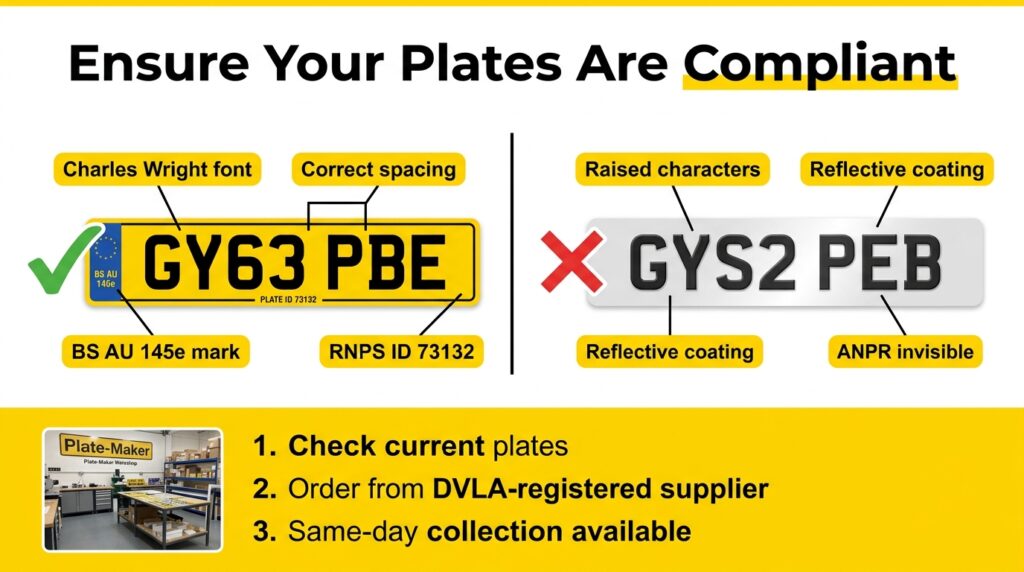
- Font specifications: Mandatory Charles Wright font with precise measurements.
On-Site Manufacturing Quality Control
Unlike resellers, we manufacture every plate on-site at our Eastern Avenue workshop in Ilford.
- Material selection: We use only certified acrylic and reflective materials.
- RNPS ID display: All our plates display our Registered Number Plate Supplier identification number (73132).
Practical Next Steps for Vehicle Owners
Check Your Current Plates
Given the heightened enforcement environment, verify your plates are compliant:
- Are characters in the correct Charles Wright font?
- Is spacing uniform and to specification?
- Do plates display the supplier’s name, postcode, and RNPS ID?
- For plates manufactured after September 2021, do they show “BS AU 145e“?
If Your Plates Are Non-Compliant
Immediate action: Order replacement number plates from a DVLA-registered supplier. Design your compliant plates: Use our online plate builder to create plates that meet all legal requirements. Choose from our range of legal styles including 3D gel, 4D laser-cut, and standard 2D plates.
Preparing for Enhanced Enforcement
- Keep your V5C registration certificate up to date.
- Maintain valid insurance and MOT.
- For business users, audit all fleet vehicles for plate compliance.
The Bigger Picture: Road Safety Strategy 2026
The number plate enforcement intensification is part of the broader Road Safety Strategy published on 7 January 2026. This includes tougher penalties for driving without insurance and the use of AI to help stamp out illegal number plates.
Frequently Asked Questions
What is the current penalty for illegal number plates in 2026?
The current penalty is a £100 fixed penalty notice. However, the government is consulting on introducing penalty points and vehicle seizure powers. See our guide on number plate fines for more details.
How much do compliant number plates cost from Plate-Maker?
Our standard 2D number plates start from £24.95 per pair. We offer same-day collection from our Ilford workshop or next-day UK delivery.
What documents do I need to buy number plates in 2026?
You must provide proof of identity and proof of entitlement to the registration mark. These are strictly enforced by DVLA-registered suppliers.
Are 3D and 4D number plates still legal after the BS AU 145e updates?
Yes, 3D gel and 4D laser-cut plates remain legal provided they meet BS AU 145e requirements and use the correct font and spacing.
How can I check if my number plate supplier is DVLA-registered?
All legitimate suppliers must display their RNPS ID on every plate. Private Number Plate Maker Ltd’s RNPS ID is 73132.
What happens if I’m caught with illegal number plates during an MOT?
Your vehicle will fail the MOT test. You cannot pass with non-compliant plates. See our guide on 5D number plates and MOTs for further information.
Conclusion
The January 2026 parliamentary answers make one thing clear: the era of lax number plate enforcement is over. With the DVLA, Home Office, and police now sharing data, the risk of detection has never been higher.
At Private Number Plate Maker Ltd, we’ve built our reputation on uncompromising compliance. As a DVLA-registered manufacturer (RNPS ID: 73132) with a physical workshop in Ilford, we ensure every customer is protected. Ready to ensure your plates are fully compliant? Design your plates online or visit us for same-day collection.