
 Printed
 3D Plate
 4D Plate
 5D Plate
 Ghost
Ghost Bevel
Bevel
 Printed
 3D
3D 4D
4D 5D
5D Ghost
Ghost Bevel
BevelOperation Topaz: £2.7 Million Police Funding Targets Illegal Number Plates

Executive Summary
Operation Topaz is a national police enforcement initiative backed by £2.7 million in government funding for each of the next three years, launched in summer 2025 to target illegal and unreadable number plates used to evade enforcement cameras and commit crime. The operation represents a strategic partnership between the Department for Transport, Home Office, and National Police Chiefs’ Council, focusing specifically on ghost plates, cloned plates, and vehicles with non-compliant registration marks that defeat ANPR systems.
For UK drivers, this means intensified enforcement activity targeting vehicles with illegal plates, with penalties of up to £1,000 for non-compliant number plates under current regulations. The operation is intelligence-led, using predictive ANPR technology to identify vehicles linked to criminality, including uninsured drivers, county lines drug dealing, and violence against women and girls offences.
As a DVLA-registered number plate manufacturer (RNPS ID: 73132), Private Number Plate Maker Ltd manufactures all plates on-site at our Ilford workshop to full BS AU 145e:2018 compliance, ensuring they are fully readable by ANPR cameras in all weather conditions. This guide explains what Operation Topaz means for drivers, how to ensure your plates are legal, and why compliance matters now more than ever.
What Is Operation Topaz?
Official Launch and Government Backing
Operation Topaz was officially launched in July 2025 as a national initiative led by the National Police Chiefs’ Council with substantial government financial backing. In a written parliamentary answer on 19 November 2025, Lord Hendy of Richmond Hill confirmed that the Government has pledged £2.7m for each of the next three years to support police enforcement activity through this strategic partnership around roads policing.
The funding represents a significant commitment to tackling number plate crime, which has been identified as a critical vulnerability in the UK’s security and policing infrastructure. The operation is coordinated via a central Operation Topaz team and is designed to support and enhance the existing NPCC Roads Policing Strategy.
Strategic Partnership Explained
The three-way partnership structure is significant:
- Department for Transport – Provides policy direction and works on regulatory improvements for number plate standards and supplier registration
- Home Office – Coordinates law enforcement strategy and provides operational support through police funding
- National Police Chiefs’ Council – Leads operational deployment and coordinates enforcement activity across police forces in England and Wales
This multi-agency approach reflects the government’s recognition that illegal number plates are not just a road safety issue but a national security concern linked to serious and organised crime.
Why Operation Topaz Was Launched
The Scale of Number Plate Illegality
The scale of the problem became impossible to ignore following parliamentary scrutiny in late 2025. A parliamentary group report published on 9 December 2025 uncovered widespread number plate illegality, putting national security at risk, and revealed that the UK has more than 34,000 number plate suppliers registered with the DVLA.
The report concluded that the current registration plate system represents a critical vulnerability in the UK’s security infrastructure, with illegal plates being used to facilitate a wide range of criminal activities.
Real-World Evidence of Non-Compliance
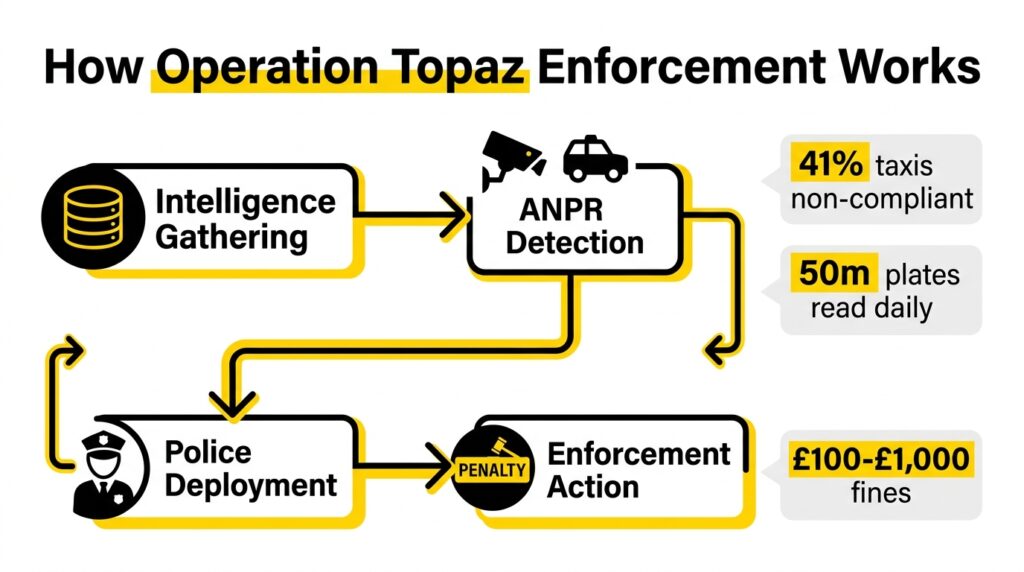
Concrete evidence of the problem emerged from enforcement operations. In March 2023, the Metropolitan Police working with Transport for London carried out 1,000 vehicle checks using cameras capable of detecting ghost number plates. The results were shocking: 41% of licensed taxis and private hire vehicles were found to have non-compliant plates.
This finding was particularly concerning because taxis and private hire vehicles are subject to regular licensing checks and should theoretically have higher compliance rates than private vehicles.
Link to Serious Crime
Operation Topaz is not just about road safety – it is fundamentally about tackling serious crime. During a House of Lords debate on 22 January 2026, Lord Hendy confirmed that the government recognises the urgency and importance of tackling the use of illegal number plates designed to evade enforcement cameras.
The debate highlighted multiple criminal uses of illegal plates:
- Uninsured driving: 70% of uninsured drivers are criminals, and they are five times more likely to have collisions, which are nine times more likely to be serious
- County lines drug dealing: Illegal plates allow drug dealers to move vehicles without detection
- Petrol theft: Criminals use cloned or ghost plates to avoid identification at forecourts
- Robbery and car boot sales: Illegal plates facilitate theft and illegal trading
- Violence against women and girls: Operation Topaz specifically targets VAWG offenders who use vehicles on roads
Chief Inspector Patrick McPeake of Hertfordshire Constabulary explained that Operation Topaz deployments are intelligence-led so that resources focus on those using vehicles illegally and for criminal purposes, to protect and support victims of sexual offences, domestic abuse and other violent crimes.
What Types of Illegal Plates Are Being Targeted?
Ghost Plates
Ghost plates are number plates that have been deliberately modified or manufactured to be unreadable by ANPR cameras while remaining visible to the human eye. Common illegal modifications include:
- Reflective sprays or films that create glare and prevent camera capture
- Tinted acrylic that reduces reflectivity below BS AU 145e standards
- ANPR-proof coatings that interfere with infrared detection
- Gradient effects that appear subtle but fail reflectivity requirements
(Read our: Are Ghost Plates Legal Guide)
During the January 2026 parliamentary debate, it was confirmed that the government is specifically targeting number plates intended to defeat enforcement cameras, including automatic number plate recognition systems.
Cloned Plates
Number plate cloning involves copying the registration number from a legally registered vehicle and placing it on a different, often stolen or illegally used vehicle. This allows criminals to:
- Avoid speeding fines and congestion charges
- Evade detection when committing crimes
- Use vehicles without insurance or MOT
- Commit petrol theft and other offences
The cloned vehicle’s registration appears legitimate to ANPR systems, but the physical vehicle does not match police records. Operation Topaz uses advanced ANPR technology that can detect discrepancies between vehicle characteristics and registration data.
(Read our: Cloned Number Plates & Penalties Guide)
Non-Compliant 3D and 4D Plates
While 3D and 4D plates can be legal when manufactured correctly, many suppliers produce plates that fail to meet BS AU 145e:2018 requirements. Common issues include:
- Incorrect character spacing or font
- Insufficient reflectivity due to gel overlay thickness
- Poor contrast between characters and background
- Characters that detach or fade, making plates unreadable
(Read our: 3D Gel Plates Explained) (Read our: 4D Plates Guide)
As a DVLA-registered manufacturer, we ensure every plate we produce meets the exacting standards required for ANPR readability. Our BS AU 145e certified plates are manufactured using premium materials and undergo rigorous quality control at our Eastern Avenue workshop in Ilford.
How Operation Topaz Enforcement Works
Intelligence-Led Deployments
Operation Topaz uses a sophisticated intelligence-led approach rather than random checks. According to Chief Inspector McPeake, officers are deployed to areas with high levels of offending and anti-social behaviour, targeting known offenders, and holding joint operations with partner agencies.
This means enforcement is concentrated in locations and at times where illegal plates are most likely to be detected, maximising the impact of the £2.7 million annual funding.
Advanced ANPR Technology
The operation relies heavily on Automatic Number Plate Recognition technology. The UK has approximately 11,000 ANPR cameras that read around 50 million number plates daily. Operation Topaz enhances this capability with:
- Predictive ANPR: Systems that can identify patterns and predict where illegal plates are likely to appear
- Mobile ANPR: Police vehicles equipped with cameras that scan plates in real-time
- Ghost plate detection: Specialised cameras capable of detecting plates with reflective coatings or other modifications designed to defeat standard ANPR
- Cross-referencing databases: Instant checks against multiple databases including insurance, MOT, stolen vehicles, and wanted persons
(Read our: ANPR Cameras and Number Plates Guide)
Multi-Agency Operations
Operation Topaz is not just a police operation. Forces are working alongside:
- Trading Standards: To tackle illegal number plate suppliers
- DVLA: To strengthen supplier registration and audit processes
- Local authorities: For coordinated enforcement on local roads
- Transport for London: Particularly for taxi and private hire vehicle checks
- Partner agencies: Including those focused on VAWG, drug enforcement, and organised crime
Essex Police announced in July 2025 that they would be engaging with taxi drivers in the night-time economy ensuring that they have the correct licences as part of Operation Topaz.
Current and Proposed Penalties
Existing Penalties
Under current legislation, the penalties for illegal number plates are:
- Fixed Penalty Notice: £100 fine for non-compliant plates under the Road Vehicles (Display of Registration Marks) Regulations 2001
- MOT Failure: Vehicles with illegal plates will fail their MOT test, though it has been acknowledged in Parliament that many of those who use false number plates have a proper set for the MoT or other examination and an illegal set which they then change afterwards
- Vehicle Seizure: Police can seize vehicles being used without insurance, which is often detected through ANPR checks triggered by illegal plates
- Level 3 Fine: Under Section 42 of the Vehicle Excise and Registration Act 1994, fines up to level 3 on the standard scale (currently £1,000) can be imposed for certain registration offences
Proposed Tougher Penalties
The government is actively considering significantly harsher penalties. During the January 2026 parliamentary debate, Lord Hendy confirmed that the Government are considering precisely those two things, among others when asked about increasing penalties and vehicle confiscation.
The Road Safety Strategy, published in late 2025, includes proposals for:
- Tougher enforcement: Enhanced powers for police and enforcement agencies
- Tougher penalties: Increased fines and potential penalty points
- Vehicle confiscation: Seizure of vehicles found with illegally modified plates
- AI-assisted detection: Use of artificial intelligence to identify illegal plates more effectively
(Read our: Number Plate Fines UK Guide)
Lord Snape raised a critical point during the debate: “As the penalty for non-compliance with number plate regulations is £100, does he further agree that it is a better bet to take a chance with a false number plate than it is to properly insure your own vehicle?” This highlights the government’s concern that current penalties are insufficient to deter criminal use of illegal plates.
What the Government Is Doing Beyond Enforcement
Strengthening Number Plate Supplier Registration
The DVLA is currently reviewing the entire registered number plate supplier system. Key issues being addressed include:
- Registration Fee: Currently £40, which has been described as an open incentive for fraud given that 36,000 people or companies have registered. The government is considering increasing this fee significantly.
- Eligibility Criteria: Stricter requirements for who can become a registered supplier, potentially including background checks and business verification
- Application Process: Tightening application, inspection and audit processes for number plate suppliers as confirmed by Lord Hendy
- Online Sales Regulation: The government is considering online sales of number plates, which is clearly one source of illegal number plates
(Read our: DVLA Document Requirements Guide)
Road Safety Strategy 2025
Operation Topaz is part of the broader Road Safety Strategy, the first such strategy in ten years. Lord Hendy confirmed in November 2025 that “This Government takes road safety seriously. We are committed to reducing the numbers of those killed and injured on our roads.”
The strategy includes:
- Review of number plate standards
- Enhanced enforcement mechanisms
- Consideration of new motoring offences
- Response to campaigns by bereaved families and Parliamentarians
The government intends to publish the full Road Safety Strategy by the end of 2025, with implementation continuing through 2026 and beyond.
Technical Improvements
The Department for Transport is working to understand the technical characteristics which prevent these plates being seen by ANPR. This includes:
- Research into reflective coatings and their impact on camera readability
- Development of detection systems for ghost plates
- Improved ANPR camera calibration and maintenance
- Potential mandatory technical standards for plate materials
How to Ensure Your Number Plates Are Operation Topaz Compliant
BS AU 145e:2018 Compliance
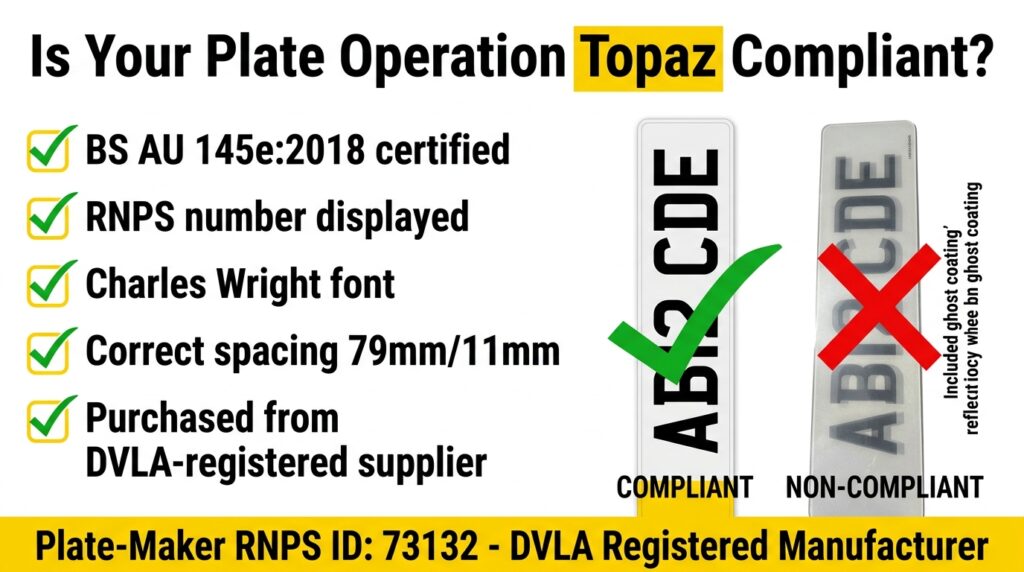
The British Standard BS AU 145e:2018 sets out strict requirements for number plates to ensure they are readable by ANPR cameras in all conditions. Key requirements include:
- Reflectivity: Background must be visible to ANPR cameras in all weather conditions and lighting
- Impact Resistance: Plates must withstand stone chips and road debris without becoming unreadable
- Weathering: No fading or delamination after exposure to UK weather conditions
- NIR Compatibility: Must be readable by infra-red traffic cameras used by police and enforcement agencies
All plates manufactured by Private Number Plate Maker Ltd are BS AU 145e:2018 certified and display our RNPS ID 73132, proving our DVLA registration and compliance with all legal requirements.
Legal Font and Spacing Requirements
Under the Road Vehicles (Display of Registration Marks) Regulations 2001, all number plates must use:
- Charles Wright font: Mandatory since 2001 for optimal ANPR readability
- Character height: 79mm for cars (64mm for motorcycles)
- Character width: 50mm (excluding I and 1)
- Stroke thickness: 14mm
- Character spacing: 11mm between characters
- Margins: 11mm minimum on all sides
(Read our: Charles Wright Font Guide)
Document Requirements
When ordering number plates from a registered supplier like ourselves, you must provide:
- Proof of Identity: Driving licence, passport, utility bill, or council tax bill (not bank statements)
- Proof of Entitlement: V5C registration certificate, V750 certificate of entitlement, V778 retention document, V948 auction win letter, or new keeper slip
These requirements are set out in Schedule 2 of the Road Vehicles Regulations 2001 and are strictly enforced by legitimate manufacturers.
(Read our: DVLA Document Requirements Guide)
Red Flags: Illegal Plate Suppliers to Avoid
Be wary of suppliers who:
- Do not ask to see your identification documents
- Offer ANPR-proof or ghost plates
- Sell plates online without document verification
- Are not listed on the DVLA’s registered supplier list
- Offer prices significantly below market rates
- Cannot provide their RNPS registration number
- Sell plates with reflective sprays or films
- Advertise “invisible to cameras” plates
Remember: buying illegal plates is an offence, and you can be fined even if you were unaware the plates were non-compliant.
Practical Takeaways for UK Drivers
What You Should Do Now
- Check your plates: Inspect your number plates for signs of wear, fading, or damage that could make them unreadable to ANPR cameras
- Verify compliance: Ensure your plates display the supplier’s RNPS number and were manufactured to BS AU 145e:2018 standard
- Replace illegal plates: If you have plates that are non-compliant, replace them immediately with plates from a DVLA-registered manufacturer (Replacement Number Plates Guide)
- Keep documentation: Retain proof of where and when you purchased your plates
- Report illegal suppliers: If you encounter suppliers offering illegal plates, report them to Trading Standards or the DVLA
What to Avoid
- Do not buy ghost plates: Any plate advertised as ANPR-proof, invisible to cameras, or with reflective coatings is illegal
- Do not modify existing plates: Adding sprays, films, or coatings to make plates unreadable is an offence
- Do not ignore the problem: Operation Topaz enforcement is intelligence-led and ongoing – the risk of detection is increasing
- Do not assume online suppliers are legitimate: Many online sellers operate outside UK regulations and sell illegal plates
How Plate-Maker Ensures Compliance
As a DVLA-registered manufacturer (RNPS ID: 73132) based in Ilford, East London, we:
- Manufacture every plate on-site at our Eastern Avenue workshop
- Use only BS AU 145e:2018 certified materials
- Verify all customer documents according to DVLA requirements
- Display our RNPS registration number on every plate
- Offer same-day collection from our Ilford workshop
- Provide next-day UK delivery for compliant, legal plates
- Maintain full audit trails for all plates we manufacture
We do not sell registration rights, we do not drop-ship, and we do not cut corners on compliance. Every plate we manufacture is designed to be fully readable by ANPR cameras while meeting all legal requirements.
Conclusion
Operation Topaz represents the most significant government-backed enforcement initiative targeting illegal number plates in recent years. With £2.7 million in annual funding for three years, a strategic partnership between the DfT, Home Office, and NPCC, and increasingly sophisticated ANPR technology, the message is clear: illegal number plates will not be tolerated.
For law-abiding drivers, the operation should have minimal impact – if your plates are BS AU 145e:2018 compliant, use the correct Charles Wright font, and were purchased from a DVLA-registered supplier who verified your documents, you have nothing to worry about.
However, for those using ghost plates, cloned plates, or non-compliant plates to evade enforcement, the net is closing. With intelligence-led deployments, advanced detection technology, and proposed tougher penalties including potential vehicle confiscation, the risks have never been higher.
The choice is simple: ensure your plates are fully compliant by purchasing from a legitimate, DVLA-registered manufacturer like Private Number Plate Maker Ltd, or face the consequences of increasingly sophisticated enforcement.
Ready to ensure your plates are Operation Topaz compliant? Start designing your plates using our 3D vs 4D vs Standard Comparison Guide or visit our Ilford workshop for same-day collection.
Frequently Asked Questions
What is Operation Topaz and when did it start?
Operation Topaz is a national police enforcement initiative launched in July 2025, backed by £2.7 million in government funding for each of the next three years. It is a strategic partnership between the Department for Transport, Home Office, and National Police Chiefs’ Council targeting illegal number plates, ghost plates, and cloned plates used to evade ANPR cameras and commit crime.
How much funding does Operation Topaz have?
The government has pledged £2.7 million for each of the next three years to support Operation Topaz enforcement activity, totalling £8.1 million over the three-year period. This funding is allocated to enhance roads policing and deliver coordinated enforcement focused on unreadable number plates and unattributable vehicles.
What are the penalties for illegal number plates in 2026?
Current penalties include a £100 fixed penalty notice for non-compliant plates under the Road Vehicles Regulations 2001, potential MOT failure, and fines up to £1,000 under the Vehicle Excise and Registration Act 1994. The government is actively considering tougher penalties including increased fines, penalty points, and vehicle confiscation as part of the Road Safety Strategy. (Read more: Number Plate Fines Guide)
Are ghost plates illegal in the UK?
Yes, ghost plates are illegal in the UK. Ghost plates are number plates deliberately modified or manufactured to be unreadable by ANPR cameras while remaining visible to humans. They violate the Road Vehicles (Display of Registration Marks) Regulations 2001 and BS AU 145e:2018 reflectivity requirements. Using ghost plates can result in fines up to £1,000 and is being specifically targeted by Operation Topaz enforcement. (Read more: Are Ghost Plates Legal 2026)
How can I check if my number plates are legal?
Legal number plates must be BS AU 145e:2018 certified, display the supplier’s RNPS registration number, use Charles Wright font with correct spacing (79mm character height, 11mm spacing), and be fully readable by ANPR cameras. Plates should have been purchased from a DVLA-registered supplier who verified your identity and entitlement documents.
Can I be fined for number plates I didn’t know were illegal?
Yes, you can be fined for displaying illegal number plates regardless of whether you knew they were non-compliant. The registered keeper of the vehicle is responsible for ensuring plates meet legal requirements. This is why it is essential to purchase plates only from DVLA-registered manufacturers like Private Number Plate Maker Ltd (RNPS ID: 73132) who verify compliance and provide documentation. (Check DVLA Document Requirements)