
 Printed
 3D Plate
 4D Plate
 5D Plate
 Ghost
Ghost Bevel
Bevel
 Printed
 3D
3D 4D
4D 5D
5D Ghost
Ghost Bevel
Bevel41% of Taxis Failed: The Met Police ANPR Sting That Shocked London

Executive Summary
A shocking 41% of licensed taxis in London failed number plate compliance checks using specialist ghost plate-detection cameras, according to data submitted to the All-Party Parliamentary Group for Transport Safety inquiry published in December 2025. Despite TfL issuing more than 4,200 fines since July 2023, follow-up checks still found 38% of vehicles in breach, revealing the limited impact of current enforcement measures. The APPG report recommends introducing penalty points, increased fines up to £1,000, and vehicle seizure powers for repeat offenders to address this national security risk.
This enforcement crackdown coincides with the British Standards Institution consultation on BS AU 145e amendments, which closed on 13 December 2025, proposing stricter requirements to prevent ‘ghost‘ and stealth plates. At Plate-Maker.co.uk, our DVLA-registered workshop (RNPS ID: 73132) manufactures only fully compliant BS AU 145e number plates that meet all legal requirements for ANPR readability and reflectivity.Critical caveat: Using illegal number plates can result in fines up to £1,000, MOT failure, and under proposed reforms, penalty points and vehicle seizure. Only plates from DVLA-registered suppliers who verify documents according to Schedule 2 of the Road Vehicles Regulations 2001 are legal.
The Met Police and TfL Enforcement Operation: What Happened
Scale of Non-Compliance Exposed
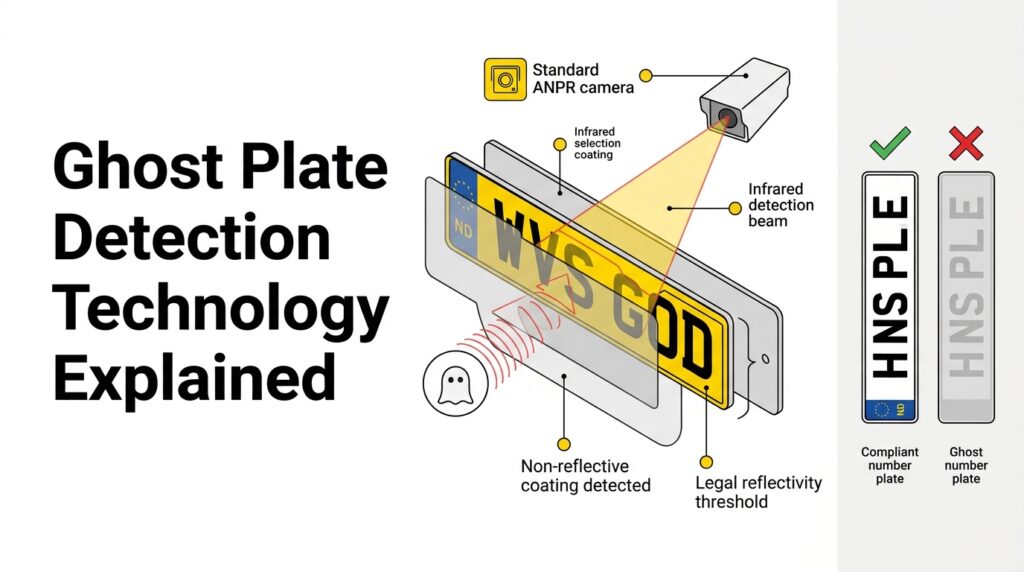
The All-Party Parliamentary Group for Transport Safety published a damning report on 9 December 2025, exposing widespread number plate illegality across the UK’s taxi and private hire sector. The inquiry revealed that Transport for London conducted 1,000 vehicle checks using specialist infrared cameras designed to detect ‘ghost plates‘ – number plates with non-reflective coatings or modifications that make them invisible to standard ANPR systems.
The findings were alarming:
- 41% of licensed taxis had non-compliant plates designed to evade detection
- More than 4,200 penalties issued by TfL since expanding ghost plate camera deployment in July 2023
- 38% failure rate persisted in subsequent checks of approximately 800 vehicles, showing only marginal improvement despite intensive enforcement
- One in fifteen vehicles across the UK may carry modified, non-compliant plates according to the broader APPG findings
Why Taxis Are Targeting Illegal Plates
The inquiry heard evidence that taxi drivers are using illegal plates primarily to avoid financial charges rather than for more serious criminal activity. Common evasion targets include:
Airport drop-off charges: London airports charge vehicles for dropping off passengers, with fees ranging from £5 to £30 depending on the airport and duration.
Congestion Charge and ULEZ: London’s Congestion Charge (£15 daily) and Ultra Low Emission Zone charges (£12.50 daily) represent significant costs for high-mileage taxi operators.
Road pricing schemes: Various clean air zones and low emission zones across UK cities impose daily charges on non-compliant vehicles.
According to oral evidence submitted to the inquiry, officials estimated that roughly one in five taxi drivers in the capital are using ghost plates to evade the congestion charge and other road fees.
The Technology Behind the Crackdown
TfL deployed specialist infrared camera technology specifically designed to identify number plates that do not meet legal reflectivity standards. Unlike standard ANPR cameras, these systems can detect:
- Non-reflective coatings applied to plates
- Reflective sprays that confuse ANPR systems
- Gradient effects that reduce contrast below legal thresholds
- Physical obstructions like leaves or cellophane
From March 2026, TfL announced it would introduce mandatory infrared number plate checks at annual taxi inspections, making it impossible for non-compliant plates to pass vehicle licensing requirements.
What This Means for UK Drivers
Current Penalties and Enforcement
Under existing legislation, drivers caught with illegal number plates face:
Fixed Penalty Notices: Typically £100 for minor non-compliance issues such as incorrect font or spacing.
MOT Failure: Vehicles with incorrectly displayed number plates automatically fail their MOT test, requiring plate replacement before the vehicle can be legally driven.
Vehicle Defect Rectification: Police can issue a Vehicle Defect Rectification Notice (VDRN) requiring proof of correction within 14 days.
Fines up to £1,000: Under Section 42 of the Vehicle Excise and Registration Act 1994, more serious offences can result in fines up to level 3 on the standard scale (currently £1,000).
However, the APPG report identified a critical weakness: illegal plate use does not currently carry penalty points, and vehicles are rarely seized unless linked to wider criminal activity.
Proposed Reforms: Tougher Sanctions on the Horizon
The APPGTS report makes several recommendations that would fundamentally change enforcement:
- Penalty Points: Introduction of 6 penalty points for drivers caught with illegal plates, bringing the offence in line with other serious motoring violations.
- Vehicle Seizure: Powers for enforcement bodies to seize vehicles belonging to repeat offenders, creating immediate financial consequences beyond fines.
- Increased Fines: Substantial increases to fixed penalties to ensure they represent a genuine deterrent rather than a “cost of doing business”.
- Supplier Restrictions: Significant reduction in the number of licensed number plate suppliers, with annual fees, regular audits, and removal of non-compliant sellers.
The UK currently has 34,455 registered number plate suppliers, many operating from private homes with minimal oversight and no background checks. Some suppliers handling customers’ identity documents were found to have serious criminal convictions, including for violent offences and fraud.
National Security Implications
The report heard stark warnings from National Trading Standards about the broader security risks:
“Ghost plates pose a serious threat to counter-terrorism operations. Vehicles with stealth plates can bypass surveillance systems around critical infrastructure such as airports, government buildings, and transport hubs. This creates vulnerabilities that could be exploited by terrorist groups planning vehicle-borne attacks.”
The UK’s ANPR network captures approximately 90 million reads each day across more than 18,000 cameras, forming a critical component of law enforcement and national security infrastructure. Widespread use of ANPR-evasive plates undermines this entire system.
The BSI Consultation: December 2025 Proposals
What Changed in the BS AU 145e Amendment Consultation
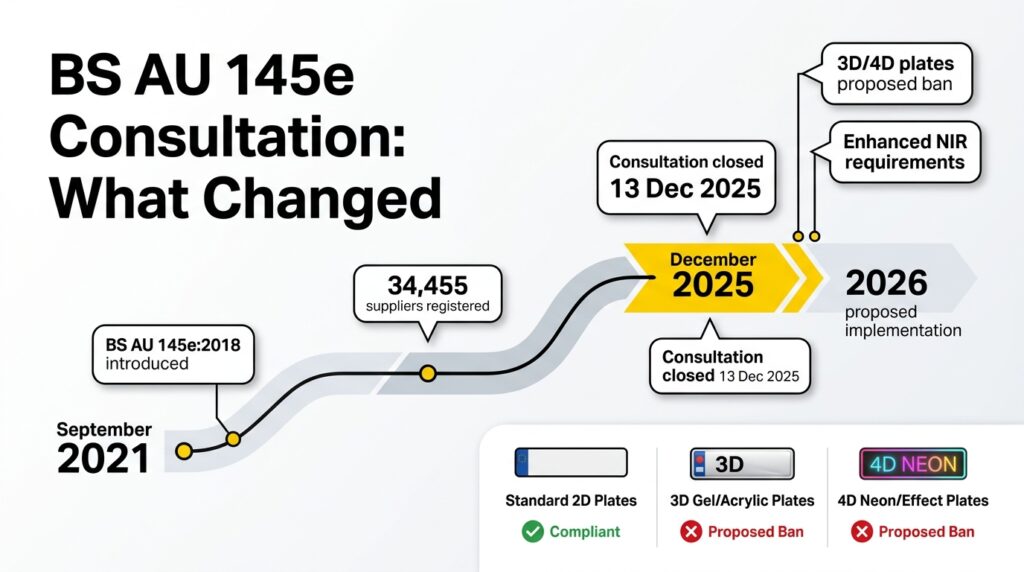
Alongside the enforcement crackdown, the British Standards Institution conducted a public consultation on proposed amendments to BS AU 145e, the British Standard governing number plate manufacture. The consultation closed on 13 December 2025.
Key proposed changes include:
- Ban on 3D and 4D plates: The draft amendment introduces stricter wording that would effectively eliminate raised gel and laser-cut acrylic plates by prohibiting any characteristics that could reduce reflectivity or ANPR readability.
- Prevention of ‘ghost’ characteristics: Specific measures to prevent gradient effects, reflective sprays, and any surface treatments that interfere with infrared detection.
- Single shade requirement: Plates fitted after 1 September 2021 must use a single shade of black for all characters, eliminating variations that could affect camera readability.
- Enhanced NIR compatibility: Stricter testing requirements for near-infrared reflectivity to ensure plates remain readable by all ANPR camera types in all weather conditions.
Industry Response and Concerns
The proposed changes have generated significant debate within the number plate manufacturing sector. Critics argue that banning popular legal styles like 4D and gel plates could drive demand toward unregulated suppliers who already operate outside DVLA requirements.
The British Number Plate Manufacturers Association has stated its support for the APPG recommendations, arguing that stronger regulation would strengthen compliance across members’ customer base, ensuring that end consumers consistently receive a high-quality, fully compliant product.
Government Response Timeline
Parliamentary written questions in March 2026 confirmed that the BSI’s consultation closed on 13 December 2025 and responses are being considered. Any updates will be communicated by the BSI.
The DVLA is simultaneously working to further reduce the number of registered suppliers while considering options for enhanced enforcement following the consultation.
How Plate-Maker Ensures Full Compliance
Our Manufacturing Standards
As a DVLA-registered number plate manufacturer (RNPS ID: 73132) based in Ilford, East London, we manufacture every plate on-site at our Eastern Avenue workshop using only BS AU 145e-certified materials.
What this means for you:
- BS AU 145e:2018 compliance: All our plates meet the current British Standard requirements for reflectivity, impact resistance, weathering, and NIR compatibility.
- Charles Wright font: We use only the mandatory Charles Wright typeface with correct 79mm character height for cars and 64mm for motorcycles, ensuring optimal ANPR camera readability.
- Correct spacing: All plates feature mandatory 11mm character spacing and 33mm age identifier gap for cars, meeting Road Vehicles (Display of Registration Marks) Regulations 2001 requirements.
- RNPS identification: Every plate displays our registered supplier identification number, proving legal manufacture and traceability.
Document Verification Process
Under Schedule 2 of the Road Vehicles Regulations 2001, we are legally required to verify customer identity and entitlement before manufacturing any number plate.
Accepted documents include:
- Proof of identity: Driving licence, passport, utility bill, or council tax bill.
- Proof of entitlement: V5C registration certificate, V750 certificate of entitlement, V778 retention document, V948 authorisation letter, or new keeper slip.
We maintain detailed records of all transactions as required by law, protecting both our customers and the wider public from plate cloning and fraud.
Same-Day Collection and Next-Day Delivery
For London taxi drivers and private hire operators needing urgent compliance, we offer:
Same-day collection: Visit our Ilford workshop at 242 Eastern Ave, IG4 5AB for immediate collection of compliant plates.
Next-day UK delivery: Order online with our plate builder and receive BS AU 145e compliant plates by next-day delivery anywhere in the UK.
Bulk orders for operators: We can accommodate fleet orders for taxi companies and private hire operators requiring multiple vehicles brought into compliance with our Trade Number Plates service.
Practical Takeaways
For Taxi and Private Hire Drivers
- Check your plates now: Use an infrared torch or visit a professional number plate supplier to verify your plates meet reflectivity standards.
- Prepare for March 2026: TfL will introduce mandatory infrared number plate checks at annual taxi inspections from March 2026.
- Understand the risks: Current penalties of £100 fines may increase to 6 penalty points and vehicle seizure.
- Use only DVLA-registered suppliers: Verify your supplier appears on the official RNPS register.
For Private Motorists
- Protect yourself from cloning: Monitor for unexpected fines or PCNs.
- Report suspicious activity: Contact police immediately if you receive fines for offences you did not commit.
- Choose compliant styles: Avoid gradient effects or any modifications that could reduce ANPR readability. Learn more in our Are Ghost Plates Legal guide.
What to Avoid
- Ghost plates: Any plate with non-reflective coatings or treatments designed to evade ANPR detection.
- Reflective sprays: Aftermarket sprays claiming to make plates “ANPR-proof”.
- Unverified suppliers: Any supplier who does not request and verify your identity and entitlement documents.
Frequently Asked Questions
Are taxi drivers specifically targeted for number plate enforcement?
Yes, taxi and private hire vehicles face heightened scrutiny due to high failure rates. TfL found 41% of licensed taxis had non-compliant plates in checks using ghost plate-detection cameras. From March 2026, TfL will introduce mandatory infrared number plate checks at annual taxi inspections.
How much do BS AU 145e compliant number plates cost?
Standard 2D number plates start from £24.95 per pair, while premium 3D gel plates range from £39.95 to £59.95 depending on thickness and finish.
What happens if I’m caught with illegal number plates in 2026?
Current penalties include £100 fixed penalty notices, MOT failure, and fines up to £1,000. The APPG has recommended introducing 6 penalty points and vehicle seizure powers for repeat offenders.
Can I still buy 4D or gel number plates legally?
Currently yes, but this may change. The BSI consultation on BS AU 145e amendments, which closed on 13 December 2025, proposes banning raised 3D and 4D plates to prevent ANPR evasion.
How do I check if my number plate supplier is legitimate?
Verify your supplier is registered with the DVLA on the official RNPS database. Legitimate suppliers must request and verify your identity and entitlement documents before manufacturing plates.
Will my vehicle fail its MOT with illegal number plates?
Yes, vehicles with incorrectly displayed number plates automatically fail their MOT test under current regulations. This includes plates that are not reflective or have incorrect character spacing.
Conclusion
The 41% failure rate among London taxis represents a watershed moment for number plate enforcement in the UK. For taxi drivers, private hire operators, and all UK motorists, the message is clear: compliance is no longer optional.
At Plate-Maker.co.uk, we have always manufactured only fully compliant, BS AU 145e-certified number plates at our Ilford workshop. Our DVLA registration (RNPS ID: 73132) and rigorous document verification process ensure every plate we produce meets current legal requirements. Ready to ensure your compliance? Design your BS AU 145e certified plates using our online builder or visit our Eastern Avenue workshop for same-day collection. Don’t risk fines, penalty points, or vehicle seizure – choose compliant plates from a trusted DVLA-registered manufacturer.