
 Printed
 3D Plate
 4D Plate
 5D Plate
 Ghost
Ghost Bevel
Bevel
 Printed
 3D
3D 4D
4D 5D
5D Ghost
Ghost Bevel
BevelBSI Proposals 2026: What the Plan to Ban Raised and Ghost Characteristics Means for UK Drivers

Executive Summary
The British Standards Institution (BSI) completed a public consultation on 13 December 2025 regarding proposed amendments to BS AU 145e, the British Standard for retroreflective number plates. The proposed changes would effectively ban raised character plates (commonly known as 3D and 4D plates) by mandating completely flat surfaces with characters not exceeding 2mm in height. As of April 2026, the BSI is still considering consultation responses, and no final decision has been published.
Current status: Raised character plates remain legal when manufactured in compliance with BS AU 145e:2018. Any changes would apply to new production only, not plates already fitted to vehicles. At Private Number Plate Maker Ltd (RNPS ID: 73132), we manufacture all plates to current BS AU 145e standards at our Ilford workshop, ensuring full compliance with DVLA regulations and Road Vehicles (Display of Registration Marks) Regulations 2001.
What this means for you: If you currently own compliant 4D or gel plates, they will almost certainly remain legal to use even if the amendment is approved. Any new regulations would govern how plates must be manufactured going forward, not require replacement of legally fitted plates.
What Happened: The BSI Consultation Timeline
Official Consultation Period
The British Standards Institution launched a formal consultation on proposed amendments to BS AU 145e:2018 on 13 October 2025. The consultation ran for eight weeks, closing on 13 December 2025. The DVLA confirmed its participation in the BSI committee responsible for reviewing the current standard for number plates.
According to parliamentary records, the Department for Transport confirmed in January 2026 that the consultation on proposed amendments to BS AU 145e was carried out by the British Standards Institution and the BSI is responsible for publishing the response to the consultation. As of late March 2026, written parliamentary questions confirm that the BSI’s consultation closed on 13 December 2025 and responses are being considered with updates to be communicated by the BSI.
The Proposed Changes
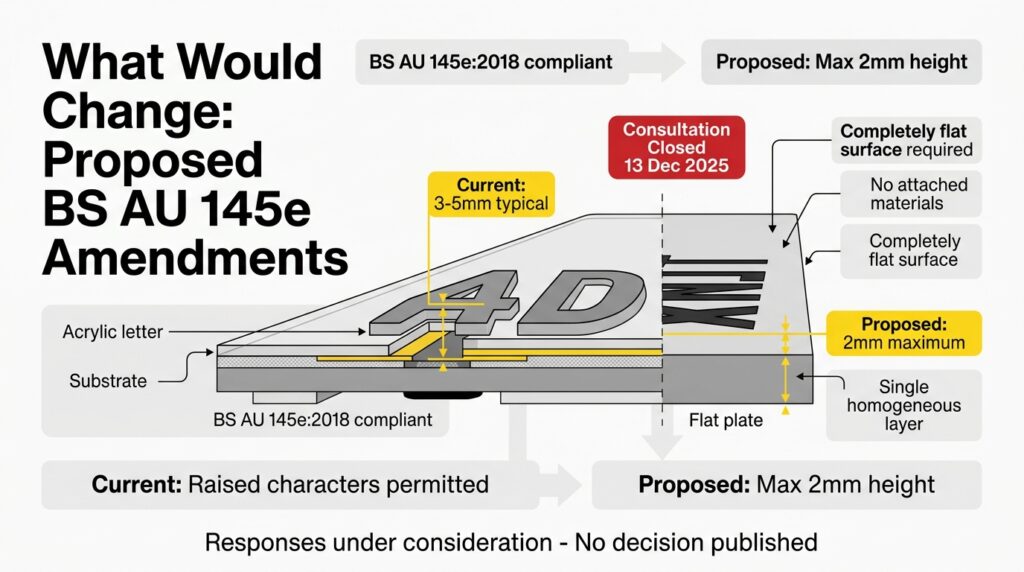
The draft amendment to BS AU 145e introduces stricter wording that would effectively eliminate 4D and gel character plates by requiring all number plates to have a completely flat surface. The key proposed requirements include:
- Character Height Restrictions: Characters must not exceed 2mm in height above the plate surface. This represents a significant restriction on current raised character plates, which typically feature acrylic or gel overlays that exceed this threshold.
- Surface Flatness Requirements: No materials of any kind may be attached to the outward-facing surface of the plate, including layered components that create the raised 4D or gel appearance. This would prohibit the attachment of separate acrylic letters or gel overlays currently used in 4D and gel plate production.
- Lamination Standards: Laminated plates must have a single homogeneous clear layer with no indentations or intrusions. This targets the multi-layer construction methods used for premium plate styles.
- Prohibition of Applied Materials: Stickers, overlays, and applied materials are prohibited if they alter surface flatness. This closes potential loopholes for alternative raised character manufacturing methods.
What This Means for UK Drivers
Current Legal Status
It is crucial to understand that raised character plates remain legal when produced using approved materials and processes that comply with BS AU 145e:2018. The current standard permits 3D (raised) characters, provided they meet all character size, spacing, reflectivity, and RNPS requirements.
Under the Road Vehicles (Display of Registration Marks) Regulations 2001, number plates fitted after 1 September 2021 must comply with BS AU 145e and be permanently marked with the standard number. The regulations explicitly state that plates can have 3D (raised) characters.
If the Amendment is Approved
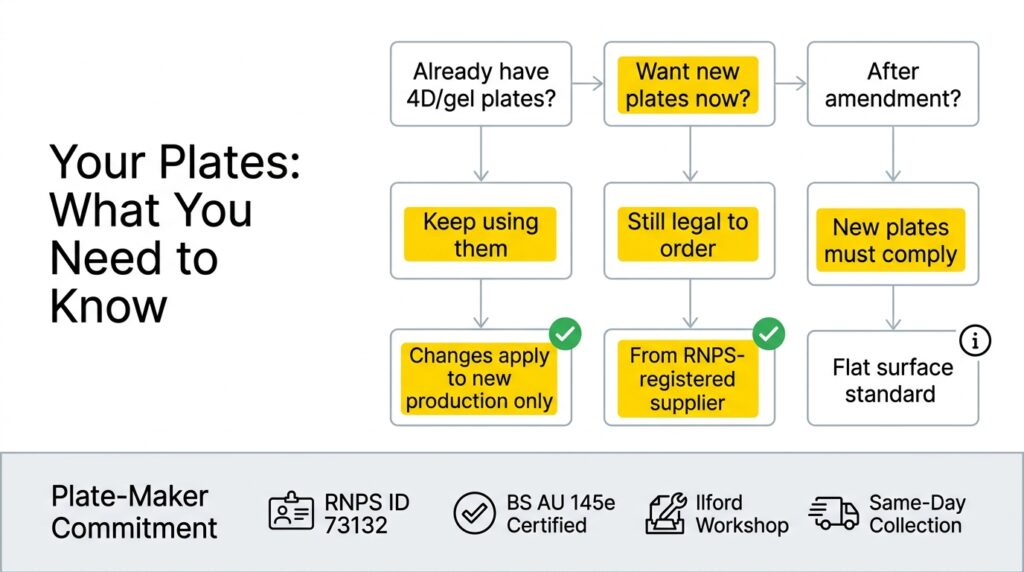
Based on historical precedent with previous British Standard updates, any changes would apply to new production only, not to plates that customers already own and have fitted legally. The BS AU standard governs how plates must be manufactured, not whether motorists must replace plates that were legal at the point of issue.
This means:
- Existing 4D and gel plates would remain valid on UK roads
- Enforcement would focus on new production once the amendment takes effect
- Drivers would not be required to replace compliant plates already fitted to their vehicles
- The standard would restrict what compliant RNPS suppliers can manufacture going forward
Market Impact and Industry Concerns
The proposed changes have generated significant concern across the number plate industry. According to industry sources, around a quarter of customers choose 4D ‘stand out’ characters, representing substantial consumer demand. Industry experts warn that if compliant businesses are forced to withdraw raised-character plates, this demand could shift towards unregulated online sellers who already ignore RNPS requirements and bypass entitlement checks.
The concern is that removing legitimate, regulated options could strengthen the illegal market and worsen number plate crime. Ghost plates and cloned registrations come overwhelmingly from illegal suppliers, and the proposed ban risks targeting the wrong issue entirely if it focuses on compliant manufacturers rather than enforcement against illegal operators.
Evidence Base and ANPR Performance
A critical question is whether compliant raised character plates actually cause problems with Automatic Number Plate Recognition (ANPR) systems. According to industry sources, there is no broad industry evidence suggesting that correctly produced plates cause ANPR misreads. Problems generally arise from non-compliant or illegally altered plates, not from legitimate 4D or gel products manufactured by RNPS-registered suppliers.
The proposed amendment aims to eliminate any potential variation by mandating flat surfaces only, but the evidence base has not been widely shared and appears to focus on incorrect or non-compliant plates rather than legally manufactured ones. Multiple DVLA RNPS suppliers report zero reliability issues when using certified materials and correct manufacturing methods.
Enforcement Context: The Ghost Plate Problem
The BSI consultation coincides with increased parliamentary and law enforcement focus on illegal number plates, particularly “ghost plates” designed to defeat ANPR cameras. In December 2025, a parliamentary committee urged a shake-up of the UK’s vehicle registration system after reports of widespread cloning, illegal online sales, and ghost plates.
Trading Standards estimates that a significant proportion of vehicles on UK roads may now be displaying an illegal or modified plate. In one London enforcement exercise, nearly 40% of checked taxi and private-hire vehicles were found to be using plate alterations that made them partially unreadable to ANPR systems.
Research by Churchill Motor Insurance shows stolen number plate reports have risen substantially since 2021, while cloned number plate reports also increased significantly in 2024. More than 25,000 Dart Charge fixed penalty notices were cancelled between 2020 and 2024 after the vehicle was proven to be displaying stolen or cloned number plates.
Current Penalties and Proposed Changes
Under current law, being caught displaying an illegal or non-compliant plate typically results in a £100 fixed penalty notice issued by the police. The current penalty for using a vehicle with a cloned number plate is up to two years in prison, an unlimited fine, or both.
However, the government published a new Road Safety Strategy on 7 January 2026, and the Department for Transport is reviewing motoring offences. A consultation has been published seeking views on the introduction of penalty points and vehicle seizure for the offence of being in charge of a motor vehicle with an incorrect, altered or false number plate.
This separate consultation on penalties runs alongside the BSI standards review, indicating a comprehensive government approach to number plate compliance and enforcement.
How Plate-Maker Ensures Compliance
At Private Number Plate Maker Ltd, we manufacture every number plate on-site at our Eastern Avenue workshop in Ilford (RNPS ID: 73132). Our commitment to compliance means:
- Current BS AU 145e:2018 Compliance: All our plates, including 4D and gel options, are manufactured to current British Standard requirements using certified materials and verified processes. We maintain batch records and quality control documentation for all production.
- Document Verification: We verify customer entitlement and identity in accordance with Schedule 2 of the Road Vehicles (Display of Registration Marks) Regulations 2001 and current DVLA guidance. Every plate we produce is traceable to verified documentation.
- On-Site Manufacturing: Unlike resellers or drop-shippers, we manufacture every plate at our Ilford workshop using BS AU 145e-certified materials. This gives us complete control over quality and compliance.
- Adaptability: Should the BSI amendment be approved, we will immediately update our manufacturing processes to comply with new requirements while continuing to serve customers with legal, compliant plates. Our workshop is equipped to produce both current raised character plates and any future flat-surface requirements.
Practical Next Steps for Readers
- If you currently own 4D or gel plates: Continue using them with confidence. They are legal when manufactured by a compliant RNPS supplier, and any future changes would almost certainly not require replacement of legally fitted plates.
- If you are considering new plates: You can still order compliant 4D or gel plates while the current standard remains in effect. Any regulatory changes would apply to new production after implementation, not to plates ordered and fitted before that date.
- If you want to influence the outcome: While the consultation has closed, you can still monitor BSI communications for updates. Future consultations on related standards may provide additional opportunities for stakeholder input.
- If you need replacement plates: Visit our Ilford workshop for same-day collection or order online for next-day UK delivery. All our plates are manufactured to current BS AU 145e standards and include proper RNPS identification.
The Bottom Line
The BSI consultation on amendments to BS AU 145e represents a significant potential change to UK number plate manufacturing standards. However, as of April 2026, no final decision has been published, and raised character plates remain fully legal when compliant with current standards.
At Private Number Plate Maker Ltd, we continue to manufacture BS AU 145e-compliant plates at our Ilford workshop, offering both traditional 2D plates and premium raised character options. We monitor regulatory developments closely and will adapt our processes to ensure ongoing compliance while serving our customers’ needs.
The focus should remain on enforcing existing regulations against illegal suppliers rather than restricting legitimate consumer choice. As the parliamentary committee and Trading Standards have highlighted, the real problem is illegal plates from unregulated sources, not compliant plates from RNPS-registered manufacturers.
Frequently Asked Questions
Are 4D and gel number plates still legal in the UK?
Yes, 4D and gel plates remain legal when manufactured in compliance with BS AU 145e:2018 by a DVLA-registered supplier. The current standard explicitly permits 3D (raised) characters provided they meet character size, spacing, and reflectivity requirements. All our plates are manufactured to current BS AU 145e standards at our Ilford workshop. (BS AU 145e Explained Guide)
What changes did the BSI propose in December 2025?
The BSI proposed amendments requiring completely flat plate surfaces with characters not exceeding 2mm in height above the surface. This would effectively ban raised character plates by prohibiting attached materials and multi-layer construction. The consultation closed on 13 December 2025 and responses are being considered. (4D Plates Guide)
Will I need to replace my existing 4D plates if the ban is approved?
No, based on historical precedent with British Standard updates, changes apply to new production only, not plates already legally fitted to vehicles. Existing compliant plates would remain valid for use on UK roads. Enforcement would focus on new manufacturing after the amendment takes effect, not on vehicle owners.
How much do compliant 4D number plates cost?
Our 4D laser-cut number plates start from £39.95 per plate, with prices varying by thickness and style. This reflects the additional CNC machining and hand-finishing required for raised character plates compared to standard 2D plates. View our current pricing and design options. (4D Laser-Cut Number Plates)
What is the difference between legal raised plates and illegal ghost plates?
Legal raised plates use compliant black acrylic or gel materials that maintain BS AU 145e reflectivity requirements and ANPR readability. Illegal ghost plates use reflective sprays, films, or coatings that interfere with ANPR cameras and fail reflectivity tests. All our plates are BS AU 145e certified and display RNPS ID 73132. (Are Ghost Plates Legal Guide)
Can I still order 4D plates while the consultation is being considered?
Yes, you can order compliant 4D plates while BS AU 145e:2018 remains the current standard. Any regulatory changes would apply to new production after implementation, not to plates ordered and fitted before that date. Start designing your plates Plate Builder or visit our Ilford workshop for same-day collection. (Same Day Collection Ilford)
Practical Takeaways
What the BSI proposals mean:
- Consultation closed 13 December 2025; no decision published as of April 2026
- Proposed changes would ban raised characters exceeding 2mm height
- Would require completely flat plate surfaces with no attached materials
- DVLA and BSI still considering consultation responses
What you should do:
- Continue using existing compliant 4D/gel plates with confidence
- Any changes would apply to new production only, not existing plates
- Order plates from DVLA-registered suppliers who verify documents
- Check plates display BS AU 145e marking and RNPS supplier ID
What to avoid:
- Illegal online suppliers who don’t verify entitlement documents
- Plates without BS AU 145e marking or RNPS identification
- Reflective sprays, films, or “ANPR-proof” products (always illegal)
- Suppliers based overseas who ignore UK regulations
How Plate-Maker ensures compliance:
- On-site manufacturing at our Ilford workshop (RNPS ID: 73132)
- BS AU 145e-certified materials with batch traceability
- Document verification per Schedule 2, Road Vehicles Regulations 2001
- Same-day collection available or next-day UK delivery
Next steps:
Design your compliant plates Plate Builder using our online builder, or visit our Eastern Avenue workshop for same-day collection. All plates manufactured to current BS AU 145e:2018 standards with full DVLA compliance.