
 Printed
 3D Plate
 4D Plate
 5D Plate
 Ghost
Ghost Bevel
Bevel
 Printed
 3D
3D 4D
4D 5D
5D Ghost
Ghost Bevel
BevelThe £40 Barrier: Understanding RNPS Registration and Number Plate Supplier Standards

Executive Summary
The Registered Number Plate Supplier (RNPS) scheme requires suppliers to register with the DVLA and pay a fee, but concerns have been raised about whether current barriers adequately prevent fraudulent operators. Under the Road Vehicles (Display of Registration Marks) Regulations 2001, all number plate suppliers must be registered with the DVLA and display their RNPS details on plates. However, parliamentary discussions have highlighted that the registration process may be too accessible, potentially allowing non-compliant operators to enter the market. At Private Number Plate Maker Ltd (RNPS ID: 73132), we manufacture every replacement number plate on-site at our Ilford workshop with full document verification in line with Schedule 2 of the Road Vehicles Regulations 2001. This article examines the RNPS registration framework, discusses recent parliamentary scrutiny, and explains how legitimate manufacturers maintain compliance while protecting consumers from illegal plates that can result in fines up to £1,000 and MOT failure.
What Is the RNPS Scheme and Why Does It Exist?
The Legal Framework for Number Plate Suppliers
The Registered Number Plate Supplier (RNPS) scheme was established under the Road Vehicles (Display of Registration Marks) Regulations 2001 to combat the proliferation of illegal number plates. Under Regulation 4 of these regulations, anyone supplying replacement number plates in the UK must be registered with the DVLA and maintain records of customer documentation.
The scheme requires suppliers to:
- Register with the DVLA and receive a unique RNPS identification number
- Verify customer identity and entitlement to registration marks
- Keep records of all transactions for at least three years
- Display their RNPS number on all plates they manufacture (DVLA Document Requirements)
Registration Requirements and Fees
To become an RNPS, applicants must complete the DVLA’s registration process and pay the prescribed fee. The registration is designed to ensure suppliers understand their legal obligations under UK number plate legislation.
Once registered, suppliers receive:
- A unique RNPS identification number (ours is 73132)
- Authorization to legally supply number plates
- Inclusion on the DVLA’s official register of suppliers
However, the accessibility of registration has become a topic of discussion among policymakers concerned about maintaining industry standards while preventing fraud.
Parliamentary Scrutiny of RNPS Registration Standards
House of Lords Discussions on Number Plate Regulation
The House of Lords has examined number plate regulation as part of broader road safety and vehicle crime prevention efforts. Peers have raised questions about whether the current registration framework provides sufficient safeguards against fraudulent operators who may exploit weak entry barriers.
Key concerns raised in parliamentary discussions include:
- Low Financial Barriers: The registration fee structure has been questioned as potentially insufficient to deter casual or fraudulent applicants. Critics argue that a modest fee does not adequately verify the seriousness or legitimacy of applicants.
- Verification Processes: Questions have been posed about the depth of background checks conducted during RNPS registration. Unlike some regulated industries requiring extensive vetting, number plate supplier registration focuses primarily on understanding regulatory compliance rather than comprehensive business verification.
- Enforcement Challenges: The sheer number of registered suppliers creates monitoring difficulties for enforcement agencies. With thousands of RNPS holders across the UK, ensuring ongoing compliance requires significant resources from the DVLA and Trading Standards.
The Scale of RNPS Registration
The RNPS scheme has grown substantially since its introduction, with thousands of suppliers now registered across the United Kingdom. This expansion reflects both the legitimate growth of the number plate industry and concerns about market saturation making enforcement more complex.
The large number of registered suppliers means:
- Consumers have many options when purchasing plates
- Enforcement agencies must monitor numerous businesses
- Quality and compliance standards can vary significantly
- Document verification practices may differ between suppliers
This is why choosing a manufacturer with rigorous verification processes matters (Number Plate Fines UK).
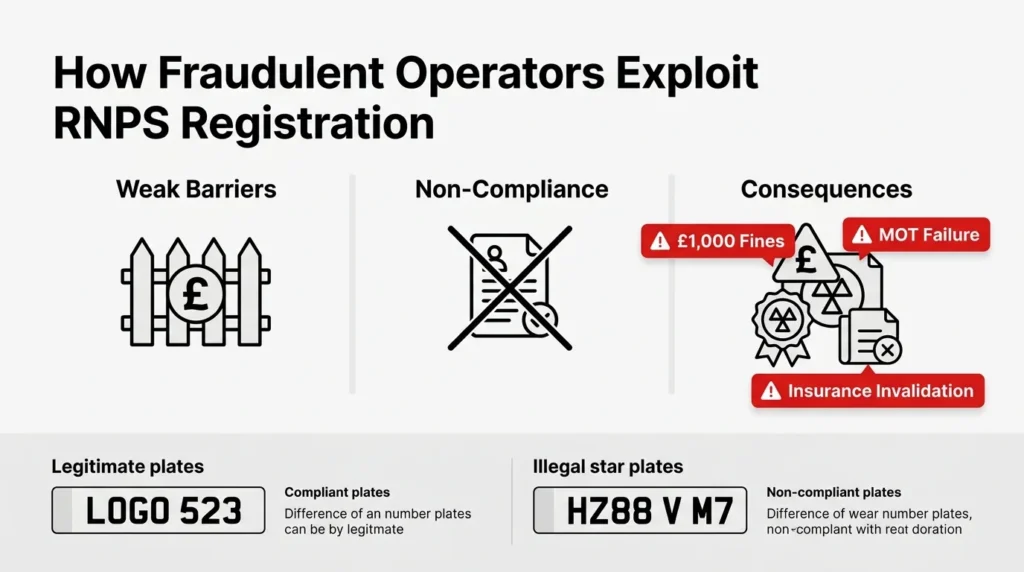
How Fraudulent Operators Exploit Weak Registration Barriers
The Gap Between Registration and Compliance
While RNPS registration is mandatory, the distinction between being registered and operating compliantly creates opportunities for bad actors. Some suppliers may:
- Skip Document Verification: Despite legal requirements under Schedule 2 of the Road Vehicles Regulations 2001, some operators fail to properly verify customer documentation before manufacturing plates. This allows illegal plates to enter circulation.
- Use Non-Compliant Materials: Not all registered suppliers use BS AU 145e certified materials. Some cut costs by using inferior substrates that fail to meet reflectivity and durability standards required for ANPR camera readability.
- Ignore Font and Spacing Requirements: The Charles Wright font became mandatory in 2001, but some suppliers continue using incorrect typefaces or improper spacing that fails legal specifications.
Consequences of Illegal Number Plates
Plates manufactured outside RNPS compliance create serious risks:
For Drivers:
- Fines up to £1,000 under Section 42 of the Vehicle Excise and Registration Act 1994
- MOT failure requiring immediate plate replacement
- Potential penalty points for displaying illegal registration marks
- Insurance invalidation if plates don’t meet legal standards
For Road Safety:
- ANPR cameras cannot read non-compliant plates
- Traffic enforcement becomes less effective
- Vehicle crime investigation is hampered
- ULEZ and congestion charge enforcement is compromised
For Legitimate Suppliers:
- Unfair competition from operators cutting corners
- Reputation damage to the industry as a whole
- Pressure to reduce prices and potentially compromise standards
How Legitimate Manufacturers Maintain Higher Standards
Beyond Minimum RNPS Requirements
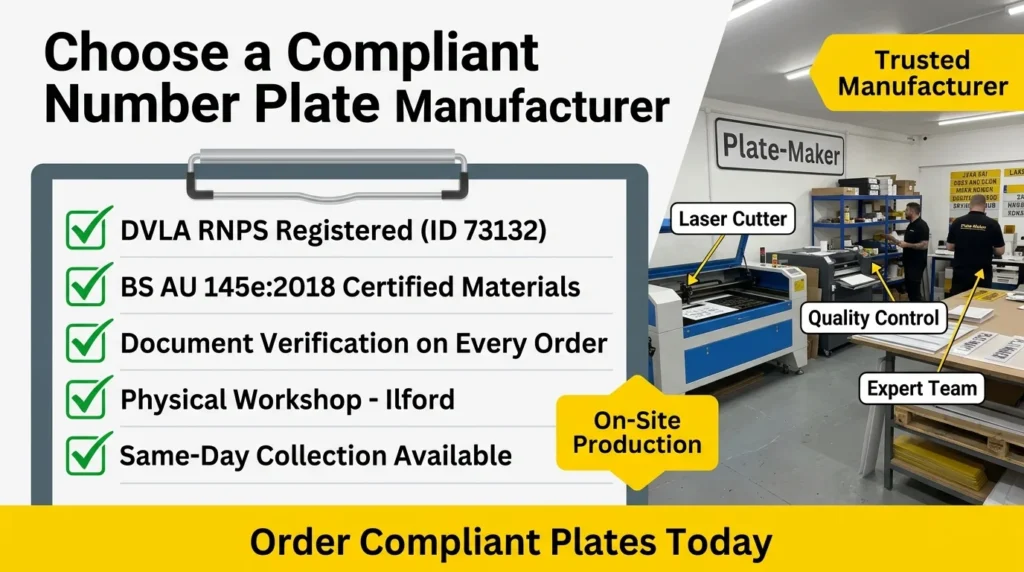
At Private Number Plate Maker Ltd, we exceed the basic RNPS registration requirements through rigorous internal controls and quality assurance processes. Our approach includes:
Comprehensive Document Verification: We verify every customer’s identity and entitlement using the documents specified in Schedule 2 of the Road Vehicles Regulations 2001. This includes driving licences, V5C registration certificates, V750 certificates of entitlement, and other accepted proofs (DVLA Document Requirements).
BS AU 145e Certified Materials: Every replacement number plate we manufacture uses materials meeting the British Standard BS AU 145e:2018 requirements, including:
- Reflectivity standards for ANPR camera readability
- Impact resistance to withstand road debris
- Weathering resistance for UK climate conditions
- NIR compatibility for infra-red traffic cameras
On-Site Manufacturing Control: Unlike resellers or drop-shippers, we manufacture every plate at our Eastern Avenue workshop in Ilford. This allows us to maintain direct quality control over every plate leaving our facility.
RNPS Transparency: Our RNPS ID 73132 appears on every plate we manufacture, providing traceability and accountability. Customers can verify our registration status through the DVLA’s official register.
The Value of Physical Workshop Operations
Our Ilford workshop provides advantages that online-only operators cannot match:
Same-Day Collection: Customers can collect plates the same day from our Eastern Avenue location, with full document verification completed in person (Same Day Collection Ilford).
Direct Accountability: Having a physical premises means we’re directly accountable to local Trading Standards and enforcement agencies. We welcome inspections and maintain open communication with regulatory bodies.
Expert Staff: Our team understands the technical requirements of BS AU 145e and the legal framework governing number plates. We provide accurate advice rather than just processing orders.
Quality Assurance: Every plate undergoes inspection before collection or dispatch, ensuring correct font, spacing, reflectivity, and overall compliance.
What Changes Could Strengthen the RNPS Scheme
Potential Regulatory Reforms
Parliamentary discussions have identified several areas where the RNPS scheme could be strengthened:
- Enhanced Verification: Implementing more rigorous background checks for RNPS applicants, potentially including criminal record checks and business history verification.
- Increased Fees: Raising registration fees to create a more meaningful barrier to entry while funding enhanced enforcement activities.
- Regular Audits: Introducing periodic compliance audits of registered suppliers to ensure ongoing adherence to regulations rather than one-time registration.
- Stronger Penalties: Increasing penalties for RNPS holders who fail to maintain compliance, including suspension or revocation of registration status.
- Centralised Monitoring: Creating a centralised monitoring system to track complaints and enforcement actions against suppliers.
What Drivers Can Do Now
While regulatory reforms are considered, drivers can protect themselves by:
- Checking RNPS Status: Always verify that your supplier displays an RNPS number on their plates and website. Legitimate suppliers proudly display this information.
- Expecting Document Requests: Never use a supplier who doesn’t ask for proof of identity and entitlement. This is a legal requirement, not optional.
- Verifying BS AU 145e Compliance: Ensure plates carry the BS AU 145e:2018 marking and use proper Charles Wright font with correct spacing. Electric vehicle owners should also ensure their EV number plates meet the same legal standards.
- Choosing Manufacturers Over Resellers: Work with companies that manufacture plates on-site rather than drop-shippers who may have less quality control (3D Gel Plates Explained). Explore our range of compliant premium options: 3D number plates, 4D number plates, and 5D number plates.
- Using Local Suppliers: Local manufacturers with physical workshops provide accountability and the opportunity for in-person verification. Consider premium styling options like bevel number plates that maintain full legal compliance.
Practical Takeaways
For Drivers Purchasing Number Plates
- Always Verify RNPS Registration: Check that your supplier displays their RNPS number prominently. At Plate-Maker, our RNPS ID 73132 appears on every plate and throughout our website.
- Expect Document Verification: Legitimate suppliers must request and verify your documentation under Schedule 2 of the Road Vehicles Regulations 2001. If a supplier doesn’t ask for documents, they’re operating illegally.
- Check for BS AU 145e Marking: Every legal plate must display the BS AU 145e:2018 standard marking. This confirms the plate meets reflectivity, durability, and ANPR readability requirements.
- Avoid “Too Good to Be True” Pricing: Extremely cheap plates often indicate corner-cutting on materials, document verification, or both. Quality compliant plates require proper materials and processes.
- Choose Manufacturers with Physical Premises: Suppliers with workshops you can visit provide accountability and transparency. Our Ilford workshop offers same-day collection for local customers (Same Day Collection Ilford).
Red Flags to Avoid
- Suppliers who don’t request documentation
- Plates without RNPS numbers
- Missing BS AU 145e:2018 marking
- Incorrect fonts or spacing
- Reflective or “ghost” effects that compromise legality (Are Ghost Plates Legal Guide). For a legal alternative, view our compliant ghost number plates that meet all DVLA requirements.
- Suppliers operating only through social media or marketplaces
How Plate-Maker Ensures Compliance
- DVLA-registered manufacturer (RNPS ID: 73132)
- Comprehensive document verification on every order
- BS AU 145e:2018 certified materials only
- On-site manufacturing at our Ilford workshop
- Same-day collection available
- Next-day UK delivery
- Expert team trained in current regulations
Ready to order compliant plates? Start designing your plates (Plate Builder) or visit our Eastern Avenue workshop for same-day collection.
Frequently Asked Questions
What is the RNPS registration fee for number plate suppliers?
The DVLA charges a registration fee for RNPS applicants, though the exact amount can change. The fee is designed to cover administrative costs of processing applications and maintaining the register. Critics in parliamentary discussions have suggested the fee may be too low to act as an effective barrier against fraudulent operators seeking registration.
How many RNPS suppliers are currently registered in the UK?
The DVLA maintains a register of thousands of RNPS holders across the United Kingdom. The large number reflects both legitimate industry growth and concerns about enforcement complexity. With so many registered suppliers, ensuring ongoing compliance requires significant resources from the DVLA and Trading Standards agencies.
Can I buy number plates from an unregistered supplier?
No, it is illegal to supply replacement number plates in the UK without RNPS registration under the Road Vehicles (Display of Registration Marks) Regulations 2001. Buying from unregistered suppliers risks receiving illegal plates that can result in £1,000 fines, MOT failure, and insurance invalidation. Always verify your supplier displays an RNPS number.
What documents do RNPS suppliers need to check?
Under Schedule 2 of the Road Vehicles Regulations 2001, suppliers must verify proof of identity (driving licence, passport, utility bill) and proof of entitlement to the registration mark (V5C, V750, V778, V948, or new keeper slip). Bank statements are not accepted. At Plate-Maker, we verify all documents before manufacturing (DVLA Document Requirements).
Are all RNPS registered suppliers equally reliable?
No, RNPS registration is a minimum legal requirement, but standards vary. Some suppliers may cut corners on document verification, use non-compliant materials, or lack proper quality control. Choose manufacturers with physical workshops, BS AU 145e certification, and transparent RNPS numbers like our ID 73132 (our About Us page).
What happens if I’m caught with illegal number plates?
Under Section 42 of the Vehicle Excise and Registration Act 1994, displaying illegal number plates can result in fines up to £1,000 (level 3 on the standard scale). You’ll also fail your MOT and may face insurance invalidation. Plates must display the supplier’s RNPS number and BS AU 145e:2018 marking to be legal.
Conclusion
The RNPS registration scheme provides a framework for regulating number plate suppliers, but parliamentary scrutiny has highlighted that registration alone doesn’t guarantee compliance. The relatively low barriers to entry mean drivers must take responsibility for choosing legitimate manufacturers who exceed minimum requirements.
At Private Number Plate Maker Ltd, we believe transparency, rigorous document verification, and on-site manufacturing are essential to maintaining industry standards. Our RNPS ID 73132, BS AU 145e:2018 certification, and Ilford workshop demonstrate our commitment to legal compliance and quality.
When purchasing number plates, always verify your supplier’s RNPS status, expect thorough document checks, and choose manufacturers who take compliance seriously. Your safety, legal protection, and contribution to road safety depend on it.
Ready to order plates from a trusted manufacturer? Design your custom plates (Plate Builder) online or visit our Eastern Avenue workshop for same-day collection (Same Day Collection Ilford).