
 Printed
 3D Plate
 4D Plate
 5D Plate
 Ghost
Ghost Bevel
Bevel
 Printed
 3D
3D 4D
4D 5D
5D Ghost
Ghost Bevel
BevelANPR and Human Rights: The Debate Over Camera Surveillance

Executive Summary
Automatic Number Plate Recognition (ANPR) cameras are a powerful law enforcement tool used across the UK to detect crime, locate stolen vehicles, and enforce traffic regulations. However, their widespread deployment has sparked ongoing debate about the balance between public safety and individual privacy rights under the Human Rights Act 1998. This article examines the legal framework governing ANPR use, including GDPR compliance requirements, the Data Protection Act 2018, and the Surveillance Camera Code of Practice. While ANPR has proven effective in solving serious crimes and recovering stolen vehicles, privacy advocates raise concerns about mass surveillance and data retention practices. For UK drivers, understanding how ANPR works and your data protection rights is essential. At Plate-Maker.co.uk, we manufacture DVLA-compliant replacement number plates that ensure your vehicle registration is clearly visible to ANPR cameras, helping you avoid penalties while understanding your rights in an increasingly monitored road network.
What is ANPR and How Does It Work?
The Technology Behind Automatic Number Plate Recognition
ANPR (Automatic Number Plate Recognition) systems use optical character recognition (OCR) technology to read vehicle registration marks from images captured by specialised cameras. These cameras employ infrared illumination to capture clear images of number plates in all lighting conditions, day or night. When a vehicle passes an ANPR camera, the system captures the image, processes it through OCR software, and converts the visual data into alphanumeric text that can be checked against various databases.
The technology relies on the Charles Wright font being clearly displayed on BS AU 145e compliant plates, which is why properly manufactured number plates with correct reflectivity are essential for accurate reading. The system can process thousands of vehicles per hour, with each read generating a timestamp, location data, and the registration number.
The National ANPR Service Infrastructure
The National ANPR Service (NAS) is operated by the National Police Chiefs’ Council (NPCC) and forms part of the UK’s policing infrastructure. The system connects thousands of ANPR cameras across the country to the National ANPR Data Centre (NADC), where data is processed and stored. According to official NPCC documentation, the NAS processes millions of reads daily, supporting law enforcement agencies nationwide.
Local authorities also operate ANPR cameras for purposes such as enforcing bus lanes, monitoring low emission zones (Ilford Number Plates), and detecting untaxed vehicles. The DVLA operates its own ANPR network to identify vehicles without valid road tax or MOT certificates.

The Legal Framework Governing ANPR Use
Data Protection Legislation and GDPR Compliance
ANPR systems in the UK operate under strict data protection requirements governed by the UK General Data Protection Regulation (UK GDPR) and the Data Protection Act 2018. The Information Commissioner’s Office (ICO) provides specific guidance on ANPR use, classifying number plate data as personal data because it can be linked to identified or identifiable individuals through DVLA records.
Under GDPR principles, ANPR operators must demonstrate:
- Lawful basis for processing: Typically legitimate interests for law enforcement, or legal obligation for statutory functions
- Purpose limitation: Data collected for specific, explicit purposes only
- Data minimisation: Only necessary data is collected and retained
- Storage limitation: Clear retention periods with automatic deletion
- Security: Appropriate technical and organisational measures to protect data
The ICO’s ANPR Code of Practice requires operators to conduct Data Protection Impact Assessments (DPIAs) before deploying ANPR systems, particularly where large-scale systematic monitoring is involved.
The Surveillance Camera Code of Practice
The Protection of Freedoms Act 2012 introduced the Surveillance Camera Code of Practice, which applies to relevant authorities including police forces and local authorities operating ANPR systems. The Code establishes 12 guiding principles for the appropriate and effective use of surveillance camera systems:
- Use must be necessary and proportionate
- Clear objectives must be defined
- Transparency and accountability requirements
- Clear policies and procedures
- Consideration of less intrusive alternatives
- Effective oversight and audit
- Clear rules and responsibilities
- Effective training
- Security of data and systems
- Retention and deletion protocols
- Accuracy and quality standards
- Independent oversight mechanisms
The Biometrics and Surveillance Camera Commissioner oversees compliance with the Code, though the office’s status has changed following the 2023 abolition of the Investigatory Powers Commissioner’s Office biometrics functions.
Human Rights Act 1998 Considerations
Article 8 of the European Convention on Human Rights, incorporated into UK law through the Human Rights Act 1998, protects the right to respect for private and family life. ANPR surveillance engages Article 8 because it involves the systematic collection and processing of information about individuals’ movements.
However, Article 8 is a qualified right, meaning interference can be justified if it is:
- In accordance with the law
- Pursues a legitimate aim (such as prevention of crime or protection of others’ rights)
- Necessary in a democratic society
UK courts have generally accepted that ANPR use for legitimate law enforcement purposes, when properly regulated and subject to appropriate safeguards, can be compatible with Article 8. The key is proportionality – the intrusion must be justified by the public benefit achieved.
Privacy Concerns and Civil Liberties Arguments
Mass Surveillance and Function Creep
Privacy advocates, including organisations like Big Brother Watch and Liberty, have raised concerns about the expansion of ANPR networks beyond their original purposes. The phenomenon known as “function creep” occurs when systems deployed for one purpose are gradually used for additional purposes not originally intended or authorised.
Critics argue that:
- The sheer scale of ANPR deployment creates a comprehensive tracking system of vehicle movements
- Data retention periods may exceed what is necessary for stated purposes
- Lack of public awareness about the extent of ANPR surveillance
- Potential for misuse or unauthorised access to movement data
- Chilling effect on freedom of movement and association
The National ANPR Service’s ability to track vehicles across the country has prompted concerns about the creation of detailed movement profiles, even for individuals not suspected of any wrongdoing.
Data Retention and Access Controls
Under the ANPR Code of Practice, data retention periods vary depending on the purpose:
- Law enforcement purposes: Generally up to 2 years for operational data
- Non-law enforcement purposes: Shorter periods, often 90 days or less
- Local authority use: Typically aligned with specific enforcement purposes
However, privacy campaigners argue that even limited retention creates risks, particularly given the sensitive nature of location data. Concerns include:
- Potential for data breaches exposing movement histories
- Unauthorised access by staff or third parties
- Secondary use of data beyond original collection purpose
- Lack of transparency about who accesses the data and why
The ICO has enforcement powers and has issued guidance requiring strict access controls, audit trails, and regular reviews of ANPR data access.
Transparency and Public Awareness
A significant concern raised by civil liberties groups is the lack of public awareness about ANPR deployment. Unlike speed cameras, which are often highly visible and publicly signposted, many ANPR cameras are not clearly marked, and their locations are not always publicly disclosed for operational security reasons.
This lack of transparency raises questions about:
- Whether individuals can give meaningful consent to data collection
- If the public understands how their data is used
- Whether there is adequate democratic oversight of ANPR expansion
- If privacy impact assessments are sufficiently public and accessible
Law Enforcement Benefits and Public Safety Arguments
Crime Detection and Prevention
Police forces across the UK consistently report that ANPR is an invaluable tool in combating serious and organised crime. According to NPCC statistics, ANPR data contributes to:
- Locating and recovering stolen vehicles
- Identifying vehicles linked to serious crimes
- Disrupting organised criminal networks
- Finding wanted individuals and missing persons
- Enforcing road traffic legislation
- Supporting counter-terrorism operations
The real-time alert capability allows officers to intercept vehicles of interest immediately, rather than relying on retrospective investigation. This has proven particularly effective in tackling vehicle crime, where stolen vehicles can be quickly identified and recovered.
Road Safety and Traffic Enforcement
Beyond criminal investigations, ANPR systems support broader road safety objectives:
- Vehicle tax enforcement: Identifying untaxed vehicles helps ensure all road users contribute to road maintenance
- MOT compliance: Detecting vehicles without valid MOT certificates removes potentially dangerous vehicles from roads
- Insurance verification: Identifying uninsured drivers protects other road users
- Congestion and clean air zones: Enforcing ULEZ (EV Number Plates) and congestion charge compliance in London and other cities
- Bus lane and parking enforcement: Supporting local authority traffic management
The DVLA reports that ANPR-assisted enforcement has significantly increased detection rates for untaxed and uninsured vehicles, contributing to fairer road use and improved compliance.
Efficiency and Resource Optimisation
ANPR technology allows law enforcement agencies to achieve more with limited resources. Automated checking of number plates against databases is far more efficient than manual checks, allowing officers to focus on high-risk vehicles rather than conducting random stops.
The technology also provides:
- Objective, timestamped evidence for prosecutions
- Reduced need for physical vehicle stops, improving officer safety
- Intelligence gathering capabilities for pattern analysis
- Cross-border cooperation between police forces
- Historical data for investigating crimes after they occur
Recent Developments and Future Considerations
Legislative Changes and Policy Updates
The regulatory landscape for ANPR continues to evolve. Recent developments include:
- Updates to the ICO’s ANPR Code of Practice reflecting GDPR requirements
- Changes to the Biometrics Commissioner role following the 2023 restructuring
- Ongoing reviews of surveillance camera governance
- Increased scrutiny of data retention periods and access controls
Parliamentary debates have occasionally addressed ANPR use, particularly in the context of broader surveillance legislation and privacy rights.
Technological Advancements
ANPR technology continues to advance, with improvements in:
- Read accuracy rates in challenging conditions
- Integration with other policing systems
- Mobile ANPR capabilities in patrol vehicles
- Cloud-based processing and storage
- Artificial intelligence for pattern recognition and anomaly detection
These advances raise both opportunities for improved public safety and new questions about privacy implications.
International Comparisons
The UK’s ANPR deployment is among the most extensive globally, but other countries operate similar systems with varying levels of oversight and public acceptance. European countries operate ANPR within GDPR frameworks, while countries outside Europe have different regulatory approaches. Comparing these systems helps inform debates about best practices for balancing security and privacy.
Practical Implications for UK Drivers
Ensuring Your Number Plate is ANPR-Readable
Given the ubiquity of ANPR cameras, it’s essential that your number plates meet legal requirements to avoid unnecessary penalties. Plates that are dirty, damaged, or non-compliant may not be read correctly, potentially leading to:
- False positives in enforcement systems
- Unnecessary police attention
- Fines for obscured or unreadable plates
- MOT failure
To ensure your plates are ANPR-compliant:
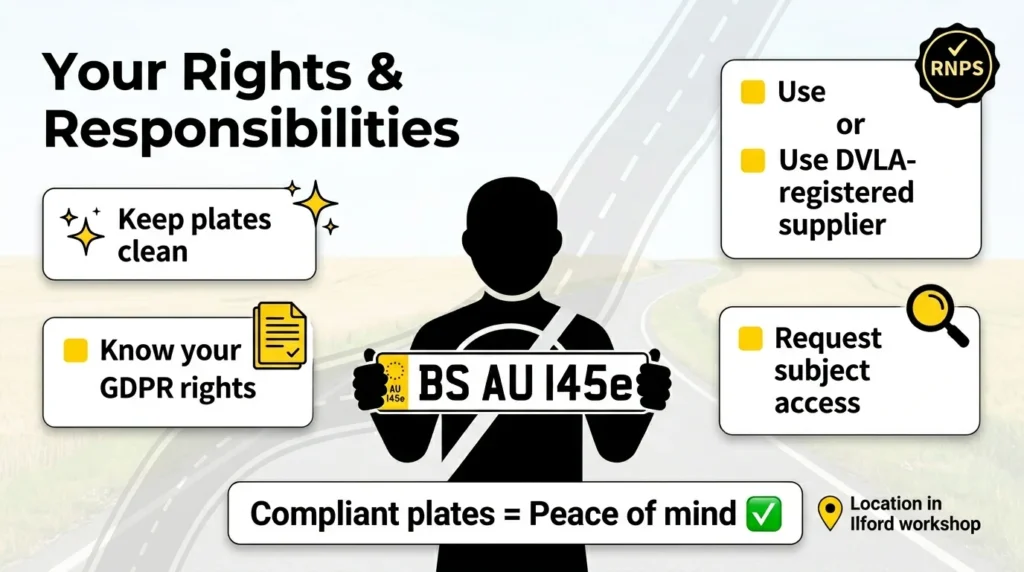
- Keep plates clean and free from dirt or obstructions
- Ensure plates meet BS AU 145e standards
- Use only DVLA-registered suppliers (like Plate-Maker.co.uk with RNPS ID 73132)
- Avoid illegal modifications like tinted covers or reflective sprays
- Replace damaged or faded plates promptly
Whether you prefer classic 3D number plates, premium 4D number plates, or the subtle aesthetic of ghost number plates, all our products are manufactured to full BS AU 145e:2018 compliance for reliable ANPR readability.
Understanding Your Data Protection Rights
Under UK GDPR, you have specific rights regarding ANPR data:
- Right to access: You can request information about ANPR data held about you
- Right to rectification: Incorrect data can be corrected
- Right to erasure: In some circumstances, you can request deletion
- Right to object: You can object to processing in certain situations
- Right to complain: You can lodge complaints with the ICO
However, these rights are not absolute and may be limited where ANPR data is processed for law enforcement purposes.
When ANPR Data May Affect You
You may encounter ANPR systems in various situations:
- Routine driving: Your movements are recorded but typically deleted after the retention period if no issues are detected
- Untaxed or uninsured vehicles: ANPR may trigger enforcement action
- Stolen vehicles: ANPR alerts police to intercepted vehicles
- Clean air zones: ANPR enforces ULEZ (EV Number Plates) and similar schemes
- Criminal investigations: Historical ANPR data may be used as evidence
Understanding how these systems work helps you comply with legal requirements while protecting your rights. For complete peace of mind, explore our full range of compliant plates including 5D number plates and bevel number plates, all manufactured on-site at our Ilford workshop.
Conclusion: Striking the Right Balance
The debate over ANPR cameras and human rights reflects broader tensions in modern society between security and privacy, efficiency and oversight, technological capability and ethical constraints. ANPR has undeniably proven its value in combating crime, improving road safety, and supporting law enforcement. At the same time, legitimate concerns exist about mass surveillance, data protection, and the need for robust oversight.
The current legal framework, including GDPR, the Data Protection Act 2018, the Surveillance Camera Code of Practice, and Human Rights Act protections, provides significant safeguards. However, these require active enforcement, regular review, and public awareness to remain effective.
For UK drivers, the practical reality is that ANPR is an established part of the road infrastructure. The best approach is to ensure your vehicle displays legal, readable number plates (design yours using our online Plate Builder) while staying informed about your data protection rights. Whether you choose to collect your plates same-day from our Ilford workshop (Same Day Collection Ilford) or have them delivered, ensuring BS AU 145e compliance helps you navigate the ANPR landscape confidently.
The ongoing evolution of ANPR technology and regulation means this debate will continue. What remains essential is maintaining the delicate balance between legitimate public safety objectives and fundamental privacy rights through transparent governance, effective oversight, and informed public discourse.
Frequently Asked Questions
Is ANPR legal in the UK?
Yes, ANPR is legal in the UK when operated in accordance with data protection legislation, the Surveillance Camera Code of Practice, and the Human Rights Act 1998. The National ANPR Service operates under NPCC authority, with oversight from the Information Commissioner’s Office. All operators must have a lawful basis for processing and comply with GDPR requirements.
How long is ANPR data retained in the UK?
ANPR data retention periods vary by purpose. Law enforcement data is typically retained for up to 2 years under the National ANPR Service, while local authority and non-enforcement data is usually kept for 90 days or less. The ANPR Code of Practice requires automatic deletion after the specified retention period, with strict access controls throughout.
Can I request ANPR data about my vehicle?
Yes, under UK GDPR you have the right to access personal data held about you, including ANPR reads. You can submit a subject access request to the relevant data controller (police force, local authority, or other operator). However, rights may be limited where data is processed for law enforcement purposes or national security.
Do ANPR cameras read all number plates automatically?
ANPR cameras attempt to read all vehicle registration plates that pass within their field of view, but success depends on plate condition, lighting, angle, and speed. BS AU 145e compliant plates with clean surfaces and correct Charles Wright font achieve the highest read rates. Damaged, dirty, or non-compliant plates may not be read accurately.
Are there privacy safeguards for ANPR systems?
Yes, multiple safeguards exist including GDPR compliance requirements, the Surveillance Camera Code of Practice, Data Protection Impact Assessments, ICO oversight, access controls, audit trails, and defined retention periods. The Biometrics and Surveillance Camera Commissioner (where applicable) also provides independent oversight. Operators must demonstrate necessity and proportionality for ANPR deployment.
Can ANPR data be used in court?
Yes, ANPR data is regularly used as evidence in criminal prosecutions and civil proceedings. The data must meet evidential standards including chain of custody, system accuracy verification, and proper authentication. Courts have accepted ANPR evidence where proper procedures are followed and the technology’s reliability is demonstrated.
What number plates are best for ANPR readability?
All DVLA-compliant plates manufactured to BS AU 145e:2018 standards are designed for optimal ANPR readability. This includes our full range: standard replacement plates, 3D gel plates,4D laser-cut plates, and 5D premium plates. The key factors are correct font, proper spacing, high-reflectivity materials, and clean surfaces – all guaranteed when you order from a registered supplier like Plate-Maker (RNPS ID: 73132). Learn more about how ANPR cameras work to ensure your plates remain fully compliant.